One sailor’s method of maintaining an iron keel
Issue 64 : Jan/Feb 2009
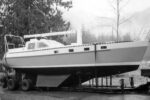
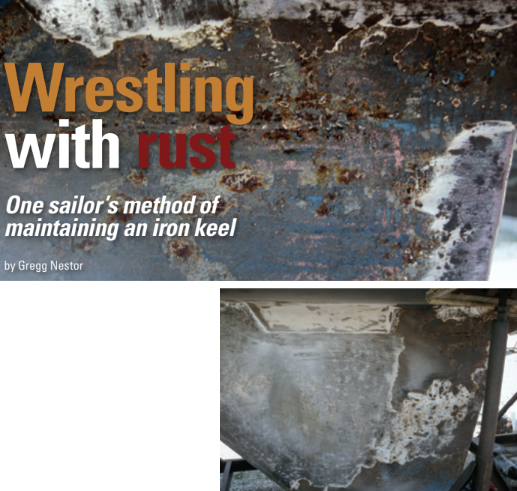
A few years back, my friend Roland purchased a used 31-foot sailboat with a fin keel made of cast iron. After his first sailing season he discovered that the keel was severely corroded beneath numerous layers of ablative bottom paint.
Autumn, with its damp and questionable weather conditions, was ruled out as the time of year to address this problem. Instead, Roland decided to use the off-season to research and develop a technique to refurbish the rusted keel and to assemble the necessary materials. Come spring, he’d tackle the problem with confidence.
But let’s pause here to explore some basic metallurgy. Only a few metals, such as gold and platinum, occur naturally in their elemental forms. Most other metals occur in nature as oxides. Iron is one of these. Iron ore is mined, processed into iron and steel, and then fashioned into all kinds of useful objects. When these objects corrode and form rust, the metals revert back to iron oxide. This cycle is nature’s way of reclaiming the metals that humans have extracted from the earth.
Some metal oxides resulting from corrosion can act as a protective coating. This is the case with aluminum, stainless steel, and lead, to name but a few. Iron oxide, on the other hand, is porous, flaky, and loosely attached. It provides little or no protection to the metal underneath. Over the years, we have developed all types of processes and coatings to break nature’s cycle. Unfortunately, even the best of these attempts do nothing more than slow down the corrosion process.
In that case, why make a keel from cast iron instead of lead? Cost and environmental concerns top the list of reasons. In the first place, lead is far more expensive than iron, pound for pound. As foundries that pour cast iron are much more common than lead smelters, it’s cheaper to make an iron keel. Also, lead and the fumes from melting it are toxic and must be carefully contained and monitored.
Surface preparation
The first step in refinishing a rusted keel is to remove all the corrosion byproducts from the metal’s surface. There are several ways to do this, including grinding, sandblasting, chemical stripping, or any combination of these. Bear in mind that metal does not corrode uniformly. Localized corrosion in the form of pitting will be common: remove the rust from all surfaces, including from deep inside any pits. If this is not done, a corrosion cell will develop beneath the porous loosely bonded rust left in the pits, and aggressive localized corrosion will occur.
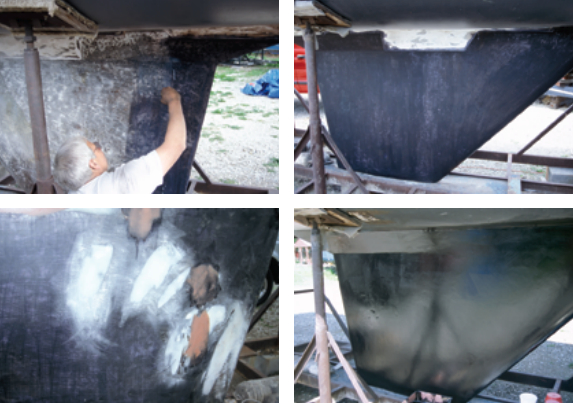
Roland elected to use a grinder with coarse-grit sanding discs to remove the flaking bottom paint and rust from his boat’s cast-iron keel. He alternated between 36-grit and 24-grit paper. While these grits normally are very aggressive, he found that their sharpness was quickly blunted by the hardness of the cast-iron keel. Several packages of sanding discs were consumed before the removal process was complete and the keel was ready for coating.
First coating
Cast iron will begin to rust as quickly as one hour after it has been cleaned. So Roland sanded and applied an initial protective coating to one side of the keel before tackling the other. He selected a product called Rust-X as a base coat. Besides acting as a passivating primer, Rust-X chemically converts any remaining rust from an oxide to a phosphate, stopping the corrosion cycle. The material is a water-thin milky liquid which, when applied, changes color from white to a blue-black. This change in color indicates that chemical passivation of the cast iron has taken place and that a sound base for the application of further coatings has been achieved. Even though a few pits were in evidence, Roland felt that the Rust-X would effectively deal with them. He was wrong.
Fairing the surface
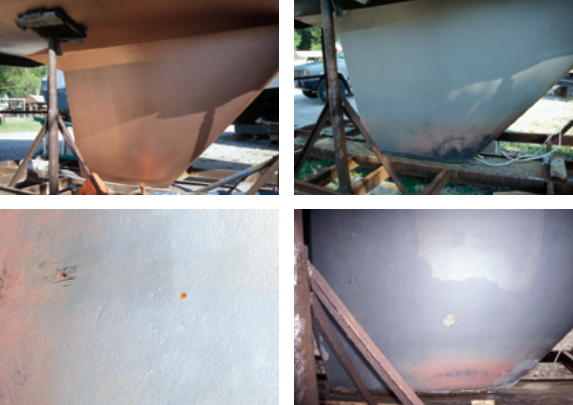
Once both sides of the keel had been cleaned of rust and initially coated with Rust-X, it was time to smooth the surface. Corrosion had taken its toll and several areas of the keel resembled the surface of the moon. Roland used an epoxy resin/filler and applied the mixture as smoothly as possible, thus minimizing the amount of subsequent sanding that would be needed. In those areas where sanding exposed bare cast iron, another coat of Rust-X was applied.
At this juncture, Roland briefly considered applying a layer of fiberglass cloth and epoxy. But since this was the first time the keel had been refurbished, Roland elected to give chemistry, in the form of barrier coatings, a test of a year or two before adding a physical protective barrier. In this way, if something went wrong, it could be easily seen and corrected without having the work and expense of repairing and reapplying a fiberglass skin.
Coatings two and three
Roland selected Interlux VC Tar to coat the now-smooth keel. He felt that two coats of VC Tar would not only provide a protective barrier coating for the Rust-X pretreatment, but also act as a compatible primer for the final coatings of bottom paint.
Many Great Lakes sailors have discovered that properly-applied Interlux VC 17 bottom paint not only performs well in this freshwater environment, but also can last two, or sometimes even three, seasons. Before launching the boat, Roland rolled on two coats of Interlux VC 17m Extra.
In retrospect
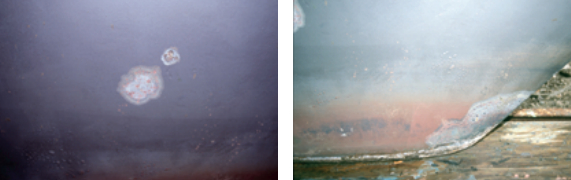
After a summer of sailing, Roland had the boat hauled. At first glance, the lower leading edge of the keel displayed the absence of bottom paint, exposing the VC Tar primer. He suspected that this was the result of a soft grounding and not active corrosion. Closer inspection of the keel revealed localized corrosion on the starboard side in the form of a couple of 1⁄8-inch pits. Except for the pits, it appeared that Roland’s labor that previous spring had paid off.
In his haste to launch the boat the following spring, Roland simply sanded those small, pitted areas and refreshed the keel with a coat of Interlux VC 17m Extra. This expediency proved to be unwise.
After a five-and-a-half-month-long sailing season, Roland again had the boat hauled. Again, the lower leading edge displayed wear. The bottom paint and the VC Tar barrier coating were gone, exposing the cast-iron keel. He attributed this condition once more to a grounding. The previous small areas of localized corrosion had grown considerably, from 1⁄8-inch spots to something the size of a half dollar. Except for the pitting, Ro- land was guardedly happy with the results.
Final analysis
Throughout the refurbishing process, Roland was careful to take a lot of photographs and to keep notes chronicling his work. After carefully reviewing everything, Roland felt that the overall results achieved were good, if not extremely encouraging, although a few areas required special note. They are:
- Following the grinding process, sandblasting of the pitted areas should have been done. This would have assured a rust-free surface, and quite possibly could have eliminated the development of localized corrosion cells.
- It was good that Roland did not sheathe the keel in epoxy and fiberglass. The small corrosion cells that did develop might have remained unnoticed until they had evolved into an alarming condition.
- When the pits were noticed after the first season, they should have been properly treated rather than simply sanded and given a coat of Interlux VC 17m Extra. Proper treatment should have incorporated all of the steps, including sandblasting or the use of a Dremel tool to clean the corrosion byproducts from the pitted area.
- Assuming that the pitted areas are properly addressed, sheathing the keel with epoxy and fiberglass prior to the application of the primer and bottom paint will add a protective physical barrier. Several layers of fiberglass and epoxy are warranted on the keel’s leading edge, especially the lower portion that’s subject to damage due to groundings.
Gregg Nestor, a contributing editor with Good Old Boat, developed a keen interest in sailing while growing up on the southern shore of Lake Erie. His third book, The Trailer Sailer Owner’s Manual: Buy-Outfit-Trail-Maintain, is soon to be released by Paradise Cay Publications. When not writing about sailing, Gregg and his wife Joyce, cruise aboard Raconteur, their Pearson 28-2.
Thank you to Sailrite Enterprises, Inc., for providing free access to back issues of Good Old Boat through intellectual property rights. Sailrite.com