Miss Marley offered “learning opportunities” aplenty
Issue 64 : Jan/Feb 2009
I bought my Cape Dory 30, Miss Marley, without a survey — not something I would recommend to anyone, but something I was willing (or foolish enough?) to do. I had heard all the horror stories about buying a boat without a survey, but getting one would have been another hassle and expense I just did not want. Cape Dory sailboats have a very good reputation as solidly built boats.
I knew she had a heavily fouled bottom because I could see the barnacles trailing in the current. The seller was very straightforward with me and said she had not been pulled out of the water for four years. He had lost his house in Hurricane Katrina and had moved inland at the insistence of his wife. He was willing to let Miss Marley go for a very attractive price. We took her out for a one-hour cruise in the Mississippi Gulf so I could see how she sailed. She was slow as molasses because of the fouled bottom and the rudder felt a little odd (which I mentioned at the time), but otherwise she seemed to sail fi ne. I gave him a check when we got back to the dock. I wanted to save the money I would have spent on a survey to have her hauled out and cleaned off back in my hometown of Pensacola, Florida.
My friend Steve and I motored Miss Marley all the way back to Pensacola along the ICW. It was a long, slow trip, never making more than 4 knots the whole 18 hours back. I took the boat out alone into Pensacola Bay a few times to become more comfortable with her. Each time I ended up motoring back because she was so slow — like a tub of water. I knew she had to be pulled out and cleaned off. I finally decided I had to get on with it, so in early October I motored her over to the nearest boatyard and had her hauled out.
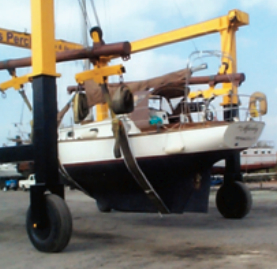
As the crane lifted her out of the water, I overheard one of the yard workers saying, “The rudder is broken.”
Rudder hanging free
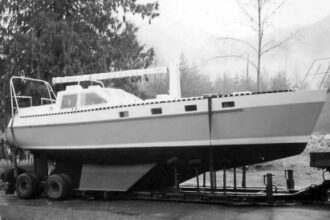
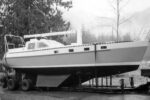
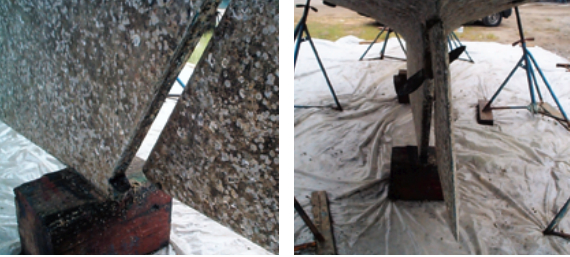
As the crane slowly rolled past me with Miss Marley dripping in the slings, I looked, and sure enough, the rudder was hanging free from the gudgeon at the heel plate. My throat tightened as I thought to myself, “Now what is this going to cost me and how am I going to get it fixed?” I had expected to spend about five days cleaning and painting the bottom, but suddenly realized that was going to stretch into weeks. I felt a horrible pain in my backside right where my wallet sat.
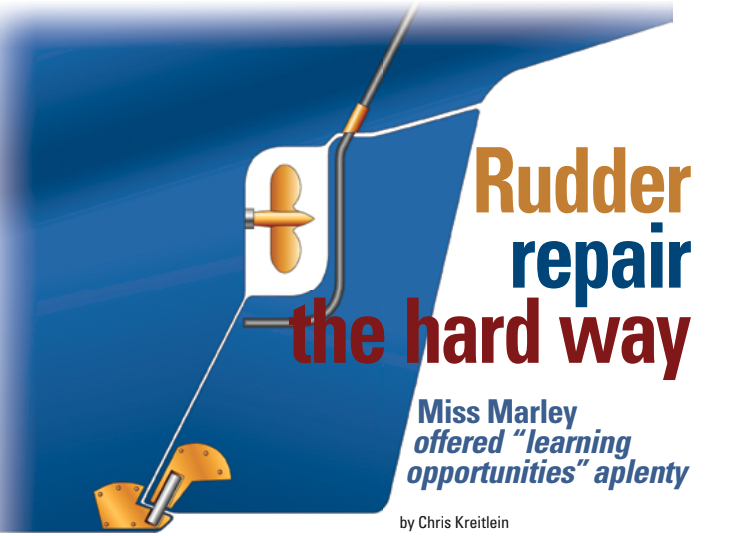
After they got the boat down on the blocks and jack stands, I crawled under the hull to look at the gudgeon. On a Cape Dory 30, the rudder is supported at the top by a stainless-steel post coming down through the stuffing box from the steering quadrant. The post extends about halfway through the rudder, where it bends in an arch to provide the leverage to turn the rudder, and then it stops. The bottom of the rudder has an encased bronze plate that holds a stainless-steel, 1-inch pin that rests in another bronze plate encased in the hull at the gudgeon. The total weight of the rudder rests and rotates on that stainless-steel pin.
On my boat, the bottom pin had rusted through and broken off. Worse yet, the rudder shaft was bent to starboard about 5 degrees. I have no idea how long the rudder had been broken or whether it was already bent when I bought the boat. I had run aground in the mud at my marina and a friendly motorboat had towed me off. Perhaps I bent the rudder.
Regular ecosystem
The state of the underwater hull was unbelievable — a regular ecosystem of its own. The sea life was alive and doing very well. Some of it was still breathing as I began scraping it off. I started with a scraper and spent two days knocking the smelly stuff off. Then I attacked her with my angle grinder mounted with a 60-grit flap disc. It took me four days of miserable dirty work to grind the bottom down to gelcoat and fiberglass. As sick as I was about the rudder, I felt good about the boat’s hull. It seemed very sound. I only found one significant blister, which I ground out and filled with polyester marine-grade Bondo impregnated with fiberglass, a product I bought at Wal-Mart.
I had to spend days sanding and smoothing off the hull with an orbital sander because I had gouged it so much with my angle grinder. During breaks in my labor, I wandered the boatyard looking for someone to fix my rudder. A couple of contractors in the boatyard looked at it and said, “Sure I can help you with that, but right now I’m pretty busy with this other job. I’ll get right back to you next week and we’ll get on it.”
I finally nailed down one guy who seemed really serious about helping me, but then the 37‐ foot Catalina he was finishing fell sideways off the blocks, snapped its rudder in half, and drove the jack stands into the hull. With that, I realized if I wanted my own rudder fixed this year, I was going to have to do it myself.
Crawling into the lockers
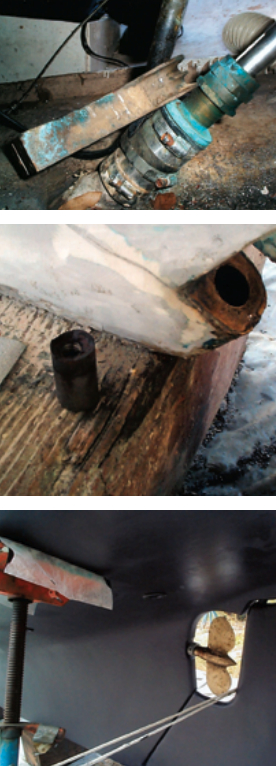
Funny what you can do when you have to. I had tried to crawl down into the tight confines of the cockpit lockers on my boat before, but I got claustrophobic and couldn’t do it. This time, on a cool October morning, I slipped off my shoes and slid right down in there. I hooked up a light and a fan to help me, grabbed some tools, and began taking the steering apart. The rudder shaft was held in place at the top by a bronze collar. It passed behind the steering quadrant bolted on the shaft, and levered against a bronze key fitted into a slot in the shaft. Then the shaft passed through the bronze stuffing box, through a double-banded black rubber hose, and out the bottom of the hull.
I had a heck of a time getting all the bolts out but finally got most of it disconnected. One set-screw on the rudder stop collar would not come out and I stripped it. I hooked up my electric drill and drilled it out. Finally, I had it all apart and was ready to drop the rudder down. The yard lifted the boat and two of us pulled on the rudder, but it would not move. I climbed up onto the boat and down into the locker again. While the boat was hanging in the slings, I loosened the stuffing-box bands and rubber hose. With two of us tugging on it and the boat swaying in the breeze, the rudder began to slide down and finally fell out at our feet. The yard sat the boat back on the blocks and I hauled the rudder off to my van.
Extracted the pin
A friend was able to drill into the remains of the stainless-steel pin stuck in the gudgeon and, with an automotive puller, pop it out. Meanwhile, I took the rudder over to another boatyard and dropped it off with a fellow who, I was told, did excellent fiberglass work. Over the next few days, with my constant encouragement, he cut into the bottom of the rudder and pulled out the remains of the pin stuck there. Then he cut open the top of the rudder to expose the bent shaft. He took the rudder over to a machine shop and left it with them to straighten. Again, with my regular visits, they finally got around to working on it. It took two tries, but eventually they were able to straighten the rudder shaft. The fiberglass work took two more days and the rudder was ready for me. The total rudder repair cost was $806.
It was not easy getting it back up into the boat. I tried digging a hole in the ground to set the rudder in. But getting it deep enough to slip the shaft up into the boat would have taken me a week. So I had the crane come back and lift the boat again. Three of us tried to maneuver the rudder back up through the stuffing box, but it would not go. Finally, we wiggled it around enough that it began to slide up. I climbed inside again to make sure it cleared the support collar at the top. It fit just right. But that was not the end of it. I had to push the rudder up high enough into the hull to slide the stainless-steel bottom pin already in the rudder into the gudgeon.
Sleepless nights
I had spent several evenings lying in bed wracking my brain on how best to do that. I thought of cutting off the top of the rudder an inch or two for just enough clearance to slide the bottom pin in, but then I would have to rebuild the rudder. A phone call to Robin Hood Marine, a Maine boatyard where Cape Dorys had been built, told me I should cut out the gudgeon and bronze plate, put in the pin, and glass it all back. I definitely did not want to do that. I finally latched onto the idea of using my angle grinder to cut out the fairing in the bottom of the hull below the stuffing box for enough clearance. Part of the fairing had been broken when the rudder was bent, so I had already cut out some of it. I decided to do that.
The yard sat the boat back down and left me to work. I began grinding away. I stopped every few minutes to struggle with the heavy rudder and to see if the bottom pin would clear the gudgeon and drop into position. All afternoon I ground away, lifted, and measured. I almost gave up, and considered taking the pin back to the machine shop to have half an inch cut off it. But finally it cleared. I greased the bottom of the pin, lifted the rudder, slid the pin over the hole, and let it drop down. It was a tight fit; I could hear the air puffing out past the grease around the pin in the hole.
Horror sets in
I was pretty happy — but my happiness changed to horror. I climbed back into the cockpit locker to begin hooking up the steering. I hooked up the top of the rudder shaft in its support collar and then began on the steering quadrant. I was squeezed down on my side with arms stretched out in front of me while staring at the steering quadrant and trying to remember how to hook it back up. Something did not seem right. I suddenly realized that I had accidentally passed the rudder shaft up through the middle of the steering quadrant instead of behind it. I could not lift it up off the shaft because the upper support collar prevented that. I sure could not drop the rudder enough to lift it off the top end of the rudder shaft because I could never have gotten the bottom rudder pin up and out of gudgeon. I was sick! How could I have done something so stupid?
I lay there for 10 minutes, wondering if I could possibly grind the quadrant off and order a new one from Edson. Looking at the situation, I saw that part of the upper rudder support collar bracket could be unbolted, so maybe I could pry the quadrant off, sliding it between the upper support collar and the rudder shaft. I unbolted part of the support bracket but the quadrant was too thick to pass between the remaining part of the bracket (which I could not remove) and the rudder shaft. I grabbed a large wrench and stuck it between the two and pried as hard as I could while tugging on the quadrant. I was surprised, but with a lot of prying force, the quadrant squeezed between the shaft and the support bracket. Happiness was suddenly restored.
Fairing and painting
After hooking the rudder back up, I spent the next two days rebuilding the hull fairing above the rudder with fiberglass and epoxy. When I finally got to the point of painting the hull, I rolled on a barrier coat of two-part epoxy paint (one gallon, at $38 a gallon), then three coats of Super Shipbottom paint, an ablative antifouling paint I found on the Internet. I got two gallons.
I spent a month and two days in the yard. I finally got back in the water with a yard bill of $765. Miss Marley had become a different boat. I could not believe how fast she moved with a slick hull and good rudder. In fact, I could hardly slow her down when I got back to the marina and nearly rammed the dock. Usually, when I cut the power a ton of barnacles caused her to stop immediately.
Anyway, it has all been quite an adventure, and I have learned a lot. Miss Marley is now safe and sound in her slip at the Bayou Grande Marina in Pensacola.
Chris Kreitlein retired from the U.S. Navy in 2005 after 28 years of service, during which he served as an officer aboard ships and aircraft. His primary warfare specialty was as a naval flight officer on the E-2C aircraft. His last tour of duty was at the Pentagon, where he briefed the Secretary of the Navy and the Chief of Naval Operations on a naval interdiction program to intercept weapons of mass destruction on the high seas.
Thank you to Sailrite Enterprises, Inc., for providing free access to back issues of Good Old Boat through intellectual property rights. Sailrite.com