It was curtains for the drapes when the blinds went up
Issue 87 : Nov/Dec 2012
Faded and threadbare, the pleated curtains in the main saloon of our Bristol 35 begged for replacement, but with another set of unoriginal, marine-store drapes? Surely there was a more inspired choice. We discovered that better idea at our local hardware store. Blinds, either the classic Venetian style or the more compact mini-blind, provide the perfect alternative.
Blinds offer several advantages over curtains. The degree of light allowed in or, conversely, the measure of privacy created, is infinitely adjustable. Curtains are either open or closed. In our humid Florida climate, curtains can mildew and must be removed for cleaning. Blinds are mildew-resistant and can be cleaned in place. Curtains, when sized for typical portlights, lend a “doll-house quality” to the interior décor. Blinds, available in a wide range of materials, colors, and finishes, contribute an air of nautical sophistication.
Once sold on the idea of blinds to dress our cabin windows, we learned there were a few technical hurdles to be cleared.
The first was sizing. Choosing from the variety of products available, we easily found blinds of the proper width but discovered that all the off-the-shelf units were far too long. No problem! Instructions in the package explained how to shorten the blinds to any length. The procedure varies among manufacturers, but invariably requires removing the lower cross-member, extracting the excess slats, shortening and re-securing the supporting lines, and refitting the bottom cross-member. Hanging the blinds where they can extend to their full length while doing this makes the process easier.
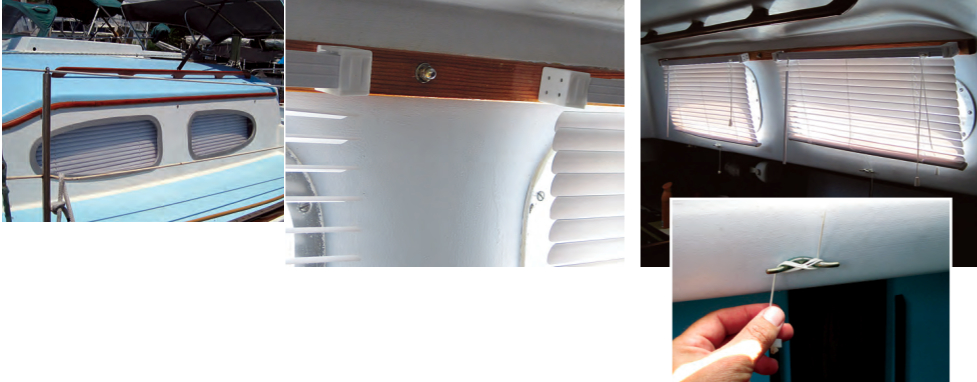
The second hurdle was that the frames of our portlights protrude slightly inward from an otherwise flush cabin side. If the mounting brackets supplied with the blinds were attached directly, the blinds would snag on these frames. Our solution was to affix a wooden furring strip above the windows and mount the brackets to it. This allows the blinds to hang and operate freely and, with a few coats of varnish, also adds a rich accent to the installation.
The third obstacle is the fact that sailboats heel. Windward blinds would cant inboard, becoming obstacles and negating their purpose. Tiny brass cleats, purchased at our local chandlery, provided the answer and added that final nautical flair to the completed project. We installed a cleat a few inches below each window, then fitted a lanyard, fabricated from the excess line cut away during the shortening process, to the bottom cross-member of the blind. Cinched off with their lanyards, the blinds stay in place at even the most ambitious angles of heel.
The final modification to our hardware-store mini-blinds was to replace the mild steel mounting screws, provided in the kit, with stainless-steel screws.
We’ve learned, much to our delight, that as long as we stick with the same brand, the blinds are interchangeable, requiring no alteration in mounting hardware. This provides not only for replacement of damaged components, but allows us to alter the cabin décor with minimal cost and effort.
The entire crew is pleased with this simple cabin upgrade. The skipper likes the salty appearance. The chief purser is thrilled the project was completed for less than $50. The boatswain is delighted with the easy cleaning and maintenance. The ship’s cat finds the dangling control lines a pleasant source of off-watch entertainment. And everyone loves the instant privacy afforded in those close-neighbor situations common to the transient dock at most marinas.
Vern Hobbs and his wife, Sally, sail a 1974 35-foot Bristol cutter along Florida’s Atlantic coast and the Intracoastal Waterway. Their day jobs pay the rent, but Vern’s earnings from his work as an artist specializing in maritime subjects finance the boat projects.
Thank you to Sailrite Enterprises, Inc., for providing free access to back issues of Good Old Boat through intellectual property rights. Sailrite.com