A cell phone signal booster brings the world aboard
Issue 108: May/June 2016
Like many sailors who still work, I like to keep abreast of things back at the office every few days, even when on vacation. The problem has been that when I anchor off, which is to say almost always, WiFi has been a problem. Usually, if I find a strong signal, it’s some kind of pay-for-play network and often slow.
My attempted work-around was a WiFi amplifier with a semi-directional antenna. The result? In the Great Salt Pond on Block Island, I once snagged 27 signals, all of them locked. No joy. When I did find an unlocked signal, I often found my computer would lose it, as the computer wanted to switch over to the strongest signal, which was always locked.
The longest distance was at Cuttyhunk, where I got a signal at more than 7 miles. All of these were ultimately futile, as it happened, and I generally ended up at the local library using the free WiFi, which was slow, slow, slow. One time, the library was closed, but the WiFi was still available and a dozen or so of us — cruisers, islanders, and vacationers — all sat out in the hot sun struggling to read our monitors in the glare. That was no way to spend my vacation. There had to be a better way.
Cell phone multitool
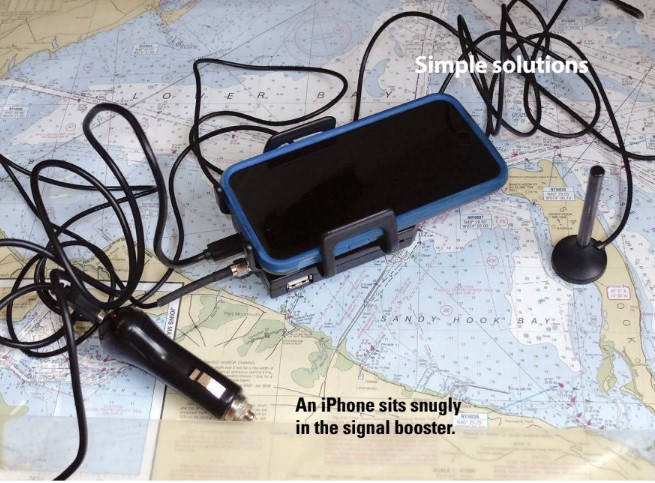
How about just using my cell phone, an iPhone 6, as a modem? That worked well when I had five bars. At four bars, not so well, and out in the mooring field, I was lucky to get two or three bars. A web search turned up a number of cell phone antenna amplifiers, some of them quite sophisticated, for use in isolated locations such as cabins in hilly terrain. What caught my eye was one for autos from Wilson Electronics, a “Sleek 4G” cellular booster for about $115. I thought it might be worth a try. (Note: Wilson Electronics is now weBoost, the model is now called the Drive 4G-S, and it’s now $200 –Editors)
Unlike something that would allow the user to hold the cell phone in the usual way and make calls, the phone must be in direct contact with the unit, which is about the same size as an iPhone. Otherwise, it feeds the signal back in a loop. The caller can use the phone in conference-call mode for voice calls, however. More to the point, it might, they claim, be able to give me a strong enough signal to allow my phone to support up to five devices.
How does it work? Like a charm. In Sag Harbor, where I had three bars, it gave me download speeds of 14.09 Mbps and upload speeds at 1.26 Mbps on my laptop. In Block Island, at a point where I did have five bars, I got 20.34 Mbps download speeds and 13.61 Mbps upload speeds, which is only a little slower than I get at home with cable. In Mattituck, on the North Fork of Long Island, with two bars, I got 4.24 Mbps download speeds and 2.42 Mbps upload speeds on my Android tablet, as measured by Speedtest.net. More to the point, I was able to upload large photos and work on web stuff with no problem where before I wasn’t able to.
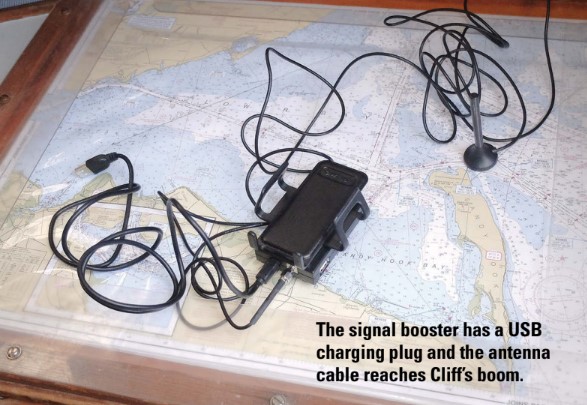
The device is small enough to not get in the way. It consists of a small antenna on one end with enough cable to get it above the boom. There’s a magnet on the antenna, so I attach it to a clamp and put it where it’s high enough to work, well away from the compass. The power supply is a USB cable that pulls 2 amps through a 12-volt adaptor, which is acceptable. It does get warm to the touch. The device itself has adjustable arms to make it fit a variety of phones, including Android cell phones as well as iPhones and the like.
The maker claims it works on all major North American cellular providers on the 850 and 1900 MHz frequencies, which are associated with voice and 3G, as well as the 700Mhz and 1700/2100Mhz 4G networks. More information on the booster and compatible phones can be found at www.weboost.com; www.wirelessadvisor.com lists the exact frequencies used by each cell phone provider.
Cliff Moore is a Good Old Boat contributing editor. His first boat was a Kool cigarettes foam dinghy with no rudder or sail. Many years and many boats later, he’s sailing a 26-foot AMF Paceship 26 he acquired and rebuilt after Hurricane Bob trashed it in 1991. He is the editor of a community newspaper.
Thank you to Sailrite Enterprises, Inc., for providing free access to back issues of Good Old Boat through intellectual property rights. Sailrite.com