A twin-keeler from across “the Pond”
Issue 108: May/June 2016
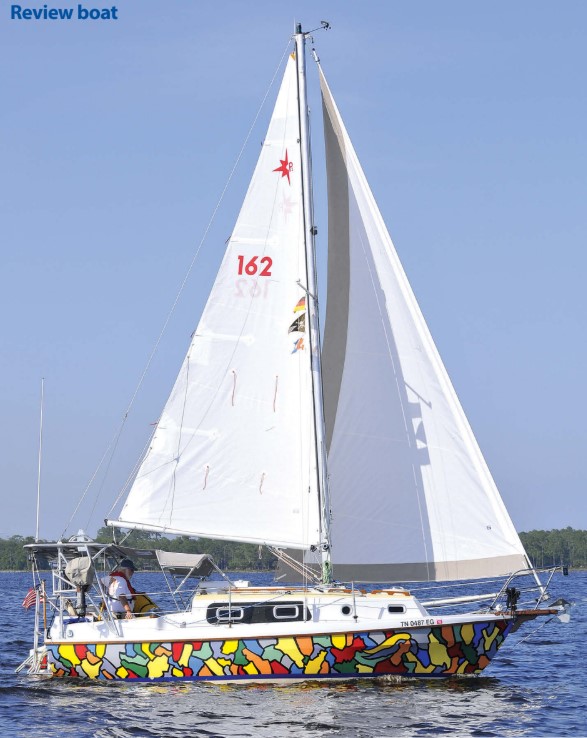
First we’ll address the elephant in the room: the wild paint job is the result of work done by William Barnhart of Mesa, Arizona, for an Interlux paint promotion. The paint and the clear coat were done with a 2-inch roller and 1-inch tip brush. There is certainly no need for a sail number to distinguish this Westerly from the crowd on Kentucky Lake!
Now that’s out of the way, this is the story of Rob and Gabi Hoffman taking a derelict small weekend cruiser and turning it into a yacht. To spend time aboard their 1971 Westerly Pageant 23, Ladyship, is to be amazed that there is so much boat in 23 feet and with so many innovations.
You may recall the story of Rob and Gabi of Nashville, Tennessee, buying a 28-foot Alubat aluminum sailboat in the south of France, shipping it to the United States, and then extensively modifying it to be a very large trailer-able cruiser (see “Establishing a French Connection,” March 2013). Since that boat, Can Can, is a tad unwieldy for quick “go-and-sail” trailering, and because they wanted to explore more, in similar comfort, in 2012 they bought Ladyship as essentially a bare hull and spent nearly three years modifying her to be their “other” boat.
Rob is retired from the U.S. Navy and from work as a commercial photographer. Over the many years he ran his business, he earned six U.S. patents in photography. This sort of creative vision comes into play in the way he modifies boats.
Rob learned to sail on Guantanamo Bay, Cuba, in a Rhodes 19 with a Cuban sailing instructor, and went on in later years to own a Venture 222 and other boats. During his naval career, he was a watch officer on the last of the wooden minesweepers, the USS Valor.
Design
Westerlys were brought to life by Denys Rayner’s Westerly Marine Construction Ltd., founded in the United Kingdom in 1963. The Laurent Giles-designed Pageant 23, with twin or “bilge” keels, was one of its more popular models. A fin-keel version was called the Westerly Kendal 23. (See the May 2014 issue of Good Old Boat for a history of Denys Rayner and Westerly.) Much of what was said about the Westerly Centaur 26 in the July 2013 issue also applies to the Pageant. Constructed to Lloyd’s standards, they are even a bit overbuilt for how most of them are sailed.
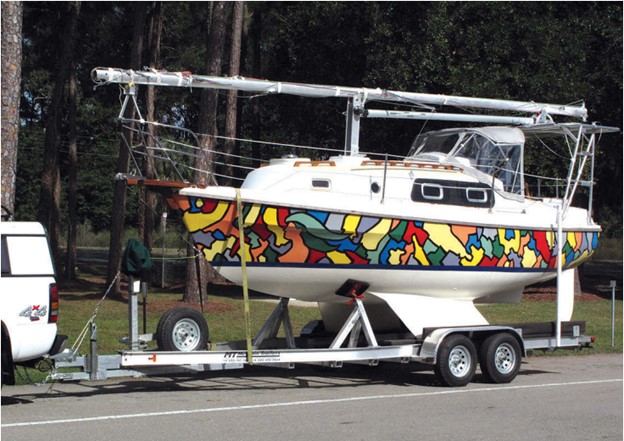
Rob found he could cut 6 inches off each of the cast-iron keels with a gas-powered saw, lightening Ladyship by around 600 pounds while retaining sufficient righting moment. Each of the keels was then reshaped to be asymmetrical for better lift. Because Ladyship has been so heavily modified, we won’t be able to go into great detail as to what a stock boat is like.
Any review of a Westerly must include mention of the twin keels. Their real raison d’être is to allow the boat to sit level on the U.K.’s ubiquitous tidal flats. With their relatively shallow draft, these “bilge-keelers” are also good for gunkholing, in part because if they happen to run aground while heeled, they can immediately float free when they become upright — because they draw less water upright than heeled.
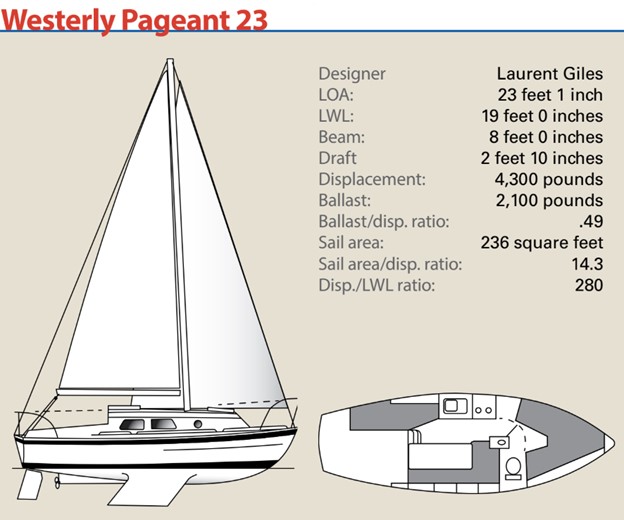
Bilge keels that have been properly designed, aligned, and shaped provide decent windward performance. Stock Westerlys, though, are known to be slower in light air than similar boats with fin keels, mainly due to the extra wetted surface area. In reducing the draft of Ladyship from the stock 2 feet 10 inches, Rob gained some speed by raising the sail area/displacement ratio to 15.2 from 14.3.
Construction
The Pageant was built to Lloyd’s standards and each boat received a certificate. The hull is solid fiberglass and the foredeck is cored with balsa for stiffness. The hull-to-deck joint is through-bolted and glassed over with mat. Bulkheads are tabbed to the hull. Hardware is through-bolted with backing plates to distribute loads.
On deck
The standard Pageant has the hull form of its big sister, the Westerly Centaur, with slab topsides running down to a firm turn of the bilge. The tall trunk cabin yields 6 feet 1 inch of standing headroom with only a slight reduction forward, and large cabin windows provide plenty of light. Here Rob has not only replaced the fixed glass but has installed opening ports that enhance ventilation while retaining great views. An overhead hatch in the forward cabin helps ventilate the whole boat.
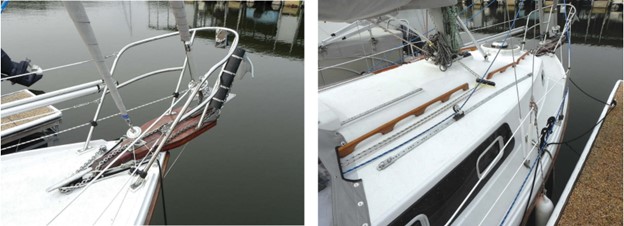
Rob has added a large ipe Brazilian hardwood bowsprit that handles the anchor as well as two roller-furling headsails. The foredeck is wide with plenty of room to handle gear and tackle. The toerails are molded in while the rubrails are teak. Ladyship has aggressive non-skid walking surfaces and three long sturdy teak handholds on each side of the cabin trunk.
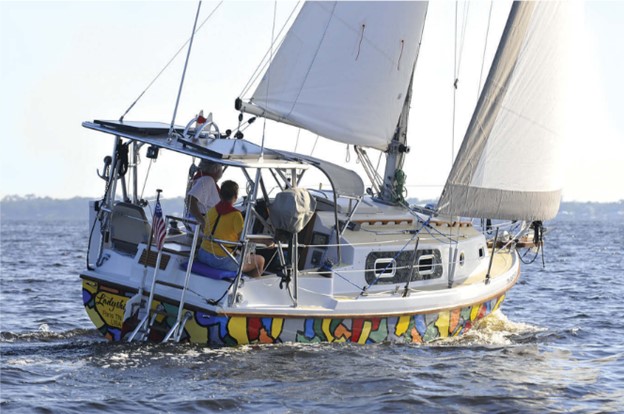
Toward the stern, Ladyship becomes even more custom. The inboard diesel has been removed and an outboard now occupies a fabricated engine well between two lockers where there was formerly a small lazarette and athwart-ships seats either side of the tiller head. Above the motor well there are two elevated forward-facing seats for the helmsman and crew.
The 20-horsepower Tohatsu is raised and lowered vertically in the well. When it’s raised, “bomb bay” doors close off the bottom of the motor well to reduce drag. (Rob now feels a 9.9-horsepower Yamaha would be sufficient; he chose the Tohatsu for its alternator, but has found the solar panels do an adequate job of charging the batteries.) A shroud around the outboard’s prop pushes the doors open and also eliminates prop walk. A small electric winch does the lifting work. The engine is operated via its tiller controls but does not rotate. Rob has installed an 18-gallon fuel tank from which he can also refuel the dinghy’s outboard motor tank.
The original rudder was a spade with a tiller mounted low and aft in the cockpit footwell. Rob has installed a so-called fisherman’s tiller that swings athwartships through a vertical arc. The balanced transom-mounted aluminum rudder salvaged from their Alubat is controlled with lines to the tiller and autopilot. Above the deep self-bailing cockpit there are three commercial-grade sealed access panels that replace the Westerly-made hatches.
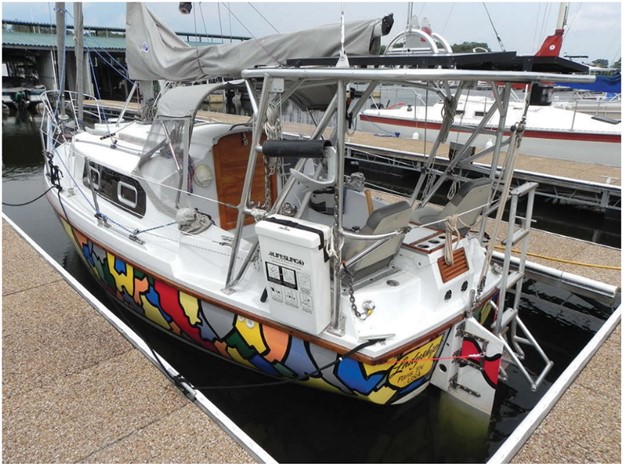
A structure of stainless steel and 2-inch-diameter schedule 40 aluminum tubing supports a hardtop over the cockpit. The hardtop provides shade and some rain protection and also supports two 100-watt solar panels. It also bears the weight of the mast when it’s lowered for transport. A roller on top of the arch aids in moving the lowered mast forward and a chock holds the boom that stays attached to the beefy tabernacle Rob fabricated. If this arch looks familiar, it is because it was built to a design by naval architect Cortland Steck, who did similar designs for Hunter Marine. The Hoffmans consulted Cortland on several of the modifications they made to Ladyship and to their Alubat.
On the stern, there’s a very sturdy ladder and a swinging support for the dinghy motor. A canvas dodger shelters the companionway and forward end of the cockpit. When they’re not using the three solid-oak dropboards, Rob and Gabi replace them with a weighted curtain that covers the companionway entrance. The footwell can accommodate a lot of water with little risk to the cabin due to the high bridge deck, and because the motor well cut is lower than the bridge deck. However, the footwell is below the waterline while under way, so Rob installed a ball valve on the scupper pipe to prevent water entry.
Accommodations
Sliding the companionway hatch forward and going down three small steps brings you into a very roomy cabin for a 23-foot boat. A Corian-topped galley counter is to port with an Origo two-burner alcohol stove and sink with pressure water (originally a foot pump). The stock stainless-steel 15-gallon freshwater tank has been retained, but a deck fill was added. One 12-volt pump supplies the sink faucet, flushes the head, and feeds a “dog” washdown in the cockpit.
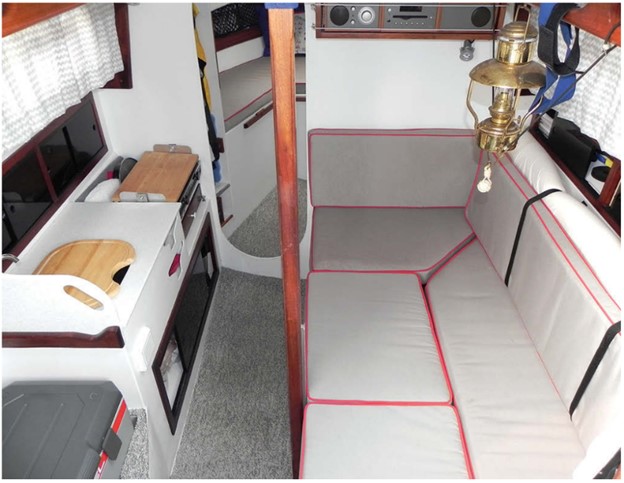
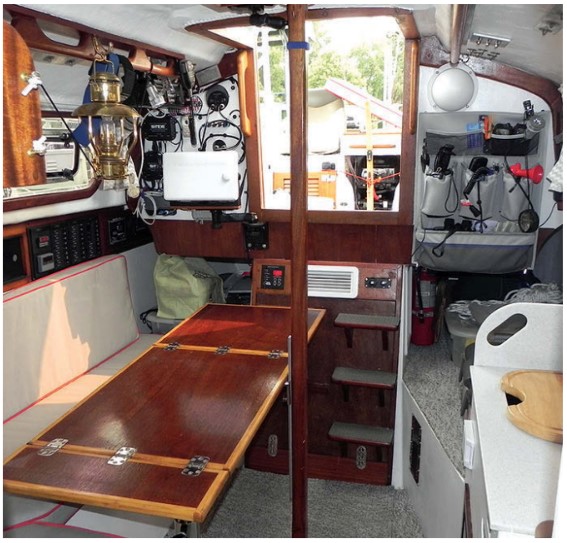
There is no interior liner. The furniture is white-painted plywood with abundant teak trim. Originally there was a wood-grain plastic laminate on the bulkheads and table. The original foam/vinyl overhead liner was in bad shape, so Gabi removed it, stripped the adhesive off the overhead, and painted it white. Two long teak handrails on the overhead and a wooden post make for secure passage under way. The main cabin bulkhead, with its “shippy” oval opening, supports the mast step. On original Pageants, the forward berth can be closed off with the open head door.
Rob has rigged the dinette table to raise and lower with a seat pedestal and sail track on the standard wooden post. The table folds in three to aid access to the settees and can be lowered to convert the dinette to a berth for one adult or two children. In addition to a large V-berth forward, there are two quarter berths aft (originally there was a sail locker to starboard). A SeaLand toilet with a built-in tank is fitted in the head compartment to starboard. The holding tank can be dock pumped or pumped overboard where allowed.
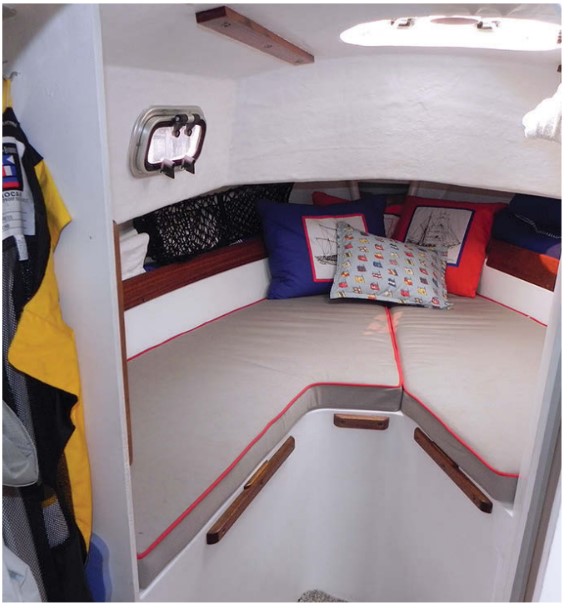
How many 23-foot boats have a hanging locker? The Pageant does. What about refrigeration? Ditto. Rob has installed an auto-switching Engel 120-volt AC/12-volt DC cooler that can be a freezer as well. Perhaps my favorite addition to Ladyship is the Mermaid water-cooled air-conditioning system installed in the space formerly occupied by the diesel engine — perfect for dealing with sultry Tennessee summers at the dock. There is storage everywhere.
In addition to shorepower and an inverter/charger, Rob added a plethora of electronics including a chart plotter that swings into the companionway so it’s visible from the cockpit. All the wiring is out in the open for easy service of the custom Blue Seas electrical panel. LED lighting is used exclusively. The house bank is two golf cart batteries.
Rig
Rob has modified the masthead rig to what he calls a “slutter rig” — a sloop/cutter with a removable inner soft-luff roller-furling headsail that replaces the stock baby stay, and a roller-furling genoa on the bowsprit. When not in use, the inner sail can be secured to a pad eye at the base of the mast to make tacking the genoa easier. The inner jib sheets to tracks Rob mounted on the cabintop with full-length backing. The change to swept-back spreaders and mounting the chainplates outboard (formerly on the cabintop) stiffened the rig but interferes with passage forward. Ladyship is rigged for a rarely used spinnaker. Where an original Pageant has end-boom sheeting, Ladyship’s mainsheet and traveler are atop the arch. She has a new suit of sails, including a loose-footed mainsail.
Under way
The Pageant, like the Centaur, tracks very well due to the longish twin keels. Due to its stiffness it has an easy motion and can point as high as 30 degrees apparent, albeit pinching. In 8 knots of apparent wind on Kentucky Lake, we saw 3.5 to 4 knots to windward. It tacks quickly. Ladyship’s vertical tiller has a firm feel but it’s a bit heavy with little feedback from the rudder. While I found using it a bit disorienting at times, and turned the wrong way in making corrections, I’m sure it would eventually become natural.
Ladyship’s elevated seats give the helmsman a high perch with a good view forward and arch supports to hang onto while heeled. The mainsheet and traveler are nearby for easy adjustment and the headsail sheets are also handy at the forward end of the cockpit. As the shrouds obstruct the sidedecks, the best way to get to the mast or bow is to hop onto the cabintop. While heeled, I preferred sitting to leeward where I could see the jib telltales and lean against the arch. If Rob added an armrest with some padding it would be perfect! I was comfortable either with my feet propped on the coaming or sitting sidesaddle.
Bracing while heeled is easy in the cockpit with its good back support, but the seats get a low PNI (Penticoff Napability Index) of 2 for being short and narrow. A stock Pageant, with its deep cockpit and tall cabin trunk, has more limited visibility but much longer seats (6 feet 6 inches), although they are still narrow for napping, probably a 3 or 4 PNI.
Under power, with the outboard’s thrust in front of the rudder, steering and handling is as easy as pie. The big motor will easily push Ladyship to her hull speed of about 6 knots. (I suspect the original 10-horsepower Volvo Penta MD1B diesel inboard would be adequate too.) The low forward location of the propeller ensures it won’t cavitate in rough conditions. However, there may be a tendency for the lower unit and doors to collect weed, but they could probably be cleared without entering the water.
Although this comfy little cruiser was never really intended for competition of any sort, Rob reports that Ladyship has performed well in just-for-fun regattas against conventional keelboats. With a little work, one could take you safely offshore. Besides its previously mentioned gunkholing capability, an advantage that comes with owning this rather spacious and capable little boat is only paying the dockage of a 23-footer.
Conclusion
Westerly built 551 Pageant 23s from 1970 to 1979. Most were sold in the U.K., but they can be found in North America and elsewhere in Europe. They are very sturdy with few natural problems other than those associated with an aging fiberglass sailboat, but condition will have a big effect on value (the Hoffmans paid $1,000 for Ladyship). While there have been few listings in the U.S. over the last few years, offerings range from $2,500 to $10,000, with $5,000 the average.
Allen Penticoff, a Good Old Boat contributing editor, is a freelance writer, sailor, and longtime aviator. He has trailer-sailed on every Great Lake and on many inland waters and has had keelboat adventures on fresh and salt water. He owns an American 14.5, a MacGregor 26D, and a 1955 Beister 42-foot steel cutter that he stores as a “someday project.”
Thank you to Sailrite Enterprises, Inc., for providing free access to back issues of Good Old Boat through intellectual property rights. Sailrite.com