. . . but extra pounds bring peace of mind
Issue 103 : Jul/Aug 2015
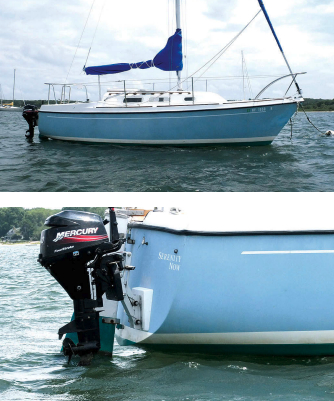
Toward the end of my summer cruise I happened to anchor for the weekend in Sag Harbor, New York, just east of the breakwater in 12 feet of water. As I was clearing away lines and covering the sails, a small sailboat passed close by. The man at the tiller was inspecting my boat in an odd way. “What’s that about?” I wondered. Although these days a 26-foot boat is one of the smallest in most places I anchor, it’s not all that unusual. He picked up a mooring just inshore of me and cleared off before we could talk. However, I passed his boat, Serenity Now, several times on dinghy trips into town.
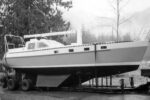
On one of those trips past Serenity Now I realized we both had Paceship PY26s built by AMF during the 1980s, when the company was diversifying from making bowling balls and pinsetters. (You’re right, what was AMF thinking?) Still, they made a lot of them, along with 22- and 30-foot versions. It’s a nice boat, reasonably well designed and built, and has served me well.
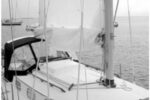
My boat, Pelorus, was named after Hannibal’s navigator (look it up in Julius Caesar’s history of the Second Punic War). She was built in 1980 and first splashed in 1981. Despite suffering several unscheduled alterations and repairs thanks to Hurricane Bob in 1990 (new bow, starboard railing and hull-to-deck joint, bow and stern pulpits, and shrouds) and once more courtesy of Hurricane Sandy in 2012 (fiberglass damage, mostly to the starboard side and transom, and a twisted stern-pulpit swim ladder), Pelorus was, I thought, pretty much the same boat I bought from the original owner in 1990 after Hurricane Bob. Well, I did swap out the engine in 2008.
Down on her lines
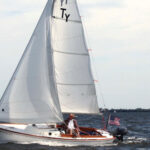
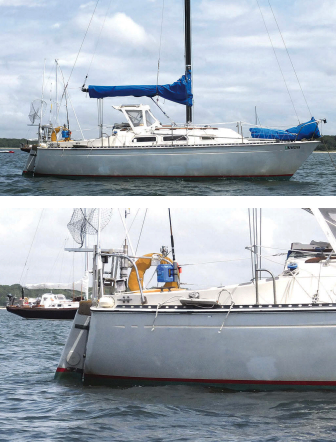
I sometimes think of myself as weighing the same 145 pounds I did when I graduated from high school in 1966. That was a clue. At first I noticed only that Serenity Now was powered by a rather large outboard and had a different paint scheme. Then I saw it: she floated higher in the water than Pelorus (it was especially obvious at the transom). “Why?” I wondered. “And what difference would it make?”
For one thing, because Serenity Now was higher in the water, she had less wetted surface and thus would be faster than my boat under most conditions. Also, because she was lighter, she would accelerate faster in a gust. That appeals to racers. I was on a racing boat once. It had a 3-pound dinghy anchor and a mud bucket for the head. Some people like it light.
But why was Pelorus so different? The short answer is that she has more stuff in her. The other boat didn’t have a VHF antenna at the masthead, so her owner saved weight from the radio, wiring, and antenna. Even a little weight at the masthead causes the boat to be more tender. Nor was there any sign of a GPS antenna. Maybe his GPS was on his cell phone.
On the other hand, I had just finished adding a tile counter in the head (see “Head Makeover,” page 48) and — although it is a joy to look at and use — it must have added 3 or 4 pounds. Even though the other boat had an outboard hanging over the stern with all its levering force, Pelorus has a Yanmar diesel inboard, a bronze prop shaft, strut, prop, full fuel tank, and a full 5-gallon jerrycan of spare fuel taking up space in the cockpit.
I had a 5-gallon jerrycan filled with water, another full of gas for my dinghy’s motor, a 10-gallon main water tank, an icebox with three blocks of ice, and a week’s worth of food, both fresh and canned. Not to mention spare sails, cockpit cover and struts, two #27 12-volt batteries, a hard dodger, 80 watts’ worth of solar panels, electric charging and monitoring equipment, a bilge full of tools (everything from a miniature screwdriver to a torque wrench for the engine), Yanmar and Honda engine spare parts (including two replacement freshwater cooling pumps for the Yanmar), boxes of screws, nuts and bolts (bronze and stainless steel), a two-burner LPG cooker, a 10-pound LPG tank, clothing, bedding, the rigid dodger and frame, two spare anchors, chain and rode, the head, an 18-gallon holding tank, bottles of cleaning products, and God-knows-what-all. I can’t forget the folding bicycle, with a design weight of 27 pounds but a godsend on places like Block Island. I once carried a folding dinghy that I stowed in the V-berth, but as my family grew, it became too small so I replaced it with a Bolger Cartopper that trails everywhere behind me, thus saving about 25 pounds in the forepeak. Oddly, that’s about what the folding bike weighs.
It adds up and pushes down
My boat’s designed displacement is 6,500 pounds, but there’s more than a thousand pounds of stuff aboard. It reminds me of one of the late, great Bill Mauldin’s WW II Willie and Joe cartoons. During the worst of the fighting, Willie and Joe, two American soldiers, are soaking wet and slogging through mud up to their ankles in a pouring rain in the mountains of Italy. Both have fully loaded packs, rifles, a machine gun, and ammo. Willie’s pack has everything but the kitchen sink and maybe that too. Joe says, “Willie, you’re carrying too much junk. Better throw away the joker in your deck of cards.”
By now I’ve probably shed 10 pounds in rust from the iron keel. I suppose I could shed a couple hundred pounds by emptying out all my tanks and tossing away the spare anchors and chain. But I can’t imagine that the result would be more fun for me. What would happen when, not if, something breaks? How would I be able to double up my anchor in a blow?
Maybe I need a bigger boat. It seems to be a rule in life, however, that the amount of stuff would swell proportionately and fill the extra space.
After giving it some consideration, I think I’ll keep my good old boat.
Cliff Moore’s first boat was a Kool cigarettes foam dinghy with no rudder or sail. Many years and many boats later, he’s sailing a 26-foot AMF Paceship 26 he acquired and rebuilt after Hurricane Bob trashed it in 1991. He is the editor of a community newspaper.
Thank you to Sailrite Enterprises, Inc., for providing free access to back issues of Good Old Boat through intellectual property rights. Sailrite.com