The inevitable, unpredictable, freshwater fertility frenzy
Issue 108: May/June 2016
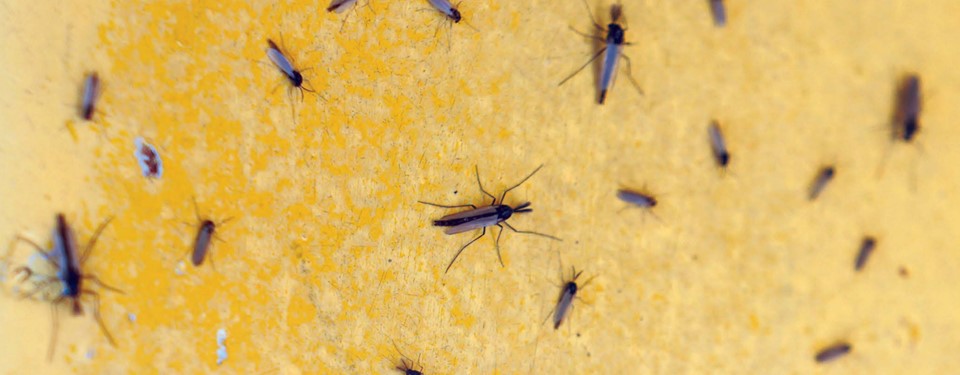
Each year, along the south shore of Lake Ontario in late April when it’s time for painting and varnishing boats, the first midge hatch occurs. Uncountable numbers of tiny black gnats emerge from the lake’s waters and fly inland. There they swarm.
As the morning sun floods lakeshore forests, boatyards, and lawns, everywhere golden motes of life float upward from grass and shrubbery to coalesce into clouds of dancing midges. The air fills with the tiny insects and bicycle riders are wise to breathe through their noses as they sweep through the living clouds.
These incredible aggregations, I have read, are a reproductive ritual. On a still sunlit spring morning as winter’s dark days are a recent memory, the whine of a billion beating wings overhead fills the air with a siren song of life: “Come, mate, and we will make more midges.”
The movement of the swarm is mesmerizing. It shapeshifts and swirls and rolls in a puff of wind and appears to act as a single entity. Even when the wind blows, the midges remain tenaciously coherent. Big swarms look like columns of smoke. Often, on a spring morning or a summer evening, they float stationary over a prominent tree or pond or roof for long periods.
Throughout the boating season, successive species of midges emerge from the lake’s depths, swarm, and die. Though they look like mosquitoes and are a bug-phobic shore-dweller’s nightmare, midges don’t bite. Some don’t even feed during their short aerial lives.
They do, however, raise havoc with a fresh paint job. On Midge Day, the gleam of a yacht’s newly coated topsides promptly becomes a vast killing field. Thousands of hapless insects land on the tacky surface to be trapped in the paint. The boat takes on a distinctly speckled appearance.
Overhead, the resident barn swallows who nest in the boat storage shed swoop and glean, stuffing themselves with midges. Spiderwebs in odd corners fill with gnats. Some webs are so packed that they sag with the weight of their clotted bounty. Out on the bay, small fish rise to the surface to pluck the midges.
As I gaze upward at the cloud of dancers whirling overhead, I ponder their mystery. How do they all decide today is Midge Day? How do they find the perfect mate in that swirling mass? And why does Midge Day always arrive just when I have applied something sticky to my boat?
A cheerful chatter from the barn swallows sweeping by reminds me that Nature has her own schedule. The wise freshwater boater adapts to it and is grateful for Creation’s wonders and mysteries.
I take comfort in the thought that we are, after all, striving for a 10-foot finish and a workboat look.
Susan Peterson Gateley lives and writes among the poison ivy and multiflora thickets of a woodlot within earshot of Lake Ontario on a rough day. She learned to sail and cruise on biodegradable boats using the “discovery method” and — after several offshore bluewater trips on other people’s boats and ships — decided she prefers “green water” coastal cruising. Her mission is to make the climb up the learning curve a little easier for wannabe sailors. Her books are available from her websites, www.silverwaters.com and www.susanpgateley.com. She still hopes to get one of her boats on this magazine’s cover!
Thank you to Sailrite Enterprises, Inc., for providing free access to back issues of Good Old Boat through intellectual property rights. Sailrite.com