Making the case for a feminine pronoun
Issue 43 : Jul/Aug 2005
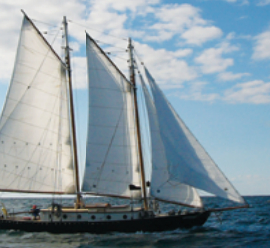
“I wonder why people refer to boats as ‘she.’ Why not call it an ‘it,’ ” a charter guest aboard our sloop asked me one day. I shrugged and muttered something about the romanticism of the sea and sailors and admitted that I really didn’t have a clue as to why boats seem to have a gender. Then, a few weeks later on a windless afternoon during a long, boring, slow passage under power with plenty of time for pondering, I came up with a possible explanation.
I think one reason for the ancient and widespread tradition of personifying boats as “she” (or, I assume, in some languages as “he”) is fear. Back when the world was vast and peopled by only a few million widely scattered humans, an open-water passage in a small frail vessel made of wood, reeds, or hides and powered only by uncertain winds had to be a scary affair, especially if the mariner sailed alone.
Faced with that situation, I suspect the ancient mariner probably did what lonely imaginative kids do to this day. For moral support he conjured up a “secret pal” in the form of a being or spirit inhabiting his hull. This little psychological crutch made good sense then as it still does today. If you can imagine that your boat possesses some sort of being or sympathetic presence, you can also imagine that she (he? it?) also, like you, is interested in continuing to survive. Now you’re not alone anymore. You’re both working together to make it to a safe harbor.
Believing in a fellow being who shares your goal of reaching the other shore is an extremely powerful self-help tool for the timid souls among us who venture forth with small ships on big (or not so big) waters. Besides, thanks to the behavior of boats afloat, it’s easy for many folks to delude themselves about the presence of a life force in that hull. Boats move in unpredictable, irregular, even mysterious ways as wind and waves nudge them about.
Rational behavior
I know it’s just metacentric forces, prismatic coefficients, centers of effort, and centers of buoyancy, but it’s more fun to see it as sentient, rational behavior when your boat feels a wave and rises to it, surging and lifting upward like a horse leaping a hurdle. We can’t see all the precise forces that act on a hull, so the illusion of purposeful movement comes easily to some of us as we sit at the helm supervising all those vectored forces while watching that questing prow before us.
Even though I know my inanimate boat doesn’t “feel” anything in an emotional sense, in one way there truly is purpose and rational expression of behavior in her interaction with wind and wave. Her response to a gust of wind is a direct result of the experience, knowledge, and judgment of a man — dead now for several decades — who designed her. When my little sloop reacts to a puff of wind by working up to weather with just a touch of helm, she seems eager and willing. She is then embodying that naval architect’s priorities, experiences, and judgment.
My boat under way is as much a piece of kinetic art as any of those peculiar sculptures you see moving and clanging in the breeze in city parks or shopping malls. And when she yields to the push of a wave or leans away from the wind and puts her rail down just so far, there is purpose here: the purpose of her human creator who knew how he wanted a hull to react to a given force. My boat is a crystallization of his intangible craft.
I don’t have any problem at all endowing my boat with a personality. The angles of her hull, distribution of her various weights, position of sail plan, shape of her rudder, and keel were all created by human intellect. This product of mathematical equations when under way is an active expression of her creator’s mind. I truly believe my little vessel carries a bit of her designer’s soul with her, just as any good work of art or craftsmanship does.
She is a vessel holding the spirits of her designer, her builder, and to a lesser extent, those who have rigged, equipped, modified, and used her through the years. Each of her owners has also left his or her mark upon my 50-year-old boat. Put all those pieces of human ingenuity and creativity together and why not call my boat “she”? It surely makes me feel better on a long, lonely, night passage!
Thank you to Sailrite Enterprises, Inc., for providing free access to back issues of Good Old Boat through intellectual property rights. Sailrite.com