Primary tools for controlling sail shape
Issue 70 : Jan/Feb 2010
On a sailboat, the sheet that controls the mainsail boom can be adjusted through a block or blocks that are attached directly to the deck. A more common configuration is to connect the sheet to a traveler.
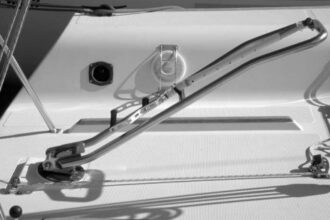
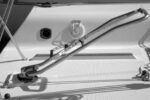
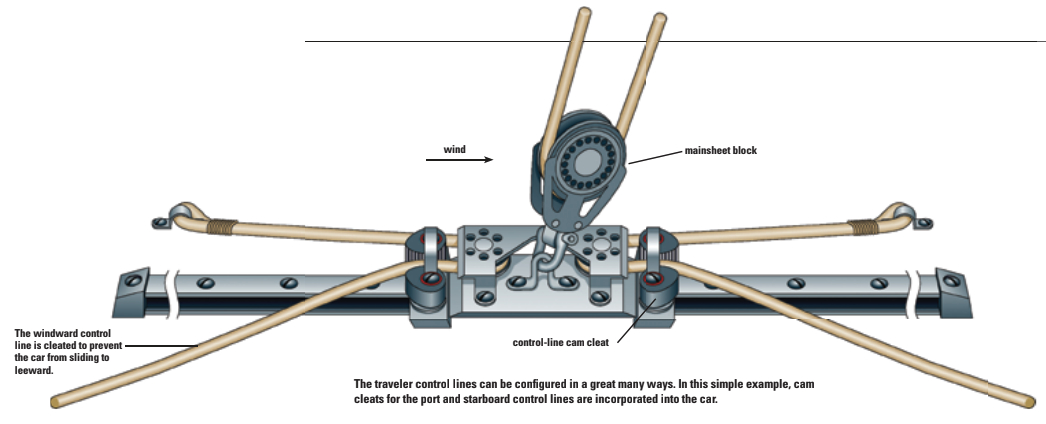
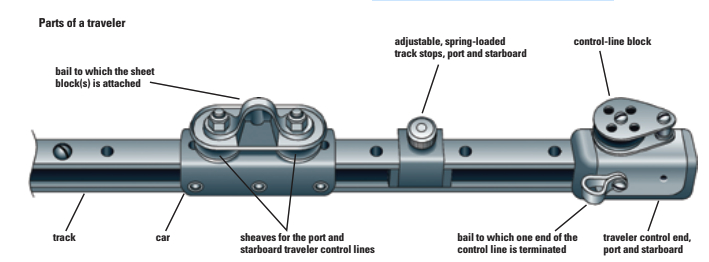
A traveler is a system in which a sheet block is attached to a car that runs along a track. The car’s position can be adjusted, thereby providing a means to fine-tune the shape of the mainsail. A traveler is indispensable to the racing sailor and is also very useful to the cruising sailor who appreciates proper sail shape.
Travelers may be used on jibs and foresails but are seen most often on mainsails.
Travelers and twist
Both the traveler and the mainsheet control the position of the boom and the amount of twist in the mainsail, but the sail responds differently to these two controls.
On a beat or close reach, where the boom is well inboard, adjusting the mainsheet will always change both the horizontal and the vertical position of the boom end. Thus, easing the mainsheet will always reduce the angle of attack of the sail and also increase sail twist (see “Doing the twist” on page 20). The mainsail responds differently to the traveler. Easing the traveler will allow the boom to fall off to leeward, but the boom end will not rise, so the angle of attack of the sail will be reduced, but the twist will not increase.
The traveler can also be used to increase twist in the sail without changing its angle of attack. In light air, the traveler can be hauled more to windward while the mainsheet is eased. When the controls are used together in this way, the boom’s horizontal angle is held constant but its end is allowed to rise, increasing twist.
Usually, less twist is desired in the mainsail in heavier air. As the wind gets stronger, the traveler is eased more and more to leeward and the mainsheet tightened a corresponding amount. This effectively decreases the angle of attack and also decreases twist as the pull of the mainsheet becomes more vertical. This is the opposite of what happens if a mainsheet is used with no traveler.
When beating to windward, the car should be readjusted on each change of tack.

Traveler technology
Early travelers consisted of a simple T-shaped track with moveable stops, port and starboard, and a car with no ball bearings. These systems were inefficient because the car tended to bind under load and could not be moved easily.
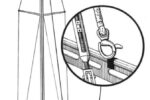
In modern traveler systems, the car is adjusted athwartships by lines that can pull it to port or starboard. These lines are typically secured with cam cleats. Ball bearings in the car allow it to run smoothly along the track even under high tension. On small-boat travelers, these bearings are usually made of black or white Delrin. On large boats, where the loads are very high, the bearings in the cars are generally made of Torlon, which is greenish-brown.
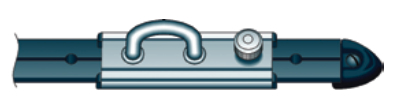
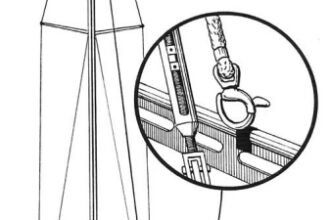
Traveler tracks are manufactured in a variety of cross sections and each type and size of track must be matched with a specifically designed traveler car. The most common tracks come in T-, X-, or I-beam cross sections. The top of the cross section, which bears the upward load, must be sturdily constructed and, since the load on the track can be very heavy, the track must be strongly bolted in place with a backing plate to distribute the stress.
Tracks attached to the deck can be custom-bent to the shape of the deck contour; they may also be on bridges that span gaps or other deck gear.
A long traveler track allows the boom to be pulled down hard to remove twist even when it’s quite far off center. The same length track used with a mid-boom mainsheet results in a greater range of control than one on an end-boom mainsheet. However, the mid-boom location also means the sheet, traveler, and boom will be more heavily loaded and more power will be required to trim the sail. The location of the sheet on the boom ultimately depends on the boat’s design and purpose and can be anywhere from forward of the companionway to the end of the boom.
Traveler maintenance
Travelers with ball-bearing cars should never be sprayed with a lubricant. This can cause the ball bearings to slide instead of roll and they will wear unevenly. Some lubricants will attract dirt and dust and accelerate the deterioration of the ball bearings. Instead, the traveler track and car should be flushed frequently with fresh water, especially in a saltwater environment. It’s also a good idea to occasionally squirt a solution of water and detergent into the car, run it back and forth on the track to distribute the solution, then flush it with fresh water.
If the car doesn’t run smoothly on the track, inspect the track for corrosion. If the track doesn’t show corrosion, it probably needs a good soap and freshwater cleaning.
Don Launer, a Good Old Boat contributing editor, has held a USCG captain’s license for more than 20 years and has sailed the East Coast from Canada to the Caribbean. His newest book is The Galley: How Things Work.
Thank you to Sailrite Enterprises, Inc., for providing free access to back issues of Good Old Boat through intellectual property rights. Sailrite.com