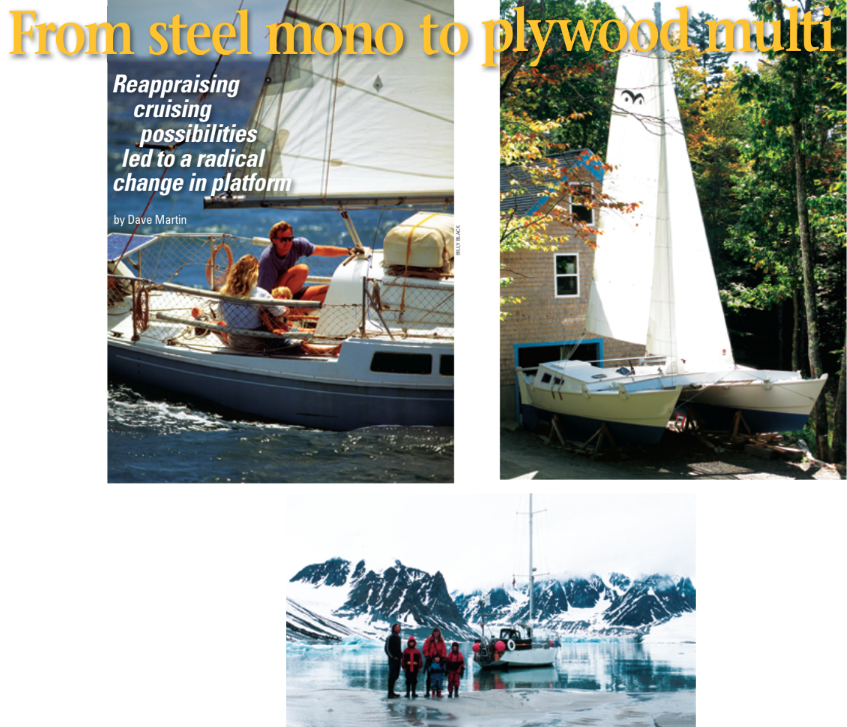
Reappraising cruising possibilities led to a radical change in platform
Issue 70 : Jan/Feb 2010
In this, the first of two articles, Dave Martin examines the reasoning behind his choosing a multihull as his next boat, his rationale for building it at home, and how he selected the design.
I n the summer of 2008, I converted our garage into a boat shop and began building a 30-foot James Wharram-designed catamaran out of plywood and epoxy.
The impetus for this project came when a slew of catamarans and trimarans sailed, as if on cue, into our local harbor in Maine. Their arrival in Round Pond Harbor rekindled my dormant interest in unique-looking craft and inspired me to research designs and play the “what if?” game. The decision to build a boat from scratch evolved slowly. But the process of actually getting from first thought to first cut tested my patience and threatened to smother the enthusiasm that inspired the idea in the first place.
Why the radical switch from Driver, our 9-ton, 33-foot steel sloop, to a lightweight wooden craft? For starters, I had begun feeling a tad bored with Driver. I’ve never sailed a safer boat, but her overfed, stately gait no longer gave me a thrill. Predictability is a fine attribute in any boat but, for me, as I race through my 40s toward that line marking 50, I realized that predictability was unsettling. Call it a mid-life crisis. I was hankering for a new challenge.
A different adventure
The concept of a catamaran with a large open deck floating upon slim, shoal-draft hulls put me in a tropical state of mind. Conversely, Driver represented storms, ice in the rigging, and northern lights. Contemplating a new boat for a different sort of adventure gave me that kid-like tremor of excitement that took me back to my childhood and the fleet of homemade model boats I launched in succession each summer on Seattle’s Lake Washington.
The mental transition from tortoise to cat was initially difficult, since catamarans defy everything I have always believed a boat should be: bulletproof, the proverbial oak-barrel-over-Niagara Falls kind of tough; a vessel that could be slammed by wind and waves of any dimension and survive right side up. Once I accepted the parameters and limitations of the catamaran form, I began my long journey researching catamaran designs, reading personal accounts and, finally, preparing my sales pitch to my wife, Jaja.
Multihulls are fascinating craft. It’s puzzling why any seafarer would sail a boat that only achieves ultimate stability when upside down. (My childhood models reinforced this concept repeatedly.) But many of the innovations we take for granted involve an element of risk. Bicycles are most stable lying on their sides. We imagine that the yellow stripe down the center of the highway will protect our car from oncoming traffic. And there are people who will gladly jump out of airplanes, trusting that the aerodynamic scraps of nylon material strapped to their backs will open up and do their job.
Within any realm there is risk, but there is always a window of safety built in. Jaja (who has skydived) was slightly skeptical about catamarans but open to further discussion.
The sales pitch
At the dinner table, I exalted the advantages of multihulls. Compared to monohulls, they are difficult to sink. A monohull has tons of weight — ballast — bolted to its hull that is continually trying to drag the boat to the bottom of the sea. The slightest hole can lead to catastrophe; life rafts are carried aboard for this reason. On the other hand, the unballasted multihull structure is inert and, with the addition of a few watertight collision chambers, the craft will float high even with a gaping hole in it. The odds are that only one hull will be damaged in a collision. If the cat should flip over, it’s possible to live in the inverted hulls, a scenario that seems better than bobbing around in a rubber life raft.
In one of the key conversations behind accepting the idea of a catamaran, we contemplated our immediate sailing plans. Where were we planning to sail in the next five years? Did we really need a storm-proof monohull? As our kids grow older and head toward high school and college, it has become important for us to stay closer to home. Heading off to the far corners of the earth is not a consideration right now. Coastal sailing is our venue; summer vacations and perhaps a winter dash down to the Bahamas while home-schooling Teiga, our youngest child. Driver is much more boat than we need for these plans. Besides, a catamaran with two feet of draft would be a perfect boat for the shallow banks of the Bahamas or the many shoal harbors in our home waters of Maine.
We put Driver on the market and sold her to a fellow from New Hampshire.
Scaling down the dream
When we first began dreaming about a house, six years ago, we let our imaginations run wild. We sketched a design that had 20 rooms, a 60- x 40-foot outdoor heated swimming pool, and a curved glass roof. It didn’t take long to figure out the cost of those dreams. We scaled our plans down to a 1,900-square-foot structure with an outdoor shower and 11 skylights.
Choosing a boat design and length presented many parallels to our choice of house design. We started big and pared it down. For me, this is more productive than starting small and wishing the boat could be bigger. When I allow myself to fantasize ownership of a monstrous boat, even though I would never be able to afford it, I temporarily get over the envy divide and take a critical look at the ramifications. Big boat: big systems, big failures, big headaches. Of course, big boats have big spaces, plenty of storage, faster speeds, and extreme levels of creature comfort. Money does not buy happiness but it does allow one to be seasick in finer surroundings.
Based on a consensus of prominent multihull cruisers and professional skippers (see the sidebar, “Resources”), it is generally accepted that a 45-foot catamaran is the minimum size to safely battle open ocean storms in the temperate zones and provide the overall comfort required to achieve a cruiser’s nirvana — whatever that is.
But something of 45 feet (or larger) is an expensive boat. Catamarans need two of almost everything: two hulls, double the hatches, twice the wire and lights. All that equates to nearly twice the cost for labor. Big cats need twin engines in order to have any maneuverability under power. Maintaining one engine is a nightmare. Imagine maintaining two: two fuel tanks, two filters, two intake strainers, twice the oil, twice the fuel. And, I wondered, “Where am I supposed to park one of these beasts?” Boatyards and marinas charge by width as well as length. Safe or not, a 45-foot cat was out of our league.
From my research, I also concluded that even the big cats run into problems during storms while there are plenty of small cats that have survived horrific conditions.
Narrowing it down
My criteria for the project were simple. I wanted to build the boat myself out of wood. By using my garage as a workshop, I could bypass paying rent somewhere else and eliminate a commute. Also, I wanted a cat that could be powered by a single outboard engine. That put the boat in the 30- to 32-foot range. Under 30 feet, catamaran hulls become too narrow for a double berth, and they are less able to accommodate an excess of provisions and extra gear. Lastly, I wanted a boat I could put on a trailer and park in my driveway to avoid hiring trucking companies and paying boatyard fees. All these particulars added up to a smaller boat being the better choice.
In any project, money is a consideration. Our goal was to keep the price under $30,000. In catamaran-speak, this is peanuts. Maybe this is partly because of the trend yachting is taking these days. Advertisers would have us believe that for a boat to have any intrinsic value and for it to have the level of comfort we deserve, it must have the best of everything on board. I wanted to oppose this idea and build an inexpensive, structurally sound craft, a boat that represented economy on all levels: a camping trip on the water . . . a return to basics.
Jaja and I were after the thrill of sailing, not the thrill of a finely appointed interior with shiny brass cabin lights, a wine rack, wool-blend cushions, pressurized hot water, and an electric flush toilet. I don’t mean to belittle a cozy interior. In fact, there us nothing as pleasing as an aesthetically proportioned and well-fitted-out boat. We had that on Driver, and we enjoyed it.
For several months, I would awake pumped up and excited contemplating the catamaran idea, only to end the day on an uncertain note. Isn’t simplicity merely subjective? Was our desire for boating purgatory a counterpoint for too much easy living in our spacious home? Why not continue to enjoy some boating luxury like we had on Driver? On the other hand, why not do with even less? Why not build a couple of kayaks and call it even? Or get a dry suit and swim? Now that would be basic.
Which design to choose?
I scoured the web for designs. Then I started to vacillate and began looking at monohulls. Once again, I found myself trying to justify a larger boat that was suited for world voyaging in case we decided to set out long-distance one day. Or perhaps we should build a 45-foot cat and just deal with it. Perhaps we should have kept Driver in mothballs in case we wanted to go high-latitude cruising again.
In the end, I remembered that, when we set off around the world on our 25-foot Direction, we were told the boat was too small. During our circumnavigation, I found that it wasn’t the physical boat that dictated the overall safety of the voyage; it was often the decisions and competence of the crew. Understanding the limitations of a small boat is imperative. With that in mind, I figured that 30 feet of boat would be perfect.
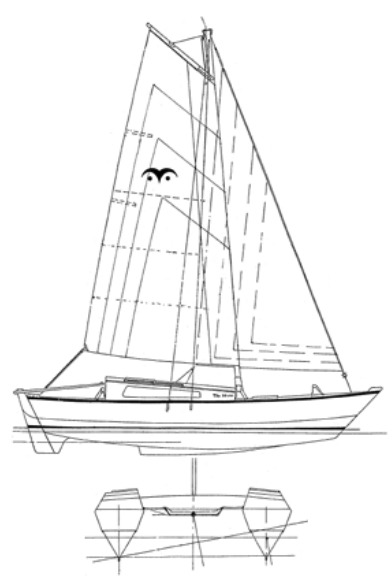
Throughout all this turmoil, I kept returning to the James Wharram website. His catamarans have been around for 50 years. Over the decades, I have seen his boats in every corner of the globe. The 30-foot Tiki design, the largest that is trailerable, seemed to be the answer to my wishes even though it mutinied against my visceral impulses. The critical difference between Jim Wharram’s boats versus almost any other catamaran built is that the beams that connect the hulls are either lashed on with rope or mechanically fastened. This means the boat can be built at home, then transported to the coast on a trailer. After a few hours of assembly, you’re ready for a season of sailing.
Most other cats are fabricated as a single solid unit. If built at home, this means transporting a very wide boat to the coast. It also requires a huge workspace. While it is possible to build all the separate components of a fixed catamaran at home in a small shop miles from the coast, a workspace near the water is still necessary for hundreds of hours of final assembly.
By comparison, the Tiki 30 can be disassembled, loaded onto a legal-width trailer, and towed behind a car. Once launched, the hulls are positioned and the cross-beams are fastened in place. Jim Wharram’s philosophy embraces building all parts of the boat from scratch to avoid the purchase of expensive fittings. This helps keeps the price low and produces a feeling of satisfaction with the finished product. I was hooked.
Accepting the decision
When planning an offshore passage, it is always a scramble to get prepared. In fact, it can be difficult to remain focused on the coming adventure. Lines are eventually cast off and the boat heads for the open horizon. The unknown is all that lies ahead. For me, there is always a moment, as the land fades away, when doubts creep into my psyche. I have to take a deep breath and reassure myself that, yes, this is a good idea. I am prepared. Similar feelings washed over me when I pushed the “Buy” button for the Tiki 30 plans. There was no turning back now. Anyway, this was going to be fun.
In part two, Dave will discuss choosing tools, the advantages of plywood (versus fiberglass) construction for the homebuilder, interpreting study plans and building plans, calculating costs, and equipping a garage for boat construction.
Dave Martin is a contributing editor with Good Old Boat. He and his wife, Jaja, live in Bremen, Maine in their self-built solar-electric house. To learn more about the Martins and their book, Into the Light, and their DVD, Ice Blink, visit their website. An audio version of the book is available.
Thank you to Sailrite Enterprises, Inc., for providing free access to back issues of Good Old Boat through intellectual property rights. Sailrite.com