Ferrari or Maserati of the water
Issue 50 : Sept/Oct 2006
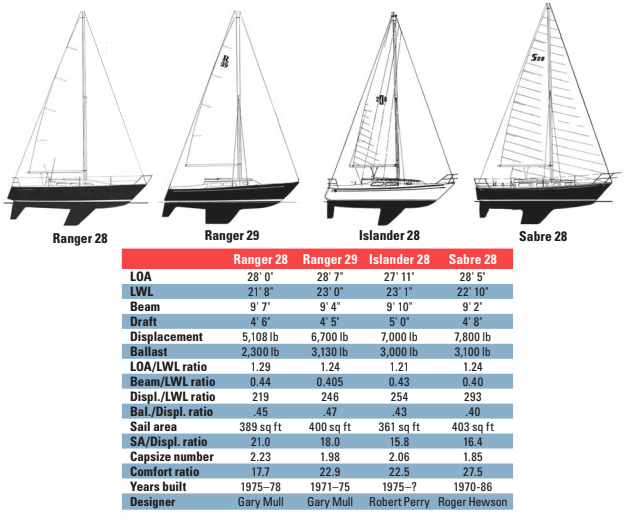
Because the Ranger 28 followed closely on the heels of Gary Mull’s very successful Ranger 29 design, it seems obvious that Ranger Yachts told the designer to come up with a more competitive yacht for International Offshore Rule (IOR) racing. The newer design with its diamond-shaped deck plan and narrow stern appears to be much more IOR-oriented than the 29, and the 28’s hull has the substantial tumblehome that was another feature common to the IOR yachts of that period. Although the draft is only an inch deeper than its earlier sister, the 28 has almost 25 percent less displacement, which makes its hull have a much shallower draft. The result is that the fin itself is consider- ably more than 1 inch longer from hull to tip. It is also much shorter fore and aft, with a considerably higher aspect ratio as a result. That will increase efficiency as it reduces wetted area, and performance will be substantially enhanced.
The 28’s sail area/displacement ratio of 21 is unusually high, and its displacement/LWL ratio is very low compared to other yachts of its size and era. And, despite displacing 1,600 to 1,700 pounds less than the other fine yachts in this comparison, the 28 still carries a substantial 45 percent ballast ratio. If we equate these two Rangers to automobiles, I would say that the 29 is a sporty, fast convertible and the 28 is a Ferrari. In saying this, I have to advise that I’ve seen a review of the 28 on the web in which an owner claims that the 28’s draft was later increased to 5 feet, its displacement to 6,000 pounds, and its ballast to 2,980 pounds. If true, that would increase the displacement/LWL ratio to 263.5 and the ballast ratio to a very high 50 percent and lower the sail area/displacement ratio to a still generous 18.8. In that case, I’d have to revise my opinion of the 28 from a Ferrari to, perhaps, a Maserati!
Like a Ferrari or Maserati, the 28 has its shortcomings. Obviously, on a racing machine, creature comforts have to give way to performance, but the 28’s meager 5-foot 10-inch headroom is low by even 1970s standards, and the accommodations offer considerably less space, comfort, and stowage than its 29-foot sister. Indeed, neither of the Rangers comes close to providing the cruising comfort of the Sabre 28, while the even roomier Islander is the only one of the group that has a head that does not close off the passageway forward when in use. There is no doubt where Gary Mull set his priorities in the design of the 28. Its accent is definitely on performance.
Of course, if the displacement actually is 6,000 pounds, that lowers the 28’s capsize number to 2.11 and increases the comfort ratio slightly to a still corky 20.8. The capsize number remains well above the breakoff point of 2.0 though, and I could not recommend a yacht with that high a number for general ocean passagemaking. I will qualify this by saying that many less able craft have made major ocean voyages . . . just not with me aboard!
Gary Mull designed the 28 for racing. Buy one in good condition, and you’ll have a wonderful club racer. With an experienced crew, plus the safety net of committee boats and other competitors, it’d be a good boat for the serious distance racing skipper in Performance Handicap Racing Fleet (PHRF) or Midget Ocean Racing Club (MORC) classes. Of course, the other boats in this comparison are no slouches either. The heavier Islander and Sabre, with their lower sail area/displacement ratios, will not shine as well in light air but will come into their own when the breeze pipes up. The Ranger 29 appears to have the numbers to be an excellent all-round performer as well.
A friendly couple could spend a week or two aboard the 28 in reasonable comfort, but it is not the ideal yacht for family cruising. A Sabre or Islander 28 would be more suitable and might be a sanity saver. However, the person who buys a sports car instead of a station wagon would enjoy the 28 for daysailing and weekending, even if he or she is not a serious competitor. There’s nothing like the fun of sidling up to another yacht your size — and even larger — and blowing its socks off! Gary Mull’s Ranger 28 is one of the few 30-year-old yachts its size that can give you that satisfaction. Try it; it really is a hoot!
Thank you to Sailrite Enterprises, Inc., for providing free access to back issues of Good Old Boat through intellectual property rights. Sailrite.com