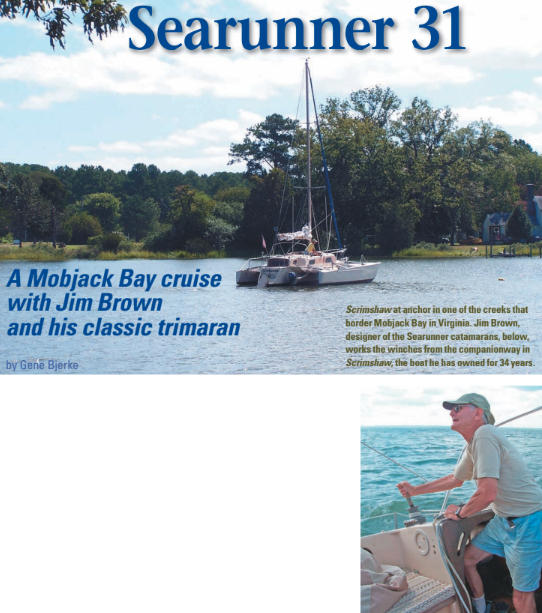
A Mobjack Bay cruise with Jim Brown and his classic trimaran
Issue 50 : Sept/Oct 2006
The end of World War II saw the flowering of a new type of sailboat . . . new to the American sailor at least. A number of designers in the United States and England took the new materials developed or perfected during the war: plywood, fiberglass, and polyester resin. They applied them to the concept of the ancient Polynesian boats and created the modern multihull. Among the pioneers was Jim Brown, who designed the successful Searunner series of cruising trimarans. Last summer I had a chance to sail with Jim on Scrimshaw, his personal Searunner 31, which allowed me not only to evaluate the boat but also to ask questions of its designer and builder.
Jim Brown was born in Ohio in 1933. When he was in his early 20s, a scuba diving trip in the Caribbean sparked his interest in sailing and he wound up crewing on schooners during the wide-open, barnstorming days of the early charter trade. This is when he chose the cruising lifestyle. Eventually he made his way to the San Francisco Bay area, where he associated himself with Arthur Piver, a pioneer in the design and construction of cruising multihulls. After about five years with Arthur, he began designing trimarans himself. Those days saw a strong interest in such vessels (mainly due to Arthur’s marketing skills), and he was often barely able to put out drawings fast enough to keep ahead of his builder-clients.
In 1965 or so Jim designed a boat for his own use. What he wanted was a trimaran that could carry a family of four on extended cruises. It had to provide some separation of sleeping areas for privacy. The result was the Searunner 31.
Scrimshaw was built in 1972 in a redwood canyon in Northern California, far from the water, so it had to be demountable for transport (though not trailerable as such). When the main components were completed, it was hauled in three pieces on a flatbed truck. It was assembled and completed in Santa Cruz. The amas (outrigger hulls) are attached to the main hull by aluminum A-frame trusses, bolted to main-strength bulkheads.
After launching, Jim took off on extended cruise with his wife, Jo Anna, and two preteen sons. They sailed down the West Coast, through the Panama Canal, and three years later came ashore in southeastern Virginia, where Jim continued to design multihulls. (One of his protégés is multihull designer Chris White.) Though they were now land-based, they cruised the boat extensively from Nova Scotia to Cuba. Once the boys grew up, the boat evolved into a husband-and-wife coastal cruiser. He traveled to Africa and the Pacific for United Nations-sponsored projects, for which he endeavored to teach local fishermen how to build inexpensive boats.
Jim and Jo Anna, a retired school teacher, still live on a quiet river in Virginia. He has continued to design boats, sometimes in cooperation with other multihull designers. His most recent project is the WindRider series of daysailing trimarans. However, his designs are basically handled by his long- time business partner, John Marples. Jim’s main project now is something he calls “the Outrig Project,” in which he hopes to assemble extensive material on the history of the modern multihull since World War II before everyone who remembers it is gone.
Design and construction
To date, about 1,500 Searunner plans (all sizes) have been sold. There is no way to know how many have actually been built. The Searunner Owners List online lists 104 Searunners, of which 37 are Searunner 31s.
An important aspect of the Searunner design was an ability to go to windward in heavy weather. The way Jim accomplished this was to give the boat a deep centerboard: 5 feet 9 inches, board down. But the trunk for such a board would take up too much room in the cabin of a narrow trimaran hull. Jim’s solution was to place the cockpit amidships on top of the centerboard trunk. The center cockpit not only allowed him to brace the trunk very solidly, it also gave the helmsperson an unobstructed view forward and separated the accommodations below. With a relatively wide transom, there’s room for a dinette aft.
Multihulls in the early days were often built by amateurs (or by professionals on a one-off basis). Thus, another requirement was straightforward construction with readily available materials, primarily plywood and fiberglass.
In profile, Searunners are recognizable by a flat sheer topped by a long, flat cabintop that takes up most of the center of the boat. The center cockpit is just abaft the mast. Jim calls the aft cabin the “sterncastle” and the forward cabin the “forecastle.” As is typical of trimarans, the main hull is narrow at the waterline, to reduce wetted surface area, but the accommodations — mainly in the form of berths — extend out-board over the water in short “wings” to increase interior volume. The rest of the space between the main hull (vaka in Polynesian parlance) and amas is open, with netting to keep things from falling through. Searunners larger than 31 feet have solid wings.
On deck
It’s best to board a trimaran — either from a dinghy or the dock — amidships at an ama. On Scrimshaw you step off the ama onto a piece of light plywood lying on the netting and then up to a redwood-plank “running board.” Stepping over the coaming, you find yourself in a snug (4 feet long by 7 feet wide) cockpit. Companionways at either end of the cockpit lead to the forward and aft cabins. The mast is just in front of the cockpit, with the folding canvas dodger in between.
Access to the fore and stern decks is via the “running boards” on either side of the cabin. There are sturdy bow and stern pulpits made from aluminum pipe. These pulpits extend all the way to the cabintops, where they become handrails. This creates a secure enclosure around both decks. On the foredeck there is an aluminum Fortress anchor on a bow roller. The rodes store in a self-draining compartment. Abaft that is an acrylic hatch to the forepeak.
The afterdeck is much smaller. It contains a self-draining lazarette (where a stern anchor and its line can be stored). The outboard rails of the amas have gated rope lifelines, and the stanchions can do double duty as attachment points for headsail sheeting blocks and docklines.
Scrimshaw’s cockpit has a bulkhead-mounted compass on either side of the forward companionway hatch. The tiller is positioned low, just above the sole, and I found it very convenient to steer with one foot, leaving both hands free. If you want, it can be tilted up for use at normal height. Scrimshaw has an autopilot (Autohelm 2000) that stores in a recess under the starboard seat and swings out to engage the tiller at the level of the sole. The remote controls for the outboard motor also are located at the forward end of the same seat front, so most boat-handling operations can be carried out without leaving the cockpit.
There are two secondary winches mounted outboard of the cockpit coamings (for vangs, barber haulers, and spinnaker sheets). The cockpit drains through eight scuppers into a self-bailing sub deck a foot below the sole. This sub deck, which is sealed from the interior of the boat, is a useful place to store portable fuel tanks and such. Incidentally, the centerboard can be removed through the cockpit while the boat is afloat. Done correctly, you shouldn’t take on much more than about a quart of water.
Besides the dodger, Scrimshaw is equipped with a well-secured Bimini. The cockpit can be completely tented in, either with canvas or mosquito netting, to provide another sheltered area while at anchor or even underway. As Jim puts it, “You can go anywhere without getting wet, cooked, frozen, or bugged.”
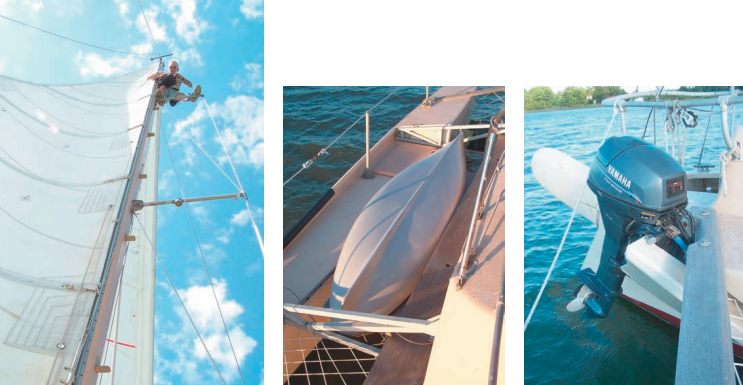
One of the advantages of a trimaran is the ability to carry a hard dinghy aboard and out of the way on the net between the main hull and an ama. Jim has been using a small kayak for a dinghy lately. Since the amas’ freeboard is relatively low, it’s easy to board the dinghy or the mother ship and to transfer supplies.
Belowdecks
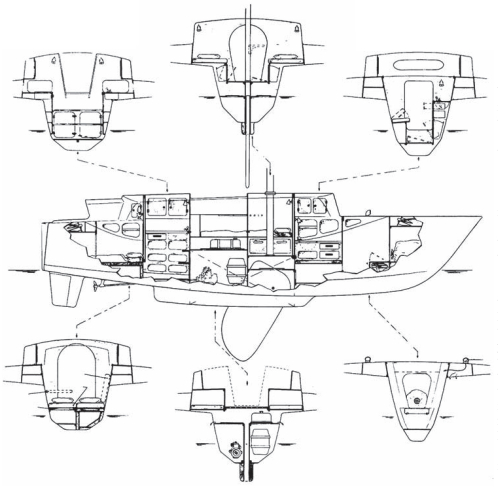
Trimarans have very narrow main hulls, which restrict living space (the amas are not used for accommodations). In Searunners, this space is divided into a number of discrete areas separated by bulkheads.
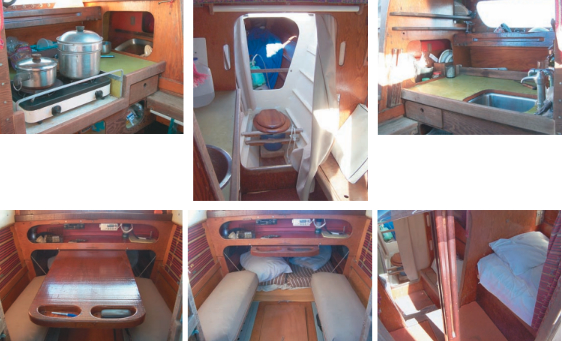
Abaft the center cockpit is the main living area. All the way aft, under the sterncastle, is the dinette with fore-and-aft settees and a table that slides out of the way under the afterdeck. The sole in this area is raised, and there is a built-in ice chest in the sole between the seats. For sleeping, the dinette seats are flipped up out of the way and the made-up mattress is slid out from under the afterdeck to form a cozy double.
Forward of this is a bulkhead beyond which the upper part of the hull widens out into the wing. This is where the galley is located, with full standing headroom (6 feet 2 inches). There is a counter with a sink to starboard. On Scrimshaw, there are both freshwater and saltwater pumps. To port is another counter with recessed two-burner propane stove. The galley has ample Formica-topped counter space, with storage areas below the counters and behind them and forward under the cockpit. There are large fixed ports on either side.
Forward of the galley is the cockpit, which is built over the centerboard trunk. This is the deepest part of the vessel and contains the largest storage area on either side of the trunk (which also puts the heaviest gear, especially the engine, if so equipped, in the center of the boat).
Forward of the cockpit is a sleeping cabin with two fixed portlights. Because the centerboard trunk continues through this cabin and the sole is on top of the trunk, there is only sitting headroom. There are single berths port and starboard. The afterhalf of each berth extends under the cockpit seats. The compression post for the mast sits on top of the forward end of the trunk.
Continuing forward is a “dressing room.” This is a small area, with full headroom. It has a counter with a sink to port and a bench to starboard. There is storage in the wings outboard of the counter and the bench. Light is provided by a wide, fixed port in the cabin front. So while the sleeping area may be somewhat cramped for anything other than sitting or sleeping, one step down and forward puts you in a more spacious area for dressing and cleaning up.
The head is forward, under the foredeck, with sail storage forward of that. Light in this area is provided by the hatch in the foredeck. Additional ventilation comes from round inspection ports on the hull sides. Jim advises capping these ports when sailing. On Scrimshaw, you can take a shower using a garden sprayer while sitting on the head’s seat cover. The epoxy-sealed sump is pumped out by hand with a bilge pump.
The rig
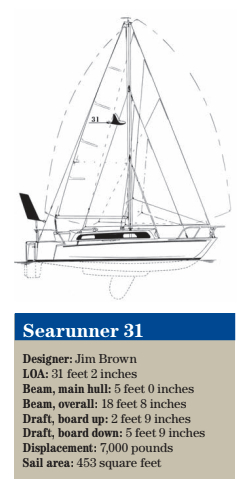
Searunners are rigged either as sloops or cutters. The difference is in the number of headsails; the mast is in the same place in each. All Searunners have a two-spreader, masthead rig. The shrouds attach to chainplates on the cabin sides, allowing the headsail to be trimmed outside the shrouds. The headstay sets a genoa on a roller, opposed by a split backstay. There is a running forestay from the upper spreaders for a staysail. This is supported by running backstays to the after A-frame (adjusted by Highfield levers). When a staysail is not set, the runners are normally released and secured at the shrouds, available for use in heavy weather. When the third reef is tied in, the head of the sail is below the upper spreaders, with the leech below the runners. A baby stay from the lower spreaders completes the standing rigging.
The 35-foot aluminum mast is stepped on the cabintop in a tabernacle. The mast can be lowered forward using the boom as a gin pole, with the mainsheet taken to a winch (and appropriate guys to control the mast sideways as it comes down). Scrimshaw has simple mast steps all the way to the top.
The mainsail has full battens and three sets of reef points. The goose-neck is fixed — luff tension is adjusted with the halyard winch. There are lazyjacks to contain the sail as it comes down. These are eased off and stowed at the gooseneck when not needed. The 140-percent genoa can be reefed as well as furled.
Scrimshaw has a large, flat-headed spinnaker. One of the advantages of a wide vessel, such as a trimaran, is that the spinnaker does not need a pole. (There is a whisker pole that is sometimes used to boom out the genoa.) All sheets, as well as control lines for the kick-up rudder, lead to winches and cleats on the top of the aftercabin. The best place for the sheet trimmer is to stand in the aft companionway: supported up to the waist, clear of the helm, and with a good view of the sails. There are no travelers or fairlead tracks. In fair weather, sheets can be barber hauled or led through snatch blocks clipped to stanchion bases on the amas.
Under way
Scrimshaw is powered by a 9.9-hp, four-stroke Yamaha outboard motor hung in the afterend of the tunnel between the main hull and the starboard ama. The engine is mounted on the end of a long, narrow, box-like structure called a “sled.” The forward end pivots under the wing. The engine can be raised and lowered from the cockpit by a line leading to the top of the aftercabin. The bottom of the sled has a sharp dead rise to deflect any waves. There are remote controls for the engine in the cockpit. In calm weather, this engine will drive the boat at 7 knots when running light, 5.5 with full cruising load. When under sail, the engine can be lifted and tilted clear of the water.
It was blowing about 20 from the north the day we went sailing. We powered down the river from Jim’s house and set full sail as we approached Mobjack Bay. I took the tiller as we sailed down the relatively smooth waters of the bay. The boat responded well with a good feel to the helm, but I was surprised that she heeled more than I expected from a trimaran (maybe 10 degrees). Jim explained that was because she was running light. When loaded for cruising she heels much less.
After a couple of miles, Jim set the autopilot, and we spent most of the rest of the day letting “Iron Mike” steer the boat. Scrimshaw is set up for singlehanding. The skipper can stand in the companionway to handle sails and still be within easy reach of the autopilot controls.
The trip down Mobjack Bay was pleasant enough, but our goal was to run out into the Chesapeake and play in the bigger waves. The trimaran easily sliced through the 4-foot waves, occasionally throwing spray, but the ride in the cockpit (at the center of gyration) was relatively smooth and quite dry. Speeds to windward averaged around 7 knots, which seemed a bit slow to me. Jim pointed out that Searunners are designed for long-distance cruising, not racing. A flat-out racing tri would be going twice as fast in the same conditions, but would not be nearly as comfortable. And the average monohull of the same length would probably have made no more than about 5 knots. A 2-knot difference is more than it seems: a 40-percent increase!
Scrimshaw tacked easily. I had a hard time trying to calculate the angles, but later, in easier water, she tacked through about 90 to 100 degrees.
After a day of sailing, we pulled into one of the creeks that border Mobjack Bay and put down the anchor for the night. Scrimshaw’s anchor has a boat-length of chain and two nylon rodes. The rodes pass through snatch blocks on the inboard sides of the ama bows before belaying to the cleats on the edge of the foredeck. This arrangement accomplishes two things: there is no chafe anywhere on the anchor line and lying to a wide bridle keeps the boat from sailing at anchor. We lay perfectly still all night.
Summing up
The five Searunner models, ranging in length from 25 to 40 feet, were never production boats. All Searunners were built one at a time to plans drawn by Jim Brown. Thus, there will be variations in details between individual boats. Jim has sailed Scrimshaw for 34 years and has honed this boat to his particular needs. That said, all Searunners share a common design philosophy, so most of the comments in this review about Scrimshaw should apply to any Searunner 31 you may run across.
When evaluating a used Searunner, keep in mind that these boats were built of plywood covered on the outside with fiberglass. In older boats, assess the bond between the glass and the wood for delamination (tapping with a finger will tell you a lot). Boats built after about 1970 probably used epoxy, which is a more powerful adhesive than less expensive polyester resin, to bond the fiberglass.
The disadvantage of a wooden boat is that it is subject to rot. Rotten sections can be replaced, but it may be difficult work. A well-built Searunner should not require much more maintenance than a boat of any other material.
Searunners were designed for strength rather than speed (though any properly sailed Searunner should outrun most similar-sized monohulls). They have made circumnavigations as well as extensive coastal cruises. The design divides the accommodations into smaller pieces than you might be used to, but they can be cozily comfortable and still provide some privacy for a family or two couples cruising together.
Searunners for sale are hard to find. The ones I found ran in the $40,000 to $50,000 range. It would appear that Searunner owners are happy with their boats.
Thank you to Sailrite Enterprises, Inc., for providing free access to back issues of Good Old Boat through intellectual property rights. Sailrite.com