An honestly biased look at a much-revered racer/cruiser
Issue 22 : Jan/Feb 2002

Lest there be any confusion about where I’m coming from, I think that, despite her age, the Cal 40 is as legitimate a “performance cruiser” today as she was when launched more than three decades ago. I don’t care that she is not a floating condominium designed for dockside entertaining, that her main saloon is not outfitted with an entertainment center, or that her galley does not have a microwave.
Not that I’m averse to speed and comfort, mind you.
Speed? She’s legendary for surfing to 20 to 25 knots during passages between California and Hawaii. For the record, this Bill Lapworth design is the winningest ocean-racing-class boat of all time.
Comfort? The cockpit is large enough to seat eight NFL linemen. Spaces belowdecks are large enough to cook three-course meals for the crew. Settees are long and wide. She will sleep eight in comfort, not that she needs a crew that large to produce fast passages. And there’s enough wood joinery to create a warm, nautical environment.
I warned you: I like this boat.
Design
Like many boats produced during an evolutionary period in the 1960s, the Cal 40 has an interesting pedigree. Her design commission originated in 1963 with George Griffith, an avid racer in Southern California who completed his first Los Angeles-to-Hawaii race in 1941 at age 20.
“I owned a Lapworth 36 at the time and wanted to build a faster boat. I felt that designing a more powerful midsection and increasing sail area would improve downwind performance, so approached Bill about the project,” George says.
The fifth in a line of Cal designs conceived by Bill Lapworth, the 40 is an evolutionary shape. Her hull shape was described by contemporaries as symmetrical with a moderately narrow stern and full bow.
“Design aspects that set her apart from her contemporaries were lighter displacement, a long waterline, moderate deadrise, a fin keel, and a spade rudder,” Bill says. A nearly flat bottom produces a powerful hull with a generous waterline beam that allows her to surf when sailing downwind. A byproduct of the flat bottom is that she pounds when going to weather, a condition offset by reducing speed or footing off. Though the full bow detracts slightly from light-air performance, she’s light enough in the ends to lift.
Bill Lapworth made history by designing a deep, high-aspect ratio, balanced spade rudder that delays stalling while producing lift with low drag. The shape is fairly broad at the top and fits close to the hull, which acts as an end plate to reduce turbulence. He is generally considered by peers to have been one of the few designers who could design a functional spade rudder.
Retrofitting rudders
Many current owners, however, especially those preparing for extended bluewater passages, have retrofitted Carl Schumacher-designed rudders that reduce loads when sailing downwind in a blow (see sidebar on Page 48).
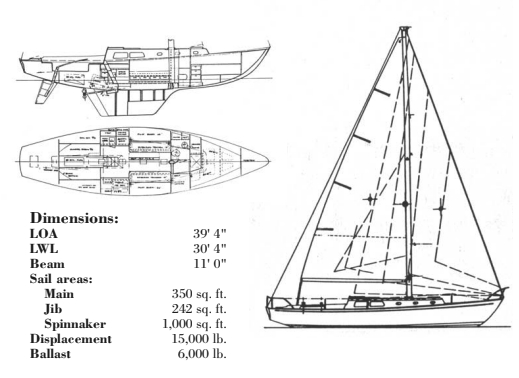
Since the coachroof is only 16 inches high, the Cal 40 has a pleasingly low profile. She carries a moderate sail plan with a medium-aspect ratio characterized by a longfooted main that balances a spinnaker when running. Her sail area/displacement ratio is 18.3, so she’s significantly lighter than what then was the Cruising Club of America’s target of 15.4 for sloops. Compared to boats of her generation, she is light; the displacement/length ratio is 242 — now considered average, but revolutionary in the 1960s. With a Performance Handicap Racing Fleet (PHRF) rating of between 108 and 120, she’s a rocket when compared to boats of her vintage. The Columbia 40, for instance, which rated 170, had a 27-foot waterline and displaced 20,000 pounds.
Now 82, Bill Lapworth says, “The Cal 40 received a lot of attention, and is one of my favorites.”
Eventually, with completed blueprints in hand, George Griffith began seeking a builder. “I first went to Kettenburg, in San Diego, and he threw me out of his office. Lester Stone, in San Francisco, told me he’d build the boat, but I wouldn’t like it or the price. Stevens Brothers, in Stockton, told me the same thing.”
Jack Jensen, of Jensen Marine, attempted to dissuade George Griffith from pursuing the project but, when he committed to buying 10 boats, Jensen Marine assumed the task.
Overall honors
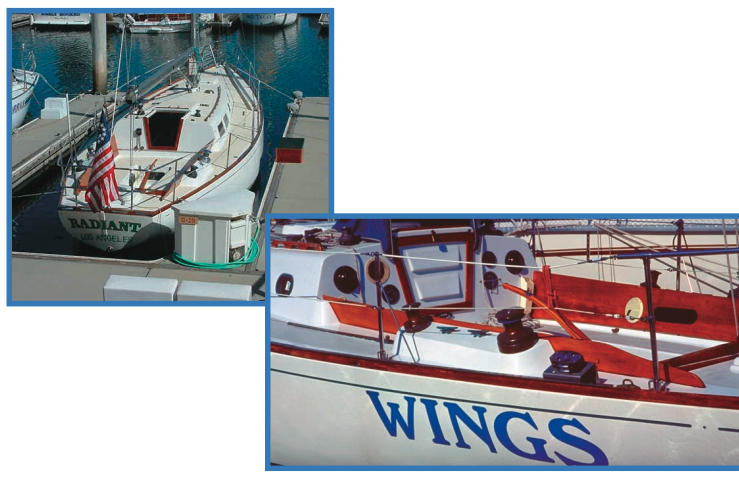
George took delivery of hull #1, Persephone, and the following year, hull #2, Jack Jensen’s Conquistador, took overall honors in the 1964 Southern Ocean Racing Conference (SORC). That victory was the first of a series of successes that included Ted Turner’s first-place finish aboard Vamp in the 1966 SORC. The boats collected three consecutive first-place finishes in the Transpac between 1965 and 1967, and they were still winning ocean races in the 1990s.
Jensen Marine produced more than 160 Cal 40s. Like many independent builders who became takeover targets, Jensen Marine eventually became Bangor Punta, which became Siegler Marine, Starcraft Sailboat Products, and, finally, just plain Cal Boats. It ceased operation in 1989.
One of the first boats constructed of fiberglass, the Cal 40 played an important role in establishing laminates as a legitimate construction material.

Deck Layout
Step onto the stern platform of this 40–footer and you face a long, lean cockpit. Since she’s tiller-driven, there is little visual clutter to obstruct the view forward or to interfere with movement fore and aft. At the dock, crew and guests can lounge comfortably on eight-foot-long cockpit seats. The afterdeck is 38 inches wide, an ideal location for lazing on a folding chair with a good book.
Winch islands are aft of the helmsman, who stands at a tiller, remember, and within easy reach of crew who can easily tend sheets and guys without interfering with the helmsmen. Sail controls also are close enough to the helm for singlehanding.
The cockpit has no lazarettes. However, a storage area below is accessed via a hatch on the stern, the perimeter of which houses cords that hold sheets, guys, and fenders.
The single-spreader mast-head rig and standing rigging are typical of the era. The mast is stepped to a fitting at the level of the cabin sole, and three shrouds are outboard. Interestingly, the forward lower shroud is positioned 30 inches in front of the mid shroud; many owners disconnect it from the turnbuckle and pin it inboard to allow for better sheeting angles on headsails
when sailing to weather. Standing rigging deadends at chainplates that are solidly secured to a transverse bulkhead tied into a heavy section in the bilges. Since decks are 20 inches wide, the bowperson need not be an acrobat to move forward in a blow.
Headsails may be led inboard on a 46-inch long track or outboard on a track that runs from the stern pulpit to the shrouds.
Accommodations
One owner describes the Cal 40 as “just not a liveaboard.” Another has cruised the South Pacific with his wife, in comfort. So, we now know why Ben and Jerry make both chocolate and vanilla.
My test boat was Wings, which belongs to a trio of active sailors: Christian Pittack and Annie Fitzpatrick, Bob and Kathy Peters, and Steve and Kathy Jacobsen.
Though she was built ages before the major production manufacturers managed to create interiors that look like Park Avenue apartments, she’s as spacious and well laid out as any similarly sized boat. And she’ll never be compared to the stripped-out racers on the IMS circuit. A crew of six could sail comfortably to Hawaii, as could a crew of 10, since at least two crewmembers will always be on watch.
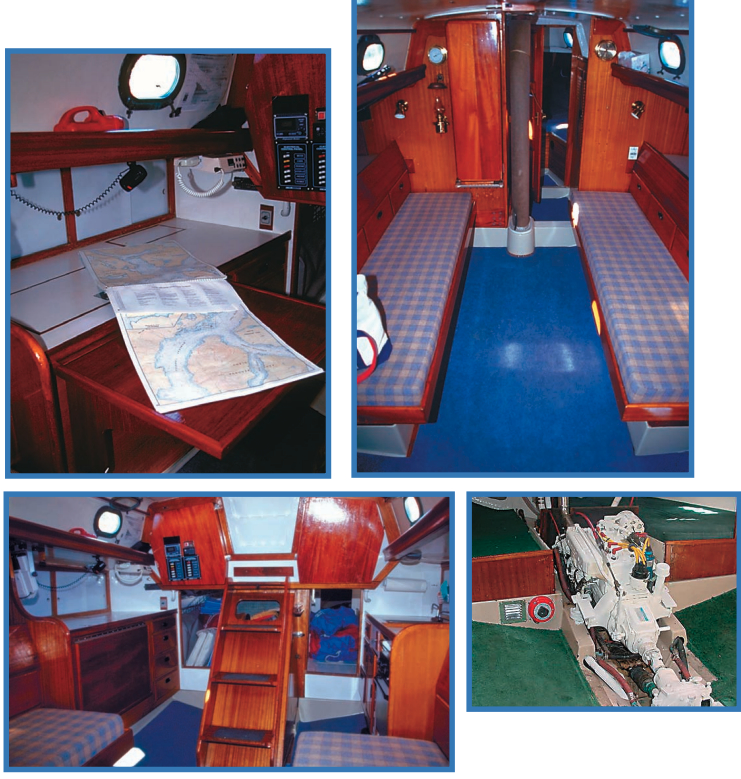
The centerpiece belowdecks is a wide-open saloon that’s more than 10 feet long on the centerline and six feet wide between settees. It’s a bit small for square dancing, but six crew members can move about without rubbing elbows.
The galley, located to port at the foot of the companionway ladder, runs forward along the hull. Some galley slaves complain that this makes cooking difficult in a seaway on a port tack since they are leaning backward. However, if you’re leaning to leeward while cooking, what difference does it make as long as you have a safety belt?
Reflecting the boat’s pedigree, however, the galley is a rather Spartan affair consisting of a stove, sink, large countertop, and several storage cabinets and doors. The icebox, located to starboard in the nav station, is notorious for having inadequate insulation. Serious cruisers will find it necessary to install new insulation or become acclimated to drinking tepid beer.
Second-class
Unless conditioned to working while standing facing outboard, the navigator aboard a Cal 40 will feel like a second-class citizen. The chart table is large enough to roll out a full-sized chart, and space is available for the installation of instruments. However, I’d prefer to work facing forward on a seat.
Berths are located in the stern, amidships, and in the bow. The port and starboard quarterberths are so large they are commonly referred to as “torpedo tubes.” Berths are 6 feet 4 inches long and 22 inches wide and have 30 inches of headroom, so it is possible to read comfortably in an upright position. A hazard is that the spaces could easily become as cluttered as Fibber McGee’s closet. Storage outboard of the berths is 24 inches wide, 30 inches tall, and runs the length of the berth. On Wings, the space housed pots large enough to boil pounds of spaghetti and large baking pans. The only downside is that this will be a noisy spot when the diesel is running.
Space for four sleepers in the main saloon is on two settees and two weather berths. The shortest berth is 76 inches long and 26 inches wide, adequate for a typical adult. The skipper’s V-berth measures 72 inches on the centerline and is 74 inches wide.
Bill Lapworth faced an interesting challenge while attempting to keep the engine low without intruding into living spaces. Because the exit for the drive shaft is in a shallow section of the hull, he solved the problem by mounting the engine backward and installing a Wolter V drive. It works!
Construction
Considering that Jensen Marine built the Cal 40 during the infancy of the fiberglass building process, these 35-year-old-boats have maintained their structural integrity surprisingly well. Hulls and deck were handlaid of solid fiberglass. Wooden bulkheads and cabinetry tabbed to the hull acted as stiffeners and produced interior structures. Decks were reinforced with plywood in areas where hardware was installed.
However, well-used boats need careful inspection in several areas. Strips of fiberglass cloth and resin were used to secure cabinetry to the hull. It’s worth inspecting these laminations to assure the integrity of these bonds; many boats require reinforcing to prevent structural failure.
Similarly, the exterior of the hull at the keel bears close inspection. The ballast is an internal lead casting dropped into the keel before the insides were assembled. If it’s not properly repaired, a vessel that has been hard aground may have water inside the cavity. Repairs will be awkward.
A caution: wiring runs are virtually inaccessible behind the interior cabinets and, in some spots, low enough to be submerged if the bilges fill. Many owners have taken the precautionary step of re-running wires inside PVC.
Finally: pay close attention to water entering the bilge from the inside of the mast. Without a boot that contains the drips, water will collect on the cabin sole at the base of bulkheads which, eventually, will become waterlogged and spongy. A preventive coat of two-part paint at the bottom of the bulkhead might prevent the condition.
Despite the flat bottom, the bilge is five feet deep so the water tank is located on the centerline. Fuel is aft of the engine, and the holding tank is located under the V-berth.
Conclusion
Do not let the Cal 40’s racing pedigree taint your impression; she is the prototypical good old boat. Though a solid bluewater boat, she’s quick. She won’t compete with today’s light-displacement sleds, but she’ll record 200-mile days. She’s also become a cult boat.
Her cockpit is spacious and comfortable, just right for evenings spent on the hook with crew, a good book, and a toddy.
Wide-open spaces belowdecks can be converted to a dining area by lowering a table hinged to the bulkhead. Her settees are long, her berths comfortable. Cruisers will appreciate storage areas in the stern, in four large drawers below the pilot berths that stretch to the hull, and in the nav station.
In human terms, she’s reached middle age. In boat years, she’s still a filly.
Ed Lawrence writes about boats and off-beat subjects for several national magazines from his home base in Montana. Between boats right now, he’s in the market for a trailerable 28-30 footer, but we suspect he’d consider a Cal 40.
Thank you to Sailrite Enterprises, Inc., for providing free access to back issues of Good Old Boat through intellectual property rights. Sailrite.com