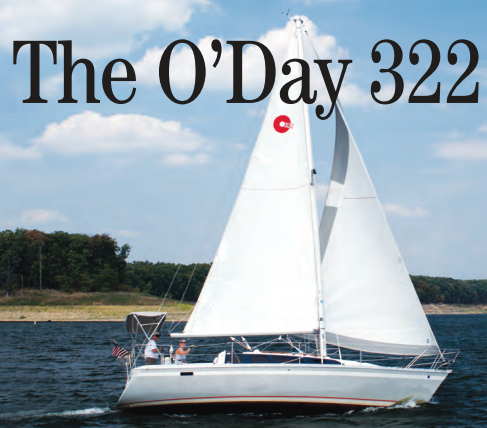
A spacious and comfortable wing-keel cruiser
Issue 93 : Nov/Dec 2013
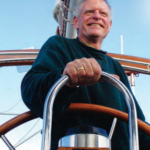
A certain connection draws some sailors back to favored nameplates. Such was the case for Jeff and Liz Fleenor. Jeff was a longtime sailor and owner of an O’Day 272 when he met Liz in the fall of 1995. Liz quickly fell in love, not only with Jeff but with sailing too. Circumstances caused Jeff to sell his O’Day 272 before he and Liz were married in 2000 but their shared intent was to return to sailing as soon as they were able. That time came in 2001 and the boat that drew them back was a 1989 O’Day 322 named Wild Goose.
Jeff and Liz journeyed to Kentucky Lake to give the boat a once-over and they were smitten from the moment they saw her. They had honeymooned under sail on a chartered boat at Kentucky Lake and it was somehow fitting that their dream was waiting for them there. With the purchase complete, they sailed Wild Goose north to be hauled and transported to Missouri’s Mark Twain Lake. That is where they welcomed us aboard in September of 2012 for this review. (To be honest about travel time, I’ll disclose that my wife, Sandy, and I had to step to the dock from our own boat and walk 40 feet to board Wild Goose.)
History
George O’Day, a native New Englander, was known for his Olympic gold medal in the 5.5 Meter Class and also for his contributions as crew on several America’s Cup campaigns. However, he’d grown up racing smaller boats and he carried that facet of his life forward with him when he founded the O’Day Corporation in the early 1950s. He began importing smaller, easily rigged and handled sailboats from the UK, and his acquisition of Marscot Plastics in 1958 brought him into the fiberglass era. That enabled him to bring sailing to a wide range of people. In 1959 he began building the O’Day Day Sailer. The Uffa Fox design was just 16 feet 9 inches long but it proved to be immensely popular — more than 14,000 were built.
The O’Day Corporation also built the Rhodes 19, Mariner 19, Javelin, and others. By the early 1960s the company had grown to become one of the largest producers of sailboats in the nation. When Bangor Punta acquired the company in 1966, George O’Day went briefly into retirement before partnering for a time with Columbia Yachts.
Bangor Punta immediately began to build a line of O’Day cruising sailboats in a range of sizes, from the O’Day 22 to the 39, all designed by C. Raymond Hunt Associates. In 1983, the conglomerate Lear Siegler bought Bangor Punta and renamed it Lear Siegler Marine. In 1987, it was again sold and reclaimed the name O’Day Corporation. During this time, the final series of C. Raymond Hunt Associates-designed boats was under construction, including the O’Day 322 that was produced from 1986 through 1989. In 1989, the company closed its doors, marking the end of an era. George O’Day didn’t live to see the end of his nameplate. He died of cancer in 1987 while still fully involved in the world of sailing.
Before the company closed, it built 228 O’Day 322 hulls. The molds for the O’Day 322, 302, and 272 were bought by a Japanese company that continues to build them as made-to-order boats under the name O’Day Japan Corporation.
Construction
O’Day 322 hulls are solid laminate laid up with alternating mat and roving. The company developed a molded-fiber-glass floor grid it called a “unipan” that was laid into the hull and bonded to it at every contact point to produce a very strong assembly.
The decks were made with balsa core except in high-load areas and at attachment points for fittings, where plywood core was used. The hull-to-deck joint is basically of the shoebox style with overlapping flanges sealed with 3M 5200 and fastened with stainless-steel screws on 4-inch centers. An aluminum extrusion that combines a slotted toerail and a rubrail completed the assembly.
The cast lead, shallow-aspect-ratio winged “Hydrokeel” is connected to the keel stub with stainless-steel bolts, nuts, and washers. Some boats have exhibited issues with the keel connection, so checking keel-bolt torque from time to time is advisable.
The spade rudder is fiberglass over a foam core and stainless-steel armature. Rudders built this way are prone to water intrusion and sometimes require repair or replacement. Any survey of an O’Day 322 should pay careful attention to the condition of the rudder. The rudder stock passes through a tube that’s bonded to the hull and to the unipan with the rudder bearing resting at the top of the tube.
There have been reports of some gelcoat cracking and crazing though Wild Goose does not exhibit any extraordinary gelcoat problems.
Rig
The O’Day 322 has a deck-stepped mast supported by a compression post. The rig has single spreaders with a slight aft sweep and single upper shrouds with dual lowers. The shroud chainplates connect to stainless-steel threaded rods below the deck that carry the loads down to the unipan hull structure. The single backstay is attached to a through-bolted chainplate centered at the stern.
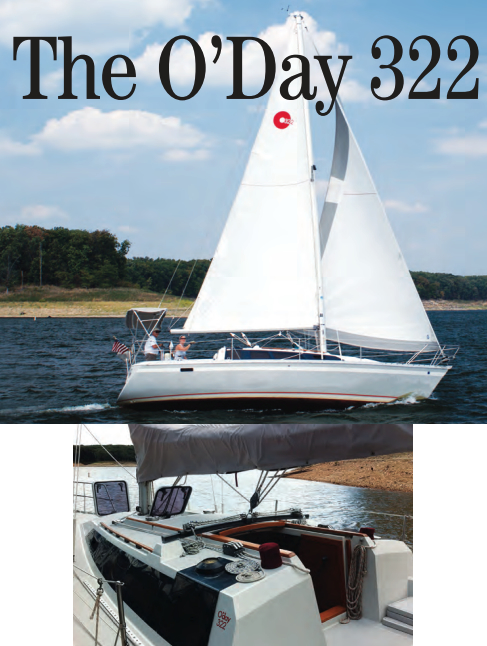
The boom swings fairly low over the cockpit, so crew must be aware of that during tacks and jibes. The low boom also makes it difficult to fit a Bimini for sun protection. Wild Goose has a small “captain’s Bimini” that provides some shade over the helm position.
Barient 21 self-tailing primary winches are mounted on the generous coaming forward of the helm and are accessible from the helm position. Barient 17 cabintop winches handle halyards, the vang, and the mainsheet, which is attached mid-boom and to a traveler mounted on the cabintop forward of the companionway hatch.
On deck
The deck has an aggressive molded-in non-skid pattern in traffic areas. Fairly wide sidedecks provide clear crew passage forward unobstructed by the chainplates, which are centered on the sidedecks. Teak grabrails along the sides of the cabintop provide handholds.
The stem fitting incorporates a dual anchor roller, and a sizable anchor locker provides ample storage for ground tackle. Chocks at the forward end of the aluminum toerail lead docklines to beefy aluminum cleats port and starboard. A stainless-steel bow pulpit provides security and double lifelines run all the way aft to the stern pulpit. Pelican hooks allow the lifelines to be detached for boarding at the cockpit.
The forward end of the cabin trunk slopes smoothly to the foredeck. A large Lewmar hatch there is over the V-berth. Aft of the mast, over the saloon, is a Lewmar hatch flanked by pie-pan vents. A sea hood aft of this hatch protects the companionway slide.
Solar vents are fitted on both sides of the companionway alongside rope clutches that secure the lines led aft from the mast through deck organizers. T-tracks and lead cars on the sidedecks provide adjustable leads for the jibsheets, which can be led back to turning blocks that provide a good lead angle to the primary winches.
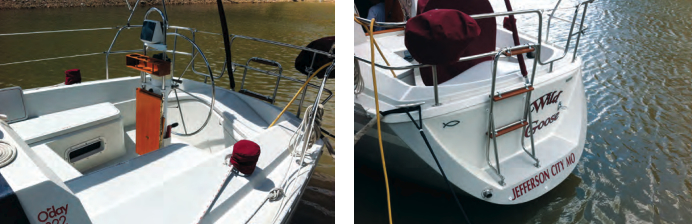
The T-shaped cockpit is functional and comfortable, if a bit small for a 32-foot boat. The cockpit seats are only 4 feet 4 inches long, so napping on them is not an option. The configuration provides good access to the helm and the contoured helm seat presents a comfortable perch at any angle of heel. A seat-height bridge deck protects the companionway and reduces the size of the opening. Smoked-acrylic drop-boards match the sliding hatch.
A cockpit locker is located beneath the port seat and the primary fuel filter is accessible at the forward end of this locker. Another cockpit locker is beneath the helm seat. Coaming cubbies on both sides provide on-deck stowage for small items such as sailing gloves.
A shallow sugar scoop in the transom provides a narrow platform for the stern ladder and dinghy access. The stainless-steel stern ladder folds up against the transom to port.
Belowdecks
The O’Day 322 has an innovative and very attractive interior. Teak is used throughout, and the fit and finish is more than adequate.
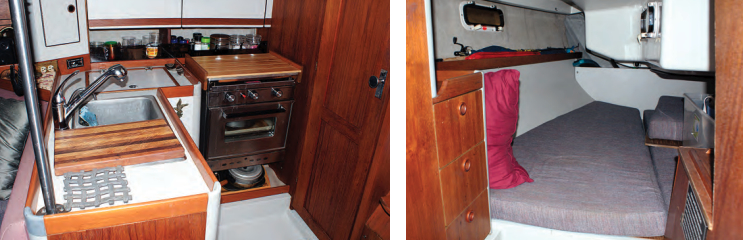
The V-berth measures 6 feet 8 inches on the starboard side, but the berth is shorter (only 5 feet 5 inches) on the port side to make room for a hanging locker in the forward compartment. The bulkhead between the V-berth and the saloon has an unusual feature. A closure panel on the starboard side of the teak door provides privacy for the V-berth occupants but can be rotated open to create a sense of spaciousness and to improve ventilation throughout the cabin.
A two-leaf table is centered on the compression post in the saloon. With both leaves up, it can accommodate several people. There is a U-shaped settee to starboard, a straight settee to port, and two tiers of shelving above the settees on both sides. Aft of the shelves are storage compartments with teak doors. The cabin-sole sections within the fiberglass liner are plywood with teak-and-holly veneer.
Four fixed windows and four opening ports provide good light and ventilation. Smoked acrylic covers the fixed windows. On some boats these have had to be rebedded.
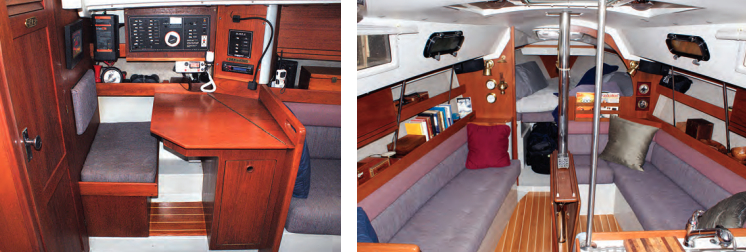
In the L-shaped galley, aft of the saloon on the starboard side, a two-burner propane stove with oven is fitted along the hull, a double stainless-steel sink in the forward counter, and a spacious icebox outboard of the sink. Jeff and Liz added refrigeration to their icebox. Storage cabinets lie over the outboard counter and, on some boats, a small microwave is mounted between the cabinets. More storage is available beneath the sink counter area. Pressurized hot and cold water for the galley and head sinks is drawn from a 60-gallon tank.
On the port side, aft of the settee, is a navigation station. It includes a chart table with hinged cover and storage, its own seat, and a shelf outboard with the main electric panel above it.
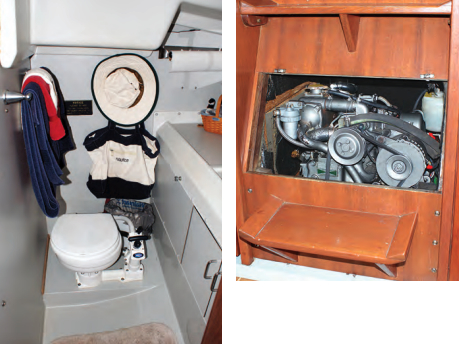
The fairly large head compartment is aft of the nav station. A vanity sink with a combination faucet/shower fixture is fitted in a long counter outboard. A separate shower sump keeps shower runoff out of the bilge. The marine toilet faces forward at the aft end of the compartment and discharges into a 16-gallon holding tank.
A teak door aft of the galley leads to the large aft stateroom, which has full standing headroom alongside a three-drawer dresser. The spacious berth lies aft and beneath the cockpit seats. Opening ports outboard and in the cockpit provide good cross-ventilation. It’s important to close the outboard port before getting under way — it’s below the rail!
Power
The O’Day 322 has a Yanmar 2GM20F diesel. Access for inspecting and servicing the engine is fairly good, with a removable panel behind the companionway ladder for the front end and a second panel inside the aft cabin for starboard side service points.
The engine is smooth and fairly quiet. It provides adequate power to drive the boat at hull speed in flat water and backing under control is a snap. Unlike many boats, the O’Day 322 shows only slight port prop walk, and that is easily overcome with judicious use of throttle and rudder.
Sailing performance
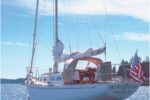
When we took to the water to photograph Wild Goose under sail, winds of 8 to 10 knots were creating a very mild chop on Mark Twain Lake. As Jeff and Liz put Wild Goose through her paces for the camera, we used our own boat as the chase boat. We were returning an old favor, since Wild Goose was the chase boat for a feature-boat article about our Tartan 37 that appeared in the January 2009 issue.
Sandy and I have both sailed Wild Goose over the years that we have known Jeff and Liz and we know her to be a stable, solid performer. She is not a racing boat and does not pretend to be one. When you pay attention to trim and sea state, however, Wild Goose does not disappoint. She points moderately well for a wing-keel boat, performing best at about 40 degrees apparent, and she tacks quickly and easily. The feel of the helm is precise and the fairly large spade rudder provides good control.
It’s worth noting that, in light air, the low-aspect-ratio vertical section of the keel does not provide much resistance to leeway and sideslip is noticeable when beating or reaching. As soon as the wind increases and the boat heels, however, the wing increases draft, adding considerable lateral resistance, and the excessive leeway disappears. The rig is smallish for a 32-footer and the O’Day 322 performs best when the wind rises.
Since the primary winches are close by the helm, singlehanding is possible. However, the mid-boom sheeting means it’s desirable to have a second crew to control the mainsheet and traveler, which are on the cabintop.
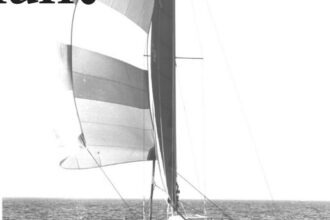
We’ve sailed Wild Goose through a series of tacks and jibes and have never noticed a problem with control. There is little, if any, roll on a deep run, and though we did not have the chance to see her perform with a cruising spinnaker, she will likely do well.
In summary, the O’Day 322 is a very good sailer and a comfortable ride. With its stability and full bridge deck, it is well suited to coastal cruising.
These boats are not widely raced, but available PHRF ratings show an approximate rating of 168. That compares to a Catalina 320 wingkeel model at 153 and a Beneteau Oceanis 321 at 162. The comparatively small rig is likely responsible for a higher rating number, but when the wind is up, the O’Day 322 can be quite competitive.
Prices and availability
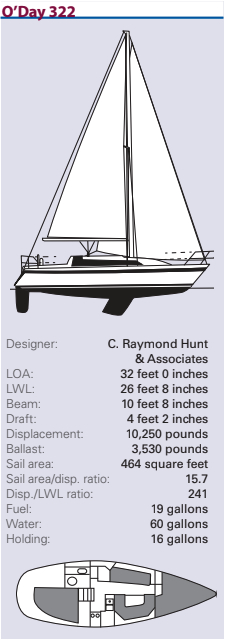
A search found four O’Day 322s on the market at asking prices from $25,000 to $29,900 — quite a tight range. With 228 of these boats built, the small number for sale may indicate that owners are satisfied with them.
Tom Wells is a contributing editor with Good Old Boat (and he has also earned the honorary title of Troubadour through his musical contributions at boat shows). He and his wife, Sandy, have been sailing together since the 1970s and own and sail a 1979 Tartan 37, Higher Porpoise.
Thank you to Sailrite Enterprises, Inc., for providing free access to back issues of Good Old Boat through intellectual property rights. Sailrite.com