Issue 19 : Jul/Aug 2001
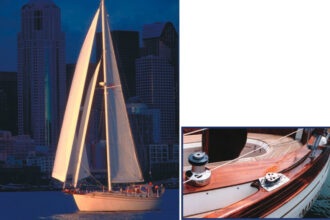
I always felt that Lord Nelson was a rather inept and unimaginative name for this line of boats since that great British sailor and admiral never sailed aboard, nor even saw, a vessel that could remotely resemble any of the Lord Nelson yachts. Indeed, it seems to me that Captain Cooke would have been a better choice for a series of rugged cruising boats but still, “a rose by any other name,” etc.
The builders of the Lord Nelsons jumped on the bandwagon originally started by Bob Berg in the late ’70s when he commissioned Robert Perry to design the Baba line of husky, full-keel, fiberglass, Danish-style double-enders. They were built by the score in Taiwan and the popularity of these yachts resulted in a number of imitators, such as Hans Christian, Panda, Union and, of course, Lord Nelson. Still, when it comes to designing nicely balanced ends and sheer lines, few of the imitators had the Perry touch, at least to my eye.
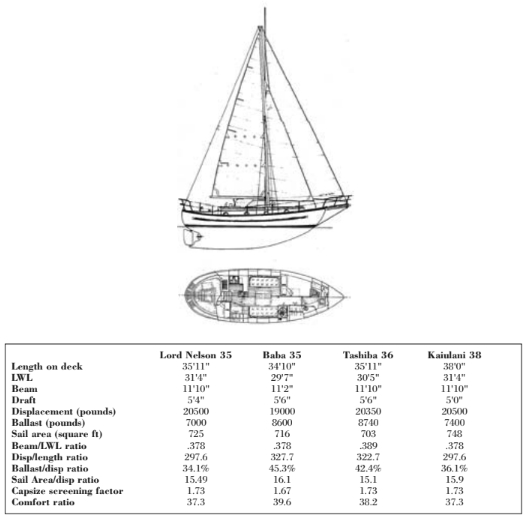
I’ve never sailed any of these husky double-enders so we’ll have to look at the numbers to see how the Lord Nelson 35 stacks up. We couldn’t find complete data and/or drawings on much of the competition but were able to come up with two Perry designs in the general size range, and the computer also spit out another design with the same waterline, beam, and displacement as the 35. Much to my surprise, it was a design of mine for a steel cutter! About a half dozen were built in Maine as semi-custom yachts, so I’ll include it as an interesting anomaly.
I was surprised when I worked out the ratios to see how close these vessels were in many regards. If you simply look at the numbers, it can appear that there’s not much to differentiate them. The main difference that I can see is that the Lord Nelson 35 has a moderate ballast ratio, even lower than the Kaiulani with its fully framed and heavy steel construction. Given her displacement, I would have expected the LN 35 to carry another 1,000 pounds of ballast and have a ratio closer to 40 percent. Either her fiberglass is unusually thick or her weighty teak trim is incredibly heavy and complete.
I have no drawing of the Tashiba underbody, but she is another Robert Perry design so I’d expect her lateral plane to be similar to the Baba, and that is cut away a bit more than the very full-keeled LN 35. The Kaiulani’s lateral plane is the most cut away so she might have an edge in light air, but the high ballast ratio of the Perry designs will help to keep them upright and moving in a real gear buster. Overall, I’d expect the LN 35’s performance to be less than sparkling with her very long keel and modest ballast but the difference, compared to the others, will be slight in a normal voyage.
In any case, none of these four yachts will break any performance records. They are intended to be long distance, “go-anywhere” voyagers; yachts that will take you out and bring you back in comfort and safety. Their comfort ratios and capsize screening factors are definite evidence of this intent, and the voyages that many of them have made bear further witness to the purpose of their design.
As far as that goes, if it takes you a day or two longer to get to Tahiti, what do you really care as long as the rum holds out and you’re enjoying the cruise?
Ted is one of North America’s best-known yacht designers, having worked on the America’s Cup boats American Eagle and Weatherly, as well as boats that won the Olympics, the Gold Cup, and dozens of celebrated ocean races. He also is the man who designed scores of good old boats . . . the ones still sailing after all these years.
Thank you to Sailrite Enterprises, Inc., for providing free access to back issues of Good Old Boat through intellectual property rights. Sailrite.com