Going NOW means holding the line on costs
Issue 19 : Jul/Aug 2001
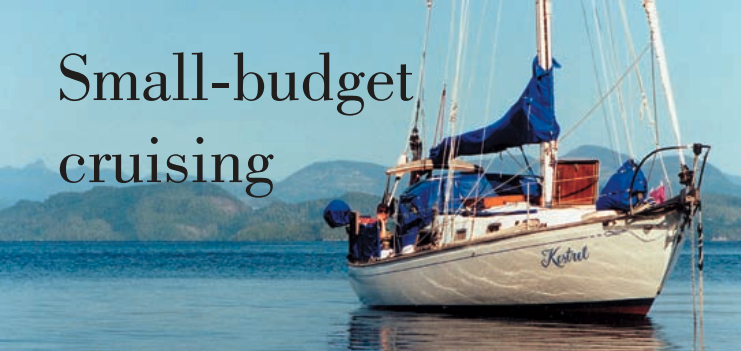
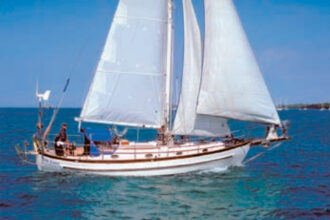
We cruised for three years aboard our 1973 Islander 34, Kestrel. In order to leave when we did (in our mid-30s) we were willing to give up our careers, travel in a smaller boat, and do without some of the “stuff” many people insist is “vital for cruising.”
To our surprise, most of the cruisers we met were older, usually retired, and owned larger, better-equipped boats. Younger cruisers in small boats with small budgets were few and far between. We wondered why there were not more young cruisers out there. One reason may be the belief that you need a big boat with lots of safety features and most of the conveniences of home in order to cruise.
Currently Spartan
Our boat would have been considered a luxury cruiser 15 or 20 years ago. But it seems Spartan by current standards. Many of the items we did without were on the majority of cruising boats we encountered in our travels. But we believed the initial cost of these luxuries could delay our departure, and subsequent maintenance costs could become a budget buster.
When we decided to go cruising we each had a sailboat, I had a San Juan 24, and Jay had an Islander 37. We had read, “The perfect cruising boat is the one you now own.” People have cruised in 24-foot boats, but they probably were smaller than Jay’s 6 foot 2 inches. The Islander 37 was an option, but it would require many costly upgrades before it was ready for offshore cruising. Paying off the mortgage of the 37-footer and the cost of “beefing it up” would have whittled away our cruising kitty to just one year’s cruising. We decided to buy a smaller boat that was already set up for cruising.
Older and smaller
Before we bought Kestrel, we had a list of 36 items we hoped to have on our dream cruising boat. Our budget for purchase was about $25,000 in 1998, limiting us to older, smaller boats. When we found Kestrel, it was love at first sight. She met 28 of our 36 wish list items. More importantly, she “spoke” to us. We made an offer that afternoon. The biggest problem? We had been planning to start our cruise in Florida, but Kestrel was in Seattle. Instead of getting our feet wet with warm Caribbean island-hopping in the trades, we were faced with the West Coast of North America: 2,000 miles of big seas, nasty capes, and freezing ocean. We didn’t don swimsuits and shorts until we reached Cabo San Lucas and entered the cruising ground of the Sea of Cortez, six months after we left Portland, Oregon.
No watermaker? No problem
When we pulled into Bahia Magdalena, Baja California, a couple in a large power yacht whom we’d helped at a previous anchorage invited us over for showers. What luxury: a real warm-water shower! Having a watermaker made that offer possible.
We had decided against buying and installing a watermaker primarily because of cost. While occasionally envious of other cruisers, we have never regretted that decision. In the U.S. it’s a simple matter of pulling up to a dock to fill water tanks. In Mexico and Central America it’s often necessary to carry the water to the boat in jerry jugs.
Of course, without a watermaker we are much more consumption-conscious. We usually bathe in the ocean (unless we’re anchored in a dirty bay), then we do a final rinse using fresh water warmed in a solar shower. This usually consumes less than one gallon for both of us. Full showers using fresh water can use up to three gallons apiece. And we don’t bathe every day. Baby wipes are great for a body-wash without water.
We wash our dishes with salt water and rinse with fresh. We have friends who use a spray bottle to rinse their dishes, using even less water for rinsing. We use manual foot pumps in the galley. For ocean crossings, I am considering measuring our daily ration of two gallons into gallon jugs to better monitor usage. Kestrel carries 60 gallons in her two tanks, and we can carry another 24 gallons in jerry jugs.
Not exactly refrigeration
We started our travels with an old worn out cold plate in our icebox. Eventually the system lost its charge. The icebox was not well insulated. To overcome the heat of Baja California, the compressor ran constantly. It was an amp hour hog, and one of us despised being a slave to the refrigerator: “We need to charge the batteries so let’s motor the first hour or so.” “But there’s wind. I want to sail!”
When the compressor died, we gladly tore it out and now use the icebox for canned food storage. While in San Diego after a sailboat delivery, Jay bought a thermal electric cooler for $99. We use it like a cooler to keep leftovers cool and to chill beverages for the end of the day. We turn it off and on as needed. Used this way, it is more economical.

All-bands receiver
We pulled into Bahia Culebra, Costa Rica, and were surprised when asked, “Are you northbound? We don’t know of you because we haven’t heard your boat name on any of the nets.” These cruisers assumed that all cruisers have ham or a single-sideband (SSB) transceiver. We are not radio enthusiasts. When anchored, we often turn off our VHF radio as we prefer the quiet to the “social engagement central and the coconut telegraph.” We responded that we were traveling south and do not have an SSB nor ham radio transceiver, though we do listen in on the nets when we are preparing for passages or underway.
We have a small, portable “all-bands” receiver, which has served us well and cost $140. We can pick up the nets for weather and other information, time ticks, the international high seas weather stations, and weatherfax. Instead of an SSB for emergency, we have a 406 MHz EPIRB. Our portable’s reception isn’t as great as many transceivers with elaborate antenna setups, but we’ve gotten by with our little portable. We can pick up most SSB and ham frequencies. We use a scrap piece of wire with alligator clips on each end to make up a small jumper cable. We clip one end of the jumper to the radio’s antenna and the other to one of our chainplates. The whole shroud then becomes the antenna, and reception improves considerably. A drawback is interference from other systems on the boat. Our diesel engine does not interfere much, but other systems have to be shut down to get clear reception.
Manual backups
We know of a boat whose captain removed the main compass because he had all of his electronic charts, GPS, radar, depth sounder, and so forth networked electronically at the steering pedestal. Hearing this sent shivers down our spines. We both left computer-industry jobs. Knowing what we know about computers and electronics, we don’t trust them!
With that said, we have and use electronics quite a bit on Kestrel. But we also have manual backups for those things that are necessary for safe navigation: we have a sextant (and know how to use it), and a lead line lives in the bilge. Radar was not a high priority on our dreamboat wish list. To our benefit, Kestrel was sold with radar. We are glad we have the radar as it has helped us tremendously in navigating out of Gray’s Harbor channel in Washington state in the fog and several times brought us safely into open-bay anchorages at night. It shows squalls and helps us pick our way through commercial shipping traffic. But we do not see the radar as a necessity. We use it to enhance navigation and not often at that.
Other electronic items we use are the depth sounder (ours is a fish finder) and the GPS. We have a main GPS unit and a back-up hand-held unit, which is kept in the abandon-ship bag. We have a wind meter, which we consider to be optional. And we have a knot log, but the impeller is often jammed full of crustaceans and other sea life.
Supplemental charging
Gasoline-powered generators, wind generators, towed generators, and solar panels are among the most common supplemental charging devices. Our motto is, “If you don’t use the amp hours in the first place, you don’t need additional power.” We have a 400-amp-hour house battery bank. For additional charging we have two 45- watt solar panels. Even during the wet season in Costa Rica, we had more than enough electrical energy to keep up with daily usage if we controlled the use of our cooler. The solar panels are nice, as they are quiet. We bought them used for $250. We don’t have a regulator for the solar panels. While cruising, overcharging was never a problem.
Kestrel came with an 800-watt inverter, and we didn’t have an opinion one way or another about these devices when we bought her. Now that we have the inverter, it’s hard to imagine living without it. We admit it: it’s easy to get accustomed to luxuries. We use the inverter to recharge our cordless tools and to supply power to the computer. Since we use the computer for weather-fax, we don’t think we’d give it up. You can get the same weather information on the high seas as voice forecasts, but we prefer visual images. Given our usage, we could get by with a 140-watt inverter, which costs only $40.
Windvane steering
When we sailed 600 miles from San Diego, California, to Asuncion, Baja California, the windvane steered for the entire five-day passage. It even steered us through a gale. We were very thankful for the helping hand, as I was sick during the first couple of days of the voyage while Jay ran the boat singlehanded. This made for a tired crew, and the windvane was indispensable.
Kestrel did not come with a windvane, but we noticed mounting brackets for one and asked. The previous owner still had the windvane and sold it to us for $500. Now we say, “don’t leave home without one.” It is a godsend during passages, though we are still learning about fine-tuning two years later.
Kestrel also has an autopilot which has served us flawlessly. The previous owner used it during his cruises to Mexico and up into Canada, so it has seen a lot of use. We use this autopilot when motoring, when the winds are too light for the windvane, and when the seas are too lumpy for the windvane.
As a backup, we have a spare electric tiller pilot set up reversed for the windvane trimtab. We’ve met a few boats with neither a windvane nor an autopilot, but most boats have both. Surprisingly, some people admit they have never learned how to use their windvane. We like the quiet of the windvane and its lack of appetite for electrical power. If we had to choose, we’d opt for the windvane before the autopilot.

Bite the bullet
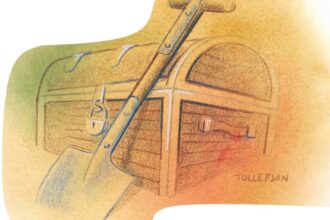
We imagine most boats carry insurance, especially when the owners sold everything to “take the leap” into cruising or when the yacht was a $250-million investment. Instead, we bought a relatively inexpensive boat and agreed to bite the bullet and take the loss if we lose Kestrel. Good seamanship and hefty ground tackle are Kestrel’s insurance.
Used rowing dinghy
We think the type of dinghy you choose is a very personal decision, and we couldn’t justify buying the latest and greatest rigid inflatable boat. Instead, we went to a boat swap meet and paid $350 for a used 8-foot fiberglass rowing dinghy manufactured by Gig Harbor. We love our dinghy, Rockhopper, and wouldn’t give it up for anything.
We left Oregon with two dinghies: Rockhopper and an old inflatable stuffed in the lazarette. We carried the inflatable for nearly a year before we decided to compare it with the hard dinghy. We tried it for a week and decided the hard dinghy was our dinghy of choice, hands down. The inflatable required pumping up and assembly. It was wet and seemed to require more work than the hard dinghy. It was more stable, but that was the only advantage it had over the hard dink. We sold the inflatable.
Some factors for our decision to buy a hard dinghy were: initial low cost; ease of bringing the dink aboard and launching by hand; durability, in that it doesn’t deteriorate as readily in the sun; ease of rowing; light weight (about 60 pounds) so dragging up the beach is no problem; no dinghy wheels required; ease of repair; less prone to theft; and far greater resistance to accidental groundings.
Exploring anchorages
We initially did not have an outboard, but bought a used 2.5-hp outboard in La Paz for $250 because we wanted the extra range it provided. The small outboard pushes the dinghy beyond hull speed and is especially useful when we’re jerry jugging water or fuel. Even if you have an inflatable, a big engine is not necessary if you can live without speed. We prefer to row the majority of the time even after buying the outboard. We enjoy the tranquillity of rowing.
Engine oversight
We feel strongly there should be no compromies made on the engine. Ours was used and turned out to be troublesome. If we were to do it again, we’d buy a boat with a brand-new or nearly new engine. Even though we motor 40 to 50 percent of the time, we sail considerably more than most cruisers we’ve met.
Although we preach that there should be no compromises with the engine, in our experience a cruiser does not need to have all the latest and greatest equipment to get out there. Neither does a cruiser need a $100,000 boat. An older, well-found and well-equipped boat is not hard to find, though a little dock walking may be in order. The latest gadgets are not necessities.
By purchasing only the minimal gear you need, you will save a considerable amount of cash that can be put toward the cruising kitty. We found many reasonably priced, used items in good condition by checking out swap meets and marine consignment shops (For a list of these, see the classified ad page on the Good Old Boat Web site. -Ed.). We also bought equipment through regional sailing magazine classifieds. If you’re deciding whether or not to purchase a big-ticket item think of ways in which you can compromise your cruising life to live without it.
Leslie Fournier and Jay Fraser left Scappoose, Oregon, in 1998. Over the next three years they sailed north to Canada and then south as far as Costa Rica before returning to Oregon. They live aboard Kestrel while saving for the next cruise.
Thank you to Sailrite Enterprises, Inc., for providing free access to back issues of Good Old Boat through intellectual property rights. Sailrite.com