What you need for cruising. . . besides the boat
Issue 37 : Jul/Aug 2004
I’ve been giving a lot of thought lately to what kind of coin to put under the mast of Sangoma, a 1983 Cape Dory 27 I’m refitting. My wife is no help. She doesn’t believe in coins under masts. She says they perpetuate a despicable ancient tradition of payola and subservience to petty tyrants — the gods of the wind and sea. She accuses me of being hopelessly superstitious and wants to know when the heck I’m going to get a life — a modern life.
I’m a reasonable person and I can see her point, although I’m not so much superstitious as supercautious. Anyone who has read Hamlet knows there’s more in heaven and earth, Horatio, than modern life can account for, which is why most sailors are supercautious. They have to be. Out at sea, you’re on your own. Just you and the guys waiting to snatch the coin from under your mast.
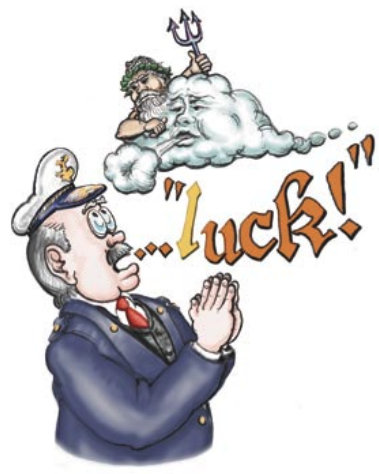
I once knew a sailor so supercautious he couldn’t bring himself to say out loud a four-letter word ending in “uck.” He was a scientist named Dr. Earle Reynolds, and I heard him give a Rotary Club speech about his ocean crossings in a ketch called Phoenix. He listed the essential requirements for safe, successful passages as:
- A well-found ship,
- A good crew,
- Adequate preparation and maintenance,
- Seamanship, and
- The fifth essential.
Not once in a half-hour speech did he mention the uck word or define the fifth essential. Instead, he described it by giving examples of how, um, fortunate some famous round-the-worlders had been. Harry Pidgeon, for example, fell asleep and ran aground in Sea Bird near Cape Town — in the only sandy bay on a hostile, rock-strewn shoreline. Joshua Slocum’s Spray was being run down by a pirate vessel off the coast of Morocco when a squall hit — and dismasted the pirate ship. They — and many others — enjoyed large helpings of the fifth essential. I’m not surprised that Dr. Reynolds was supercautious, even if he was a pragmatic scientist. There are already too many things a sailor can do to bring bad uck. Here are just some:
Changing the name of a yacht.
Strangely enough, while it’s supposed to bring good uck in Europe, it’s said to be unucky in America. I even had to invent a denaming ceremony for my boats. While my wife is predictably disdainful about groveling to Neptune and Aeolus, she is quite partial to the champagne that seals the pact.
Giving a yacht a presumptuous name.
No owner in his or her right mind should call a boat Sea Conqueror or Wind Tamer. That’s a direct affront to the sea gods, who like boat names to be suitably humble. You can’t be too careful in this respect. The name Titanic may seem pretty harmless, but in Greek mythology the most important of the 12 Titans, the vengeful Kronos, cut off his father’s genitals with a sickle and threw them into the sea. No wonder Neptune was upset.
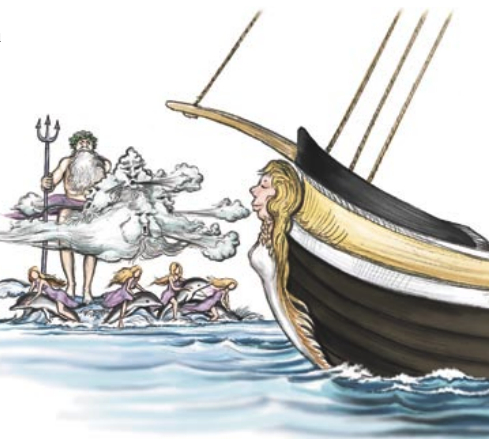
Painting a boat green or blue.
Ancient sailors believed every ship had its own soul and personality. Thus, a vessel could never presume to be part of the sea, so boats were seldom painted in the sea’s colors. If there was one thing the gods hated, it was presumptuousness. For sailors, it could be fatal.
Launching a boat without a figurehead.
This was a very serious offense in the old days because figureheads represented another major sacrifice to the ancient gods, one that riles my wife even more than a coin under the mast.
In the beginning, real human heads were placed on the bowsprit of a vessel starting her first voyage. They were invariably the heads of beautiful virgins—hence, the term maiden voyage. This great sacrifice was intended to ensure the safety of crew and ship on the stormy waters ruled by Neptune, Aeolus, and their groupies, a thuggish bunch of minor deities. When the maiden’s head fell off the bowsprit, it was a sign that the gods had accepted the sacrifice and that the maiden’s soul had entered the ship.
Today, in these times of female emancipation, it’s difficult to find young women willing to donate their heads to such a worthy and noble cause, so we have to make do with wretched carved figureheads.
Whistling while on watch.
We all know that this brings stormy weather. After all, it’s perfectly obvious that if a sailor has time to whistle, then he or she isn’t working hard enough. But the sea gods delight in finding work for idle hands, and a storm is a really quick fix for that problem.
Sticking a knife in the mast.
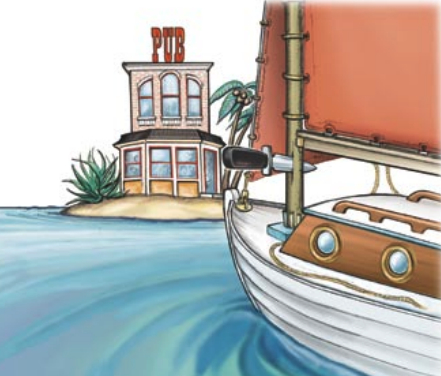
In these days of aluminum spars, this problem is not as common as it once was. However, if you have a wooden mast, be aware that a knife will bring heavy weather—unless the knife has a black handle. A black-handled knife is fine to stick in the mast on calm days when you need a little breeze to get you home before the pub closes. To be safe, make sure all your knives have black handles and all your masts are wooden.
Sailing on a Friday.
I don’t think this applies to round-the-buoy races or short trips around the bay. I believe it’s meant for passage-makers, although the belief that it will bring bad uck is found all over the world, possibly because Christ’s crucifixion took place on a Friday.
I once overstayed my visa by a whole day while calling at a small island 200 miles off the coast of Brazil in my 31-footer, because I would have had to sail on a Friday. They didn’t call out the gendarmes to arrest me. The Brazilians understand these things.
Crossing the equator under sail without offering sacrifice.
Last time I crossed the line I conducted a splendid little ceremony that involved (among other things) spraying my wife and son with beer and lowering two unopened cans into the sea. The extent of that sacrifice is evident when I tell you that we carried only a dozen beers to start with, and we were 13 days from land. It was a rough passage, and as an aside I took the opportunity to petition the gods for a little less wind — alas, to no avail.
We continued to fly along, but for the next 11 days nobody could stand on deck without clinging on. We strapped ourselves in our berths. We ate cold meals. The mast wedges fell out and the toilet clogged up. The lesson is simple: never try to piggyback a wheedling request onto a sacrificial ceremony the way Congress tacks barrels of pork on to legislative bills.
The gods won’t stand for such deceitful maneuvers.
Throwing back the sea’s gifts.
Never throw overboard anything the sea deposits on your deck. The old belief is that it must remain there until you safely reach port, unless, of course, it is reclaimed by the sea. My startled son once hurled back a flying fish that slapped into his face in the cockpit at night. The next day it clouded over so we couldn’t get sextant sights. Purely by great fortune and foresight (the possession of a GPS) were we able to avoid the calamity of missing the only island within hundreds of miles.
Being unpleasant to ships’ ghosts.
A surprising number of boats have ghosts. The last haunted one I visited was Destiny, an 83-foot schooner in San Diego that once belonged to Howard Hughes. Debbie Reynolds and Jane Russell were said to have been hidden aboard Destiny as a publicity stunt. Ava Gardner, Terry Moore, and Marilyn Monroe had been aboard too. The Joseph Kennedy family and Douglas MacArthur are supposed to have been guests on board, as was the actress Marion Davies.
The ghost is pleasant and appears to be curious. She is a woman in a long, white satin gown. Which woman? Nobody knows. But everybody’s very careful not to scream or startle her or get out a handgun and take a potshot. And that’s the way it should be. It’s very bad uck to upset a ship’s ghost.
Dying in the zone of suspended retribution.
Despite all their supercaution, oldtime American whalers believed that once you had battled your way around Cape Horn into the Pacific, you entered a zone where retribution for most minor human failings (liquor, lust, lying, laziness, and lack of respect for the sea gods) was held in abeyance.
In this area, on the Pacific west coast of North and South America, a sailor could get away with almost anything without bringing his ship bad uck, provided he was willing to recant and repent when he passed the Horn again on his way home.
Mind you, it wasn’t all honey and roses. If you died in this zone of suspended retribution, from the effects of overindulgence in any of the aforementioned failings, you went straight to Davy Jones’ locker. Now, Davy Jones was the devil, of course, so your fate was the ultimate in bad uck. To prevent your coming back to haunt them, your mates sewed your body in a weighted hammock and put the last stitch through your nose.
I think I’m going to buy a copy of Hamlet and leave it somewhere for my wife to find and read. She needs to know the difference between superstitious and supercautious — and why I always polish the gearknob and genuflect to the instrument panel before I try to start the engine.
Thank you to Sailrite Enterprises, Inc., for providing free access to back issues of Good Old Boat through intellectual property rights. Sailrite.com