A handy sailing rig for dinghies and small trailerables
Issue 103 : Jul/Aug 2015
The gunter rig was developed by Edmund Gunter in the late 1700s. It has always been popular in Europe and, during the age of whaling, it was often the rig of choice for the small whaleboats carried aboard whaling ships.
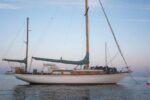
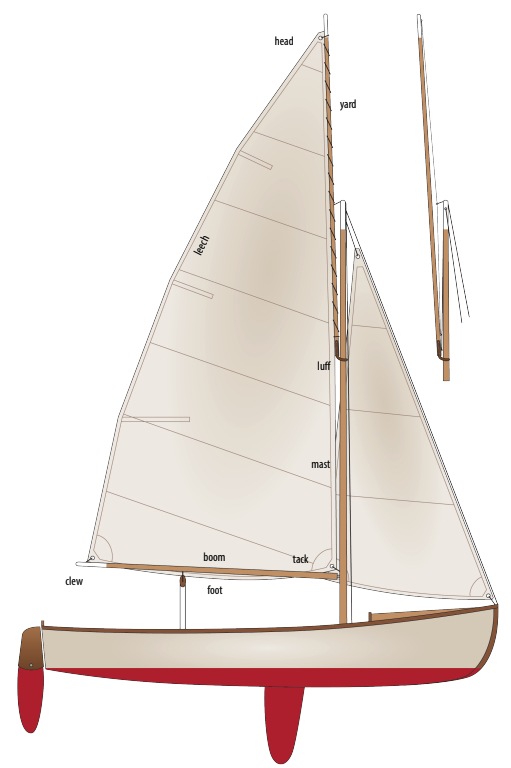
The gunter is a fore-and-aft sailing rig consisting of a short mast, boom, and yard (sometimes called a gaff or spar). When raised, the yard is vertical or nearly vertical and becomes, in effect, an extension of the mast. With the yard raised into position, the sail looks similar to a Marconi or Bermuda sail, and its efficiency and ability to point to windward are comparable.
In its early days, the gunter rig was used on a variety of cutters and schooners and other medium-sized craft. Today it’s found primarily on small boats, such as sailing canoes and dinghies.
Short spars
The gunter rig’s spars — the mast, boom, and yard — are all short, about the same length as the boat itself, and can often be stowed within the boat. This is a great advantage for trailerable boats and tenders. The short mast also simplifies stepping the mast and reduces the weight aloft.
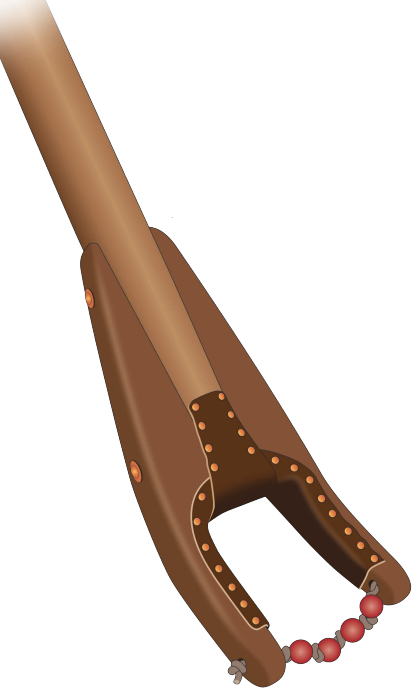
The rigging variations for the gunter rig are almost limitless: the sail can be loose-footed with no boom, loose-footed with its clew attached to a boom, or arranged so the foot of the sail is attached along the length of the boom. The lower part of the luff can be loose, attached to the mast only at the tack, or it can be bent on using hoops, a track, lacing, or robands (short lengths of line). In nearly all its variations, the upper portion of the luff of the sail is laced to the yard. The yard is commonly, but not always, attached to the mast with jaws.
Several methods are used to raise the yard and sail, with the most common being the sliding-line gunter, the parrel gunter, and the simple gunter. The sail can be reefed using typical slab reefing or by easing off on the halyard or halyards and lowering the yard down the mast while keeping it vertical.
The sliding-line gunter
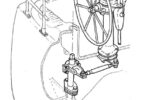
The sliding-line gunter has two halyards. One leads over a turning block at the top of the mast and down to the bottom of the yard or the jaw. This halyard is used to hoist the yard up the mast. The second halyard also leads over a block at the top of the mast but is attached to a line or wire running from one end of the yard to the other using a small block or shackle that slides along that line. This halyard is used to raise the yard into a vertical position.
The parrel gunter
A parrel is a set of wooden or plastic beads, usually about an inch in diameter, threaded on a line. These rolling beads allow a sail or yard to remain attached to the mast while sliding up and down it with little friction. In the parrel gunter, the yard is secured vertically against the mast by a number of parrel loops (or by other suitable means) so it is free to slide up and down the mast. A halyard attached to the jaw or bottom of the yard is used to hoist it up the mast. A disadvantage of this arrangement is that the yard, attached to the mast in the vertical position, adds weight aloft when not under sail unless the rig is disassembled.
The simple gunter
This rig uses a single halyard that goes around a turning block at the top of the mast and is attached to the yard at a fixed point. The bottom portion of the luff of the sail is attached to the mast using a mast track, parrels, mast hoops, or lacing. As the yard is raised, the sail is pulled up until the luff of the lower portion of the sail is taut. As with nearly all gunter rigs, the upper portion of the luff of the sail is permanently fastened to the yard, usually by lacing. When the lower luff of the sail (between the jaw of the yard and the tack of the sail) is taut, further tensioning the halyard pulls the yard into its near-vertical position against the mast.
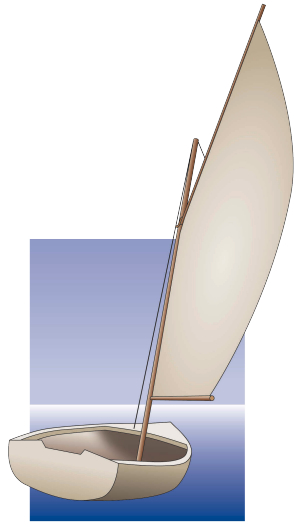
In another variation, the yard, when raised into a vertical position, goes into a clip at the top of the mast that prevents it from sagging to leeward when close-hauled in strong winds. This is done to prevent a slight loss of efficiency.
When a dinghy is fitted with a sliding-line or simple gunter rig, it can be rowed by binding the boom, sail, and yard together with shock cords and using the yard halyard to raise this bundle up to about a 45-degree angle and out of the way of the rower.
No matter what arrangement is used in a gunter rig, it is an interesting rig to see and to sail.
Don Launer, a contributing editor with Good Old Boat, built his two-masted schooner, Delphinus, from a bare hull. He has held a USCG captain’s license for more than 40 years and has written five books. His 101 articles through November 2011 are available for downloading as a collection from the Good Old Boat download website. Look under Archive eXtractions at www.audioseastories.com.
Thank you to Sailrite Enterprises, Inc., for providing free access to back issues of Good Old Boat through intellectual property rights. Sailrite.com