A fine example of English lines and lineage
Issue 105 : Nov/Dec 2015
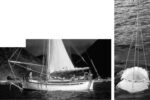
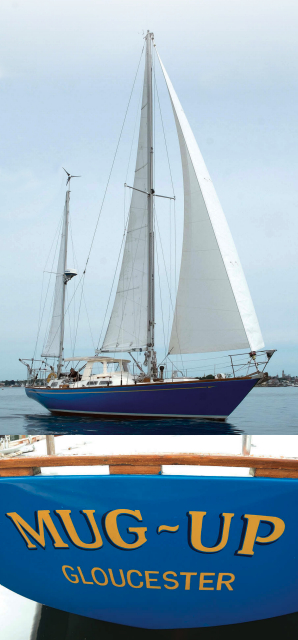
In the retail publishing business, it’s the cover photo that sells a magazine on newsstands. “Lose 25 pounds in one week!” screams the cover blurb, alongside a photo of a slim young movie star. The cover of this issue of Good Old Boat is similarly beguiling, except our readers are smarter. They know the boat on the cover, no matter how big or small, represents what they, given enough time and energy, could accomplish on their boats. So when photographer Paul Rezendez captured Mark Lacey’s Mug Up, anchored in a picturesque Maine cove, the resulting photograph is not only a work of art, it represents a key element of a complex chain reaction in boatyards and backyards everywhere.
Mark’s 12-year refit of the British-born 46-foot Holman & Pye-designed 1972 Bowman yawl is not only stunning, it’s critically connected to the magazine you have in your hands.
“I had the topsides all finished, sanded and prepped, waiting for paint, when the contractor who agreed to do the Awlgrip part of the job backed out,” the 59-year old carpenter from Gloucester, Massachusetts, told me. “I was then faced with the prospect of finding someone else to do the painting or do it myself. I remembered seeing an article in Good Old Boat about painting the topsides with a roller and, after rereading it, I thought, why not give it a try? The worst that could happen is I’d have to give it another final coat.”
Considering the number of sailors who have complimented Mark on the paint job, both he and the magazine are bona fide heroes. The photos attest to the dedication, hard work, and skill Mark applied throughout the boat. From proverbial stem to stern, Mug Up is a yacht worthy of a closer look.
Let’s begin with the name. “Mug up” has a variety of meanings in different regions and cultures, but in Gloucester’s historic fishing industry and, more important, in Mark’s carpentry business, “mug up” is that long-awaited break in the morning’s toils when the laborer opens the Thermos and pours a “cuppa” hot brew. It would be interesting to know the number of mug ups that took place during Mark’s work on this boat. Undoubtedly it’s in the thousands.
A long courtship
Mark and his wife, Sue, first fell in love with this boat in the Bahamas during the winter of 1990-91. They were sailing north in an Alberg 30 along with another couple in the Bowman. It turned out Mark had gone to high school with the owner’s wife. During the few weeks of sailing, the Laceys had plenty of opportunity to see the yawl in action, fiddle about belowdecks, and generally get to know her. They were very impressed, to say the least.
That winter, the owner called Mark and offered to sell her. Mark declined. The next winter the phone rang with the same offer. Mark politely turned him down. This went on for a few years until, finally, Mark’s cash flow and the owner’s expectations coincided and the deal was done.
What Mark hadn’t counted on was that the boat had been virtually abandoned in Florida and as a result was the worse for wear. A lot! The owner adjusted his price and Mark adjusted his expectations.
Despite the boat’s rough shape, Sue still remembered falling in love with her as she had been in the Bahamas, not as she was in her abandoned state in Florida. Mark clearly had his work cut out for him.
“It was a mess. It was filled with dirt, dog hair, everything. The fuel was unusable. The hull was roughed up from rubbing against barnacle-covered dock pilings. But underneath it all there was a boat with, as they say, good bones. It is a pretty boat. Even with all that mess, as I sailed it up north people would come up to me and say, ‘Wow! What a beautiful boat!’ and that’s saying a lot, considering what shape she was in.”
Piece by piece
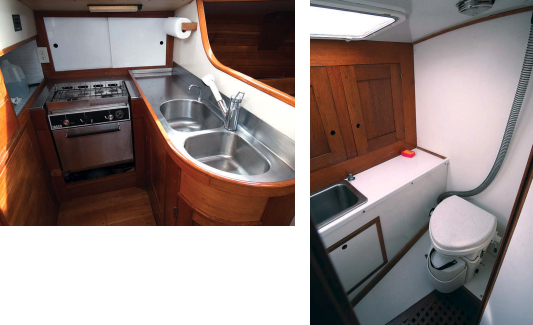
When asked what one thing stands out in his memory as the most memorable part of the overhaul, Mark is hard-pressed for an answer. “It’s not one thing,” he freely admits, “it’s everything. The little table we’re resting on (in the cockpit), the pedestal itself that I completely built. I overhauled the entire hydraulic system. Some of the stuff I had to farm out. For example, the galley sink I sent out and had welded because I’m not a welder. But I came up with the idea for a one-piece sink and countertop surrounded by teak.
“If I had thought ahead of time how much work was involved,” he says, “I probably wouldn’t have done it. But by taking each project or system one at a time and working carefully until it was fixed or overhauled, it became doable. Everything, every system on this boat, has my thumbprint on it. I feel comfortable taking her out in virtually any weather, either alone or with a crew. She’s an unbelievably safe boat.”
The most traumatic part of the refit was cutting holes in the hull or deck with a Sawzall. “I thought I should have my head examined!” Mark says. “That was by far the most difficult part of fixing up this boat. There were areas of decking, for example, where I had to cut away and replace water-logged plywood and reglass over it. That was hard.”
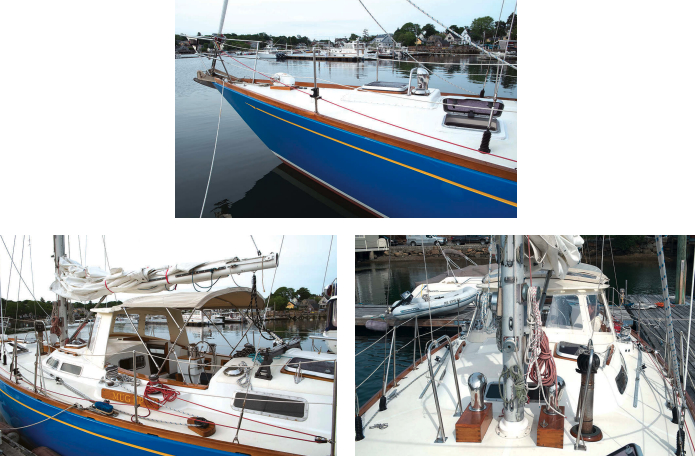
Mark removed all the wood and hardware from the deck, then filled, faired, and painted it. He installed all new wood: teak toerails, cockpit coaming, Dorade boxes, name boards — the list goes on. He also installed new Plexiglas deadlights and the trim around them.
Looking at the deck, however, reveals no evidence of any repairs. In fact, Mark’s high level of craftsmanship has resulted in a boat that looks relatively new, rather than an old boat that has been fixed up. That is testimony also, he admits, to being a faithful reader of Good Old Boat.
Although Mug Up has a center cockpit, the cockpit sits so low you feel safe, secure, and snug regardless of the weather. In addition, Mark built a beautiful, wrap-around hard dodger that makes complete sense given the boat’s home port and frequent cruising grounds — foggy, cold, rainy Downeast weather off Gloucester and Maine where he spends much of the summer.
Conventional and classic
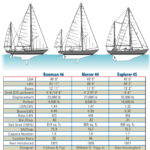
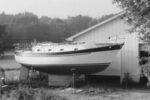
About 60 Bowman 46s (also known as the Bowman Corsair) were built and Mark has one of the few fitted with a centerboard. Mug Up draws 5 feet 6 inches with the board up, 10 feet 5 inches with it down. Mark replaced the centerboard sheaves and cable but, since it takes 190 rotations of the crank to lower or raise the board, Mark more often than not leaves it in the up position unless he’s doing some heavy going-to-weather work. The keel version of the Bowman 46, incidentally, draws 7 feet.
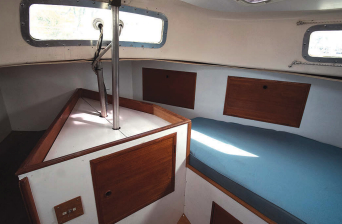
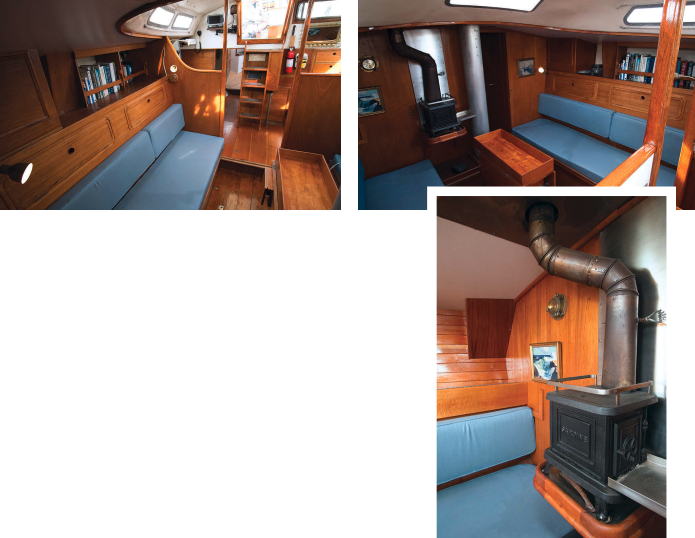
The interior layout of the boat is very conventional. It was never intended to sleep eight or 12 people, and Mark thinks the design is perfectly suited for one or two couples at most. As proof of that, he removed the head from the aft cabin to make room for bicycles and an oversized berth. The main cabin has a beautiful sea galley to port, a refrigerator/freezer (powered by a wind generator atop the mizzen) that serves as a nav table to starboard, a centerline table, settees, and a Sardine wood stove that Mark installed.
Forward, Mark fitted a new composting toilet and shower in the head compartment to port. A hanging locker is to starboard opposite the head and a V-berth occupies the bow. It’s all about as standard as layouts go, but finely executed in an assortment of fine woods (the new cabin sole is Spanish cedar) and in tip-top shape. The photos show the beautiful work Mark has done to make Mug Up the showpiece she is.
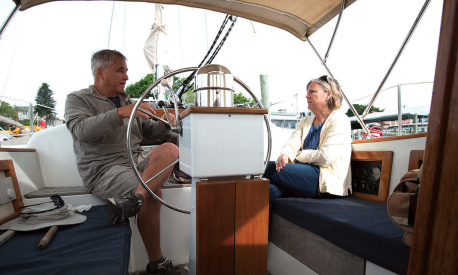
On deck, with the exception of the hard dodger, the design is also very standard, from the new stemhead fitting, anchor rollers, electric anchor windlass, and deck wash-down system Mark installed at the bow all the way to the stern pulpit, traveler, and davits standing on the stern. He led much of the running rigging into the cockpit so he can control the sails without having to leave the wheel, replaced all the old winches, and fitted an electric winch for reefing, as the big jib is hard for one person to handle. He fitted new stainless-steel Dorades and a new self-tailing winch on the mast for the main halyard. “Sissy rails” port and starboard of the mast provide security in heavy weather. A Bimini covers the cockpit and handholds on the hard dodger give crew something solid to grasp when stepping in and out of the cockpit.
Mark purchased all new sails, rigging Dutchman-style sail-furling aids for the main and mizzen, and replaced much of the standing rigging. Deck freight on Mug Up normally consists of a pair of kayaks so he and Sue can explore nooks and crannies in the shoreline Downeast.
Major moments
One of the most dramatic phases of the topsides renewal involved delamination around the chainplates, which are attached to fiberglass knees with bolts tapped into mild-steel backing plates glassed into the knees. When Mark took delivery of the boat, ooze was seeping from cracks in the hull where it covered the chainplates. He had no choice but to take out the Sawzall and do some remedial surgery, cutting out the hull outside the knees and rebuilding the area. It looks like new today. He covered the shroud turnbuckles with automotive strut boots.
After trying to keep the original, but troublesome, Perkins 4-108 going, Mark finally gave up and replaced it with a similar but newly rebuilt engine. He would have liked a few more horsepower, but that would have meant extensive work to the engine beds and shaft log, so he stuck with the same power plant design but renewed all of the associated wiring and controls. It was easy enough to remove the cockpit floor, hoist out the old 4-108, and drop in the replacement. At the same time, he lowered the engine’s raw-water through-hull and soundproofed the engine room. He also installed a new water heater, inverter, and Robertson autopilot.
The total result of Mark’s efforts is a strong and capable sea boat that’s easy to singlehand. Sue doesn’t enjoy long ocean passages, so he will often sail Mug Up alone from Gloucester to Maine, where she will join him. The 32-foot waterline, 23,500 pound displacement, and sleek underbody design make those passages enjoyable rather than hard work.
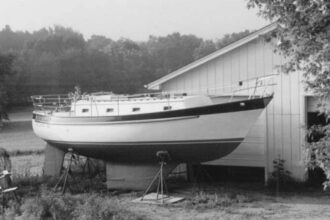
The color of Mug Up’s topsides — marlin blue — is so unusual that, together with the high quality of the paint job, her 46-foot hull presents a jaw-dropping vista. With her long over-hangs, 13-foot beam, and low freeboard, she is indeed one good-looking boat.
“I’m proud of this boat. It’s been a lot of fun,” Mark explains as we walk away from the slip. A small crowd stops to admire Mug Up and, as they do, he smiles — ever so slightly.
Gary Miller is an author and photographer. He grew up on Long Island Sound sailing a 23-foot wooden sloop. After college, a stint with Motor Boating & Sailing magazine provided him with experience on a variety of boats all over the world. His last boat was Viridian, a totally restored,1969 35-foot Pearson sloop.
Thank you to Sailrite Enterprises, Inc., for providing free access to back issues of Good Old Boat through intellectual property rights. Sailrite.com