Variations on taking in a slab of sail
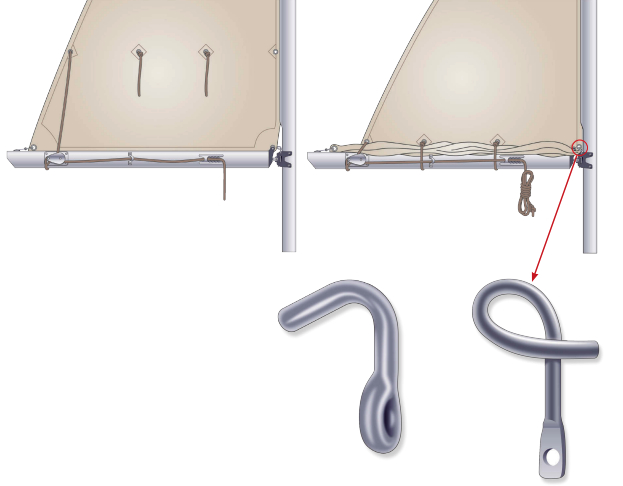
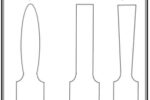
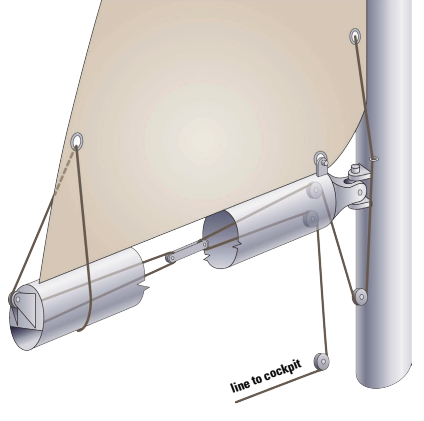
A straight reef hook can be fastened at the gooseneck, for a two-line system, or used in conjunction with a block to haul down the luff cringle in a single-line reefing system.
A ram’s horn reef hook on the gooseneck is more secure than a straight hook.
Issue 105 : Nov/Dec 2015
A sail is reefed to reduce its area so it will not overpower the boat in stronger winds. Of the many reefing systems used, slab or jiffy reefing is the most common and most traditional for a sail set on a boom, like the mainsail on a typical modern sloop. Although at one time slab and jiffy had two different connotations, the terms have become almost synonymous.
Slab reefing
In slab reefing the sail area is reduced along the foot of the sail by pulling the lower portion of the sail down to the boom with lines rove through reefing cringles at the luff and leech of the sail. Separate reefing lines might be used for the luff and leech cringles or, in a variation that first gave rise to the term jiffy reefing, a single line that pulls down both simultaneously. Either system can be set up so the sail can be reefed from the safety of the cockpit. The reefing lines should be low-stretch — not nylon — so the reefed sail maintains its shape under changing wind pressure.
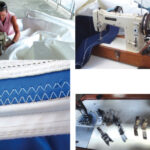
In addition to the luff and leech reefing cringles, it is common for the sail to have rows of reef points that extend across the sail between each pair of cringles. Reef points are short lengths of line attached to the sail and used to secure the reefed part of the sail after it has been lowered. Often the reef points pass through small grommets and are held in place by a knot on each side of the grommet. The sail is reinforced in this area with small patches of fabric sewn around each grommet or a strip of cloth, called a reef band, sewn from luff cringle to leech cringle along the line of the reef points.
Before a reef is taken in, the boat should be turned head to wind to relieve pressure on the luff slides that would make it difficult to lower the sail. The boom vang and mainsheet should be released for the same reason.
When the sail has been hauled down, the luff and leech lines secured, and the halyard retensioned, the reef points are used to contain the lowered portion of the sail. They should be tied with reef knots, of course, but only tightly enough to hold the skirt — the reef points are not intended to carry any active sail load.
Captain John Smith named the reef knot in 1627. On land this knot is called a square knot.
The reef hook
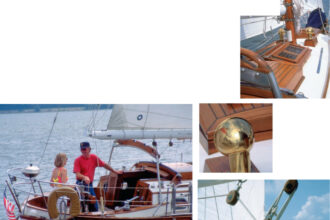
Sometimes a reef hook, rather than a reefing line, is used to secure the luff cringle. This hook is mounted on or close to the gooseneck and can be either a simple hook or a ram’s-horn reef hook, which is shaped like a corkscrew.
Using a reef hook requires someone on deck at the base of the mast. If the halyard is not led back to the cockpit, the crewmember who goes to the mast to lower the sail can easily attach the luff cringle to this hook before retensioning the halyard. If the sail’s halyard is led back to the cockpit, then a reefing line for the luff cringle is easier and safer, especially for singlehanders, since it eliminates the trip forward in conditions that are likely to be less than desirable.
Two-line reefing
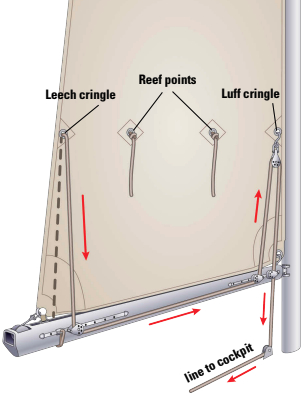
In the two-line reefing system, the reefing line for the leech cringle is fastened to an eye near the end of the boom, passes up through the reefing cringle, then back down to a turning block near the end of the boom and on the other side of it. From there it is led forward toward the mast, either outside or inside the boom.
The luff reefing line is led in a similar way from the gooseneck, through the luff reefing cringle, and back down. Both lines can be secured on the boom or led back to the cockpit.
Single-line reefing
Single-line reefing is a bit more complicated and can be accomplished in several different ways. In the most common method the reefing line is secured near the aft end of the boom, then runs up through the leech reefing cringle and down to a turning block, just as with two-line reefing. From there it is led forward, either inside or outside the boom, to a turning block on the boom just aft of the gooseneck, then up through the luff reefing cringle, down to a deck block, and aft to the cockpit.
On larger boats, a single-line reefing system is often employed that uses a shuttle block inside the boom. The principal advantage (and possibly disadvantage) this arrangement offers over an externally led reefing line is that the lines are hidden from view. Although this system may work well for the first reef and possibly a second, the boom on most boats is not long enough to accommodate a shuttle block for a third reef.
Slab reefing enables the sailor to maintain control and continue sailing when the wind picks up; but remember the old sailors’ truism: “The time to reef is when you first think about it.”
Don Launer, who was a Good Old Boat contributing editor for many years, passed away this past July (see the September 2015 issue). Among his many accomplishments, Don held a USCG captain’s license for more than 40 years, wrote five books, and built his two-masted schooner, Delphinus, from a bare hull. His 101 articles through November 2011 are available for downloading as a collection from the Good Old Boat download website. Look under Archive eXtractions at www.audioseatories.com.
Thank you to Sailrite Enterprises, Inc., for providing free access to back issues of Good Old Boat through intellectual property rights. Sailrite.com