An oceangoing cruiser by C&C and Ontario Yachts
Issue 106 : Jan/Feb 2016
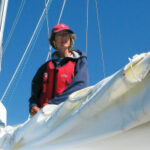
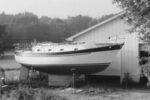
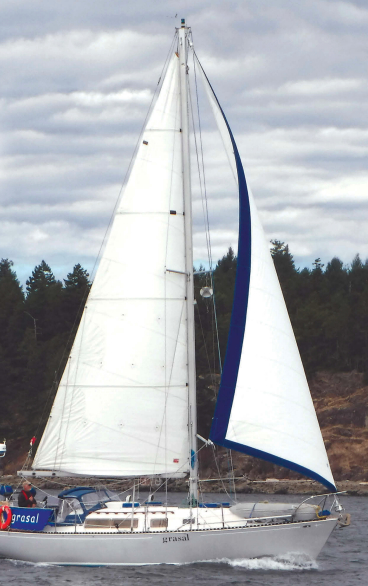
Gregg and Jean Tranter may list Calgary, Alberta, as their home, but they have spent every summer aboard grasal, a 1981 Ontario 32, since they bought her in 1987. They have circumnavigated Vancouver Island nine times, cruised to Haida Gwaii five times, Alaska twice, and ventured south along the Pacific coast all the way to Baja. Excitement along the way included being knocked down, mast in the water, off Cape Mendocino, and being nearly run down by a Navy vessel off Point Arena, California. When Gregg retired, they left on a three-and-a-half year cruise to New Zealand, and had grasal shipped home on a freighter. Grasal and her crew have been well tested in blue water, and Gregg has been kept busy upgrading her over the years to make her more comfortable and safer for cruising.
When Gregg and Jean bought the boat she was named Gracious. They intended to re-christen her Graysea, to reflect her hull color and avoid the bad luck associated with radical name changes, but while registering her, Greg discovered another boat with that name. After a hasty phone conference with Jean, Gracious became grasal, honoring tradition and their miniature schnauzer, Sal. Only later did they discover that grasal in French means “Holy Grail.”
Background and history
The Ontario 32 was designed by C&C Design Group for Dick and Maria Kneulman, owners of Ontario Yachts. Dick, a skilled boatbuilder from the Netherlands, moved to Oakville, Ontario, and established a reputation during the 1960s for well-crafted one-design fiberglass racing dinghies and Olympic-class boats. Production eventually expanded to include the sleek Cuthbertson & Cassian-designed Viking racer/cruisers and the capacious Ontario 32 and 28 performance cruisers. George Cuthbertson designed the hull of the Ontario 32, while Dick Kneulman and George Cassian collaborated closely on the design of the interior. The production run — from 1977 to 1986 — produced 158 boats.
Design and construction
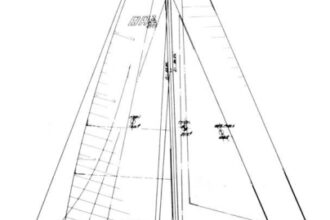
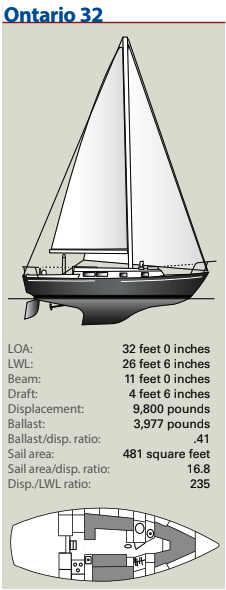
The length overall of the Ontario 32 is right at 32 feet on a waterline length of 26 feet 6 inches.The draft is 4-feet 6-inches and the beam 11 feet, which is exceptionally wide for the period. The hull is solid fiberglass and the balsa-cored deck is through-bolted at the sheer on 4-inch centers. It displaces 9,800 pounds and carries 3,977 pounds of lead ballast. The total sail area of 481 square feet gives it a sail area/displacement ratio of 16.8, and the PHRF-LO (Lake Ontario) is listed as 174. (For comparison, an Ericson 32 rates around 180 seconds per mile, and a newer Catalina 320 rates 156.)
Its capsize screening ratio of 2.06 slightly exceeds the 2.00 number generally viewed as the maximum suitable for bluewater boats (although the formula is of questionable value), but the Tranters and many others have enjoyed extended offshore voyages in these boats. A number of Ontario 32s regularly cruise the Pacific Northwest, while others cruise the East Coast to the Bahamas and beyond. Aubrey and Judy Millard retired and lived aboard Veleda IV for 12 years, cruising from the Eastern Seaboard of the U.S. transatlantic to Great Britain, Scandinavia, the Mediterranean, and the Black Sea, returning by way of the Caribbean. (Articles by Aubrey appeared in Good Old Boat’s January 2001 and March 2006 issues.)
In a departure from the slender, radically swept-back keels and scimitar rudders of the C&C racer/cruisers of the era, the keel on the Ontario 32 has a leading edge that’s angled well back, has a vertical trailing edge, is flat on the bottom, and is longer. The balanced spade rudder provides good control through the wheel steering but requires close attention to the helm.
Owners have reported hard groundings that resulted in little or no damage to the keel stub, reflecting the quality and soundness of the hull and keel construction. Most owners agree that the offset prop is not ideal for a cruising boat as it can cavitate in heavy seas and creates handling problems, particularly in reverse.
The boat is beamy and fairly high, so the stock Ontario 32 with its 15-horse-power engine was under-powered, but grasal has been outfitted with a Yanmar 3YM 30-horsepower fresh-water- cooled diesel that moves her along quite well. That economical and sturdy engine, combined with the CPT autopilot that Gregg recently installed, makes the boat well suited for the long bouts of powering typical of summer cruising along the British Columbia and Alaska coasts. Onboard tanks hold 70 gallons of water and 30 gallons of diesel fuel, and there is a 33-gallon holding tank for waste.
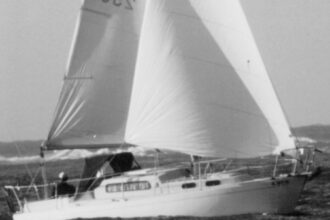
Above the waterline, C&C created a traditionally handsome cruising vessel without resorting to nostalgia or gingerbread. The boat has moderately high freeboard, a strong sheer sweeping up to the high bow, and a high but nicely proportioned cabin trunk. Many of her innovative design features, like the wide beam, foredeck anchor locker, roomy T-shaped cockpit, refined teak cabinetwork, and open-feeling saloon, have become commonplace on popular cruising yachts, so Dick Kneulman’s foresight and top-quality construction keep his boats in high demand among knowledgeable Canadian sailors.
Deck and cockpit
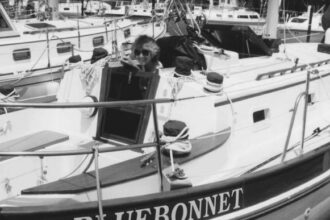
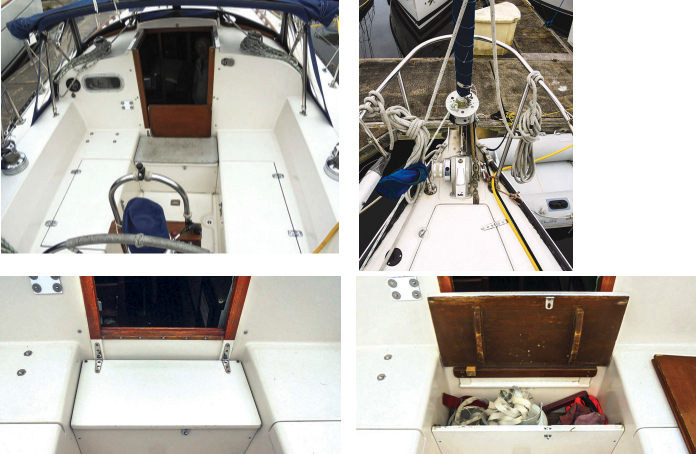
The cockpit is wide, deep, and well-protected, with comfortably high coamings. Grasal was fitted with wheel steering and has an easily rigged setup for the emergency tiller. One owner mentioned that the original wheel
steering quadrant had to be replaced. The coachroof is high and steeply cambered, so the only way to get a close-in view over the bow is to stand at the helm.
Typical of many boats of this era, there is no bridge deck, and the low companionway sill, while it eases entry to the cabin, presents a safety hazard for bluewater cruising. Gregg cleverly upgraded grasal for voyaging by fixing the lower companionway dropboard in place and bracing it with a heavily constructed self-draining stowage box that doubles as a bridge deck. Two very spacious cockpit lockers swallow bulky or wet cruising gear and are wide enough to allow side access to the engine. Gregg has fitted intermediate lifelines, installed a 55-watt solar panel and weather cloths at the cockpit, and replaced the after cleats with massively bolted stainless-steel straps for towing a storm drogue.
Wide sidedecks lead forward, protected by perforated aluminum toerails, while four Dorade vents and two Lexan hatches add light and fresh air to the cabin. Foredeck equipment includes jib roller furling and a removable forestay for the storm jib, as well as a windlass.
Accommodations
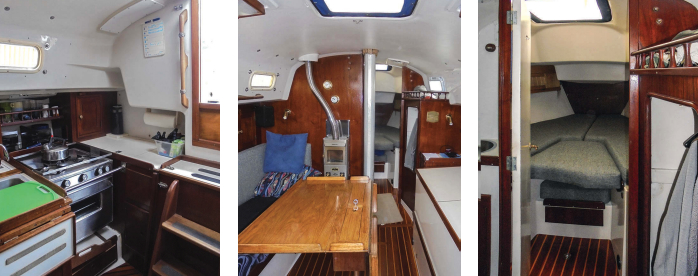
Belowdecks, the companionway steps land on a teak-and-holly sole between the generous aft-facing navigation station to port and the compact but well-equipped U-shaped galley to starboard. Partial-height bulkheads separate these conveniently located functional areas from the saloon, keeping the space visually open. The generous beam and 6-foot 4-inch headroom also contribute to this sense of spaciousness below, so when Gregg decided to install a windscreen and a spice rack above the partial bulkheads, he fabricated them from clear acrylic to retain the open feeling.
An L-shaped settee to port wraps around a fixed centerline drop-leaf dining table and, in the stock boat, a settee/pilot berth opposite to starboard provides additional seating for entertaining. Gregg and Jean did not need the additional seating or berth for their offshore adventures and wanted more stowage for long passages, so Gregg replaced the starboard settee and pilot berth with a beautifully crafted, removable food-storage locker. Complete with a portable Engel low-draw refrigerator/freezer, it remains solidly in place for their annual Northwest summer cruise. They also discovered that an insert in the deep bilge sump beneath the sole makes a usable cool cellar for vegetables.
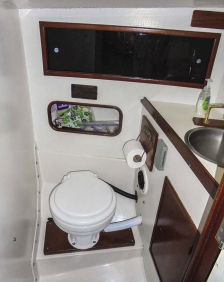
An abundance of teak cabinetwork includes deep lockers that line both sides of the saloon. A passageway leads through the teak main bulkhead to the head and forward cabin. The head is to port, opposite a hanging locker, and includes a newly installed Lavac toilet as well as a sink and shower pan. The generous V-berth in the forward cabin is flanked on either side by readily accessible teak storage lockers.
Under way
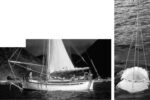
The curse of the Northwest boat reviewer prevailed, and on the day of our test sail we awoke to overcast and dead calm. We followed Gregg out of the Point Roberts, Washington, marina in a chase boat and he quickly hoisted sail. With less than 5 knots of breeze, the sails filled, but just barely. After a few photos, I transferred to grasal and took the helm. Even in this lightest of air, grasal was moving. She tacked and jibed very deliberately and was predictable and responsive to her helm, even though she barely had steerageway.
Eventually, we gave up trying to do any real sailing and Gregg fired up the diesel again. That all-too-typical windless summer weather prevented our wringing the boat out under sail this time, but her C&C heritage, as well as the coastal and offshore exploits of the Tranters and many other Ontario 32 owners, attest to the ability of the boat to cruise efficiently under sail. Owners agree she is not a demon to windward with her shoal draft, freeboard, and wide beam, but they point to her passagemaking ability off the wind, as well as her solid construction, superb design, and good looks.
Owner modifications
In addition to the previously mentioned upgrades and modifications, Gregg and Jean have made many small improvements to grasal. The VHF is supplemented by an Icom 701 ham radio for long-range voice communication when voyaging, while Winlink provides a global email connection. Peek-a-Boo porthole shutters (now called CloZures) provide light control and privacy in the cabin, mesh fabric closures snap over locker openings for ventilation, and HyperVent matting under the settee and bunk cushions prevents condensation. All in all, grasal is a boat they have made their own for nearly 30 years and their affection for her is contagious.
Conclusion
The Ontario 32 has achieved almost cult status among cruisers and many owners seem to hold on to them for years. As a result, few boats were listed for sale at the time of writing. Prices ranged from a low of $12,800 for a 1976 model to a high of $28,500 for a well-kept 1985 version. Support is no longer available from the builder, as the Ontario 32 has been out of production for nearly three decades, but owners tend to contact each other regularly for assistance and to arrange rendezvous and joint cruises.
Although the usual caveats about deck delamination, blisters, corrosion, and keel bolts apply, owners’ comments reinforce our observation that the craftsmanship and construction of these boats is well above average and they have stood up well to the rigors of coastal and longer-range cruising. They are handsome, commodious, and capable performance cruisers that have built a loyal following.
Ferd Johns and his wife, Beth, are retired architects now living on Whidbey Island, Washington. Ferd’s once formidable fleet has been reduced to two trailerable sailboats and a mini-trawler (not counting assorted kayaks and dinghies), which they use to cruise the Pacific Northwest, Chesapeake Bay, and the Florida Keys.
Thank you to Sailrite Enterprises, Inc., for providing free access to back issues of Good Old Boat through intellectual property rights. Sailrite.com