A comparative review of a Cuthbertson classic
Issue 62 : Sept/Oct 2008
I’m greatly indebted to my friend and mentor, George Cuthbertson, for giving me my start in the sailboat business more than 50 years ago. I spent three happy years working for George and his partner, the late Peter Davidson, and I learned a great deal about yachts and yacht design from both of them. George and I have remained friends through the years, so it is with great pleasure that I review this example of his work and compare it to two other fine designs.
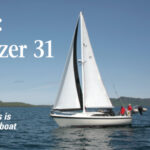
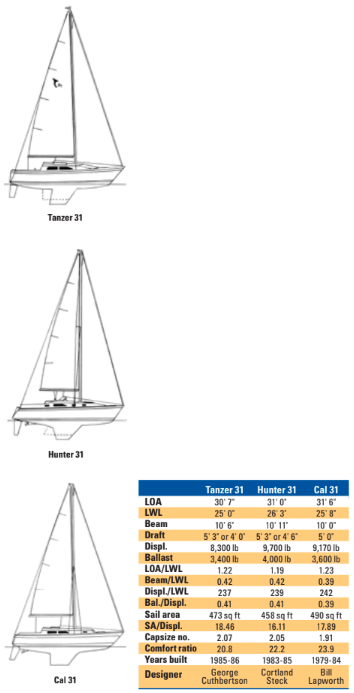
With the Tanzer 31, Hunter 31, and Cal 31, we have three very nice fin-hull/spade-rudder boats, quite close to each other in many respects, but each with the designer’s individual touch. Aesthetically, I find George’s traditional sheerline to be the most attractive. However, I prefer the Cal 31 cabinhouse for its more upright, traditional, and less rakish (slippery?) appearance, compared to the others.
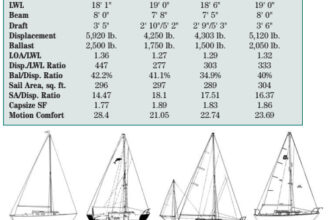
Undoubtedly, the most powerful of these three hulls will be the Hunter, due to its generous beam, heavier displacement, and good ballast ratio. This will let it stand up well to a breeze and — with its smaller sail area — it will not require reefing as soon as the others. On the other hand, it will probably not fare as well in light-to-moderate breezes, as it has the least sail area and will take more energy to move its heavier, beamier hull to windward in a choppy sea.
The Hunter does have the highest-aspect-ratio mainsail, which could help to windward. However, the skinny main may prove less effective off-wind, particularly with cruising sailors who are often reluctant to go to the trouble of setting a spinnaker. I admit to being one of those! I’ve set hundreds of spinnakers while racing but never even owned one for any of my own boats. I tend to agree with the man who said a spinnaker is not a seamanlike sail. Fortunately, today’s modern gennakers and asymmetrical spinnakers are much friendlier and handier offwind sails than the old 180-percent Cruising Club of America Rule monsters.
Good in zephyrs
The Tanzer 31 should do very well in the zephyrs with its good sail area and modest displacement, and the Cal 31 should be right up there with it. An around-the-buoys race in medium air would be a very close contest indeed. I would not place a bet as to which of these 31s would take the silver. They are three very well-matched yachts. The end result would depend almost entirely on the skipper, crew, and sails.
I must emphasize that I am discussing the deep-draft hulls. The shoal-draft versions of the Tanzer and Hunter might do well off-wind but will not perform to windward against their deep-draft sisters. Shoal draft is fine, even a necessity if you sail in shoal-water areas, but deep draft adds so much to windward performance and stability that it is the better choice for the average sailor. Unless you absolutely must have shoal draft for convenience in your general cruising area, select the deep-draft model. You will not regret it, particularly when beating to windward in a spanking breeze.
These three boats are also quite close when it comes to Comfort Ratio and Capsize Screening Factor. Designed primarily as coastal cruisers and club racers, none of the three is extreme in any way. When it comes to serious offshore sailing, I much prefer the strong double-lower shroud rig of the Cal 31 to the single-lower rigs of the others. Still, each of these three should prove capable of coastal voyages with reasonable bluewater work, given good basic construction, good condition, good gear, and an experienced skipper.
Ted Brewer is a contributing editor with Good Old Boat and one of North America’s best-known yacht designers, having worked on America’s Cup boats, as well as boats that won the Olympics, the Gold Cup, and dozens of celebrated ocean races. He also is the man who designed scores of good old boats . . . the ones still sailing after all these years.
Thank you to Sailrite Enterprises, Inc., for providing free access to back issues of Good Old Boat through intellectual property rights. Sailrite.com