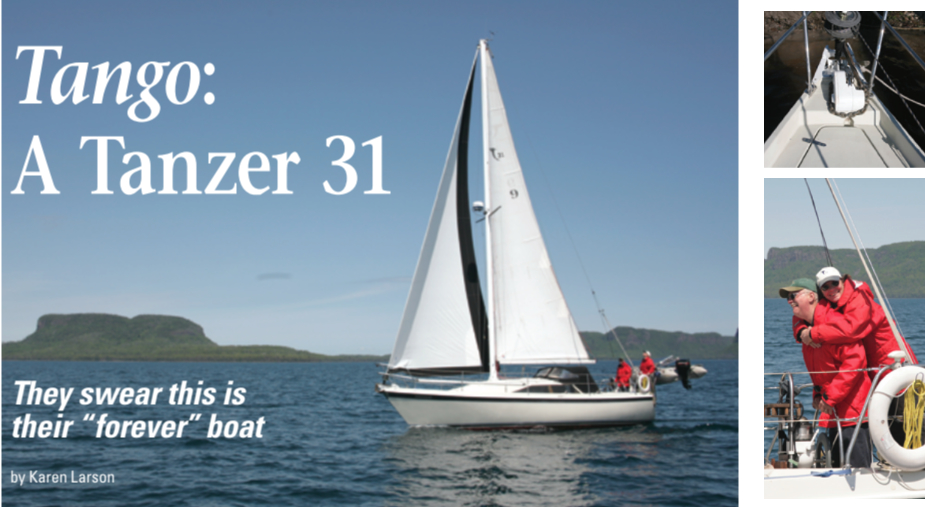
They swear this is their “forever” boat
Issue 62 : Sept/Oct 2008
As complete novices, Tony and Marianne Ouwehand went along on a weekend sail on Lake Champlain some 25 years ago. They’ve been sailing ever since. “We were hooked!” Marianne says, with a strong emphasis on hooked. She is as delighted by the memory now as she was on that weekend so long ago.
The boat was a Hunter 29. “The weather was warm,” Marianne recalls. “There were hundreds of boats everywhere. We rafted, along with some other sailboats, to a Beneteau First 42. We enjoyed partying, swimming off the back of the boat, perfect weather, good company . . . ”
What’s not to like about sailing with an introduction like that? “We lusted after sailboats,” Marianne continues. “We went to boat shows . . . and then a couple of years later we moved to Thunder Bay.”
Thunder Bay, Ontario, is a water-front city with a passion for boating. The move there from Southern Ontario made the idea of boat ownership seem much more realistic. Their daughters were aged 7 and 10 at the time of this move. “The whole family took sailing lessons,” Tony says, “and Marianne and I took Power Squadron courses.”
For two summers they were able to use a friend’s Grampian 23 with a rather unusual arrangement. Tony and Marianne paid the slip fees and expenses and were allowed to use the boat whenever the owner had no plans for it. Since he seldom had the time, that Grampian was much like a family boat for the Ouwehand foursome. Each summer they spent two weeks cruising the Lake Superior north shore, a pristine wilderness as near to heaven as it’s possible to get on this earth.
The hook was set thoroughly as a result of these cruises. Unlike so many boatowners in Thunder Bay, who both race and cruise their boats, Tony says, “We were never interested in racing.” They went along on some races with friends and learned a great deal while participating in these competitive events with the fun-loving and highly skilled Thunder Bay sailors . . . some of the best Jerry and I have seen anywhere. But, other than an intimidating trial once or twice, they did not join in the weekly events over the years with their own sailboat.
Tony and Heather, their older daughter, learned to dive, and Erin, their younger daughter, joined the Sea Cadets and raced in the nationals in Halifax one year, a clear indication of her skills. However, neither daughter sails these days; Erin and Heather are now adults, and both women have weddings planned in 2008. It is a busy year for the Ouwehand family.
A major complaint
After a couple of summers on the Grampian 23, Tony had one major complaint. “It was a head-banger boat,” he observes. It had a pop-top to provide a bit of relief, but it was a small cruiser for a family with two growing girls.
“In 1988 we bought our first boat,” Tony says, adding with a wink, “so we added it to the mortgage of the house.” This boat, a Grampian 26, sold itself to the Ouwehand gang almost as soon as the “For Sale” sign appeared on the bow.
The boat was named Unicorn and had an airbrushed unicorn on each side at the bow. The two young girls had already claimed it as their favorite boat in the marina. When the sign was posted, any resistance would have been futile. It was meant to be.
Fortunately, this larger Grampian was just what they needed. “It had standing headroom in the V-berth area,” Tony says. “Grampian had a way of building outstanding boats.”
Tony has always been a hands-on guy. He went to work in the theater because he liked building sets and producing shows and eventually moved into management roles with the Thunder Bay Community Auditorium. Now retired, he can honestly say that management was not nearly as much fun as set-building. He’s joined a church community with a large drama component, where he can offer his skills as a volunteer in the area that interested him to begin with.
Once they had purchased the Unicorn, Tony says, “That’s when I got into doing maintenance on our boat.” Let’s just say that from the moment he got his hands on a boat of his own, this do-it-yourselfer became a good old boater. And cruising the Canadian shore of Lake Superior was the incentive for having a fully equipped and well-maintained boat. When the ports of call are few and far between, one has to be self-reliant and have a strong and well-appointed boat if one is going to take one’s family out and bring the gang home again safely.
But gregarious Tony and Marianne did not only seek the most isolated wilderness coves and the most silent bays while cruising. They also buddy-boated with others from Thunder Bay — powerboaters and sailors — who had children of their own. A close clique of boating families was formed, and the stories from those years are legendary (and becoming ever more legendary with the telling over the years).
Boatless sailors
But time passes. Children become teenagers who have jobs and other activities far too important for sailing. Tony and Marianne were hiking more often than sailing. The Unicorn was nominally for sale. One day someone made a good offer and the next, Tony says with some bewilderment, “Suddenly we were without a boat.”
They expected to save their money for a summer, with thoughts of buying a boat for the next season. “But,” Marianne adds with a touch of irony, “that didn’t happen.” The best-laid plans, as they say.
Naturally, they weren’t really in the market for a sailboat (not really), but while they were visiting a cousin in Hamilton, Ontario, they planned to take a look at a Beneteau for sale there. (Idle curiosity, no doubt.) On the drive east, they stopped in Midland, Ontario, just to look around at the boats there . . . just to walk the docks. There was nothing more to it. Really. This “dock walking and just looking around” is a psychological malady that strikes most boatless sailors. Jerry and I have had the same symptoms. We are not alone. There is only one cure.
There in Midland, as anyone hearing this tale is likely to have guessed, was a Tanzer 31 named Tango. The Beneteau was unable to measure up, and the rest is as you might expect.
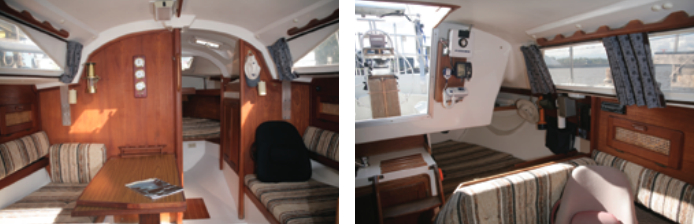
“We were not really looking,” Marianne protests with a smile, “but there was this big cabin, really huge. And
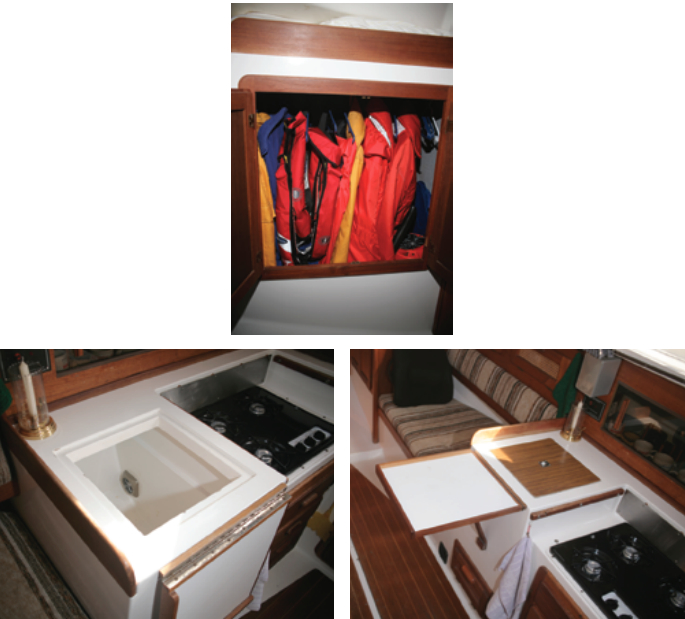
the galley with the flip-up counter . . . someone had done some good thinking there. That sold the boat for me.” She continues: “Of course, Tony spent the next two or three hours crawling into everything.”
Tony was less quickly convinced. “There were two drawbacks,” he says. “The V-berth narrowed to a point at the bow that made it possible for only one-and-a-half persons to sleep there. And it was underpowered, with a 13-horse diesel.”
Still, on the way home from Hamilton and after seeing the Beneteau, they made an offer on Tango, who got to keep her name after friends convinced Tony that “T is for Tanzer, Tony, and Tango.” And furthermore, they pointed to a favorite ski run named “Tony’s Tango.” It was meant to be.
Third drawback
Tony and another Thunder Bay sailor, Gordon Cuthbertson, brought Tango home to Lake Superior from Midland, which is located on Georgian Bay, a massive body of water that is part of Lake Huron. They immediately discovered a third drawback that Tony hadn’t noticed earlier. The sidedecks funneled any water that came aboard aft to the cockpit, where a flaw in the design of the coamings allowed it to cascade from the high side over onto the seats whenever the boat was heeled.
“We used it as an indicator that it was time to reef,” Tony says with a grin. But getting soaked each time they were heeled was unpleasant. And that was the first of many modifications to Tango. Tony added drains on each sidedeck, with each crossing to and teeing into existing cockpit drain through-hulls on the opposite side of the boat, so the water could run off and out downhill.
Fine so far. But how does a guy deal with a V-berth he doesn’t like? Answer: very creatively. Tony raised the V-berth bunk flat 5 inches, a brilliant plan that added length and width to the pointy part of their bunk, made room for a large holding tank beneath, and (once the hull liner side panels were replaced) greatly widened the space. There in the bow Tony also found a place below for two 6-volt batteries. While he was at it, he snugged two more, and a third as a starting battery, in the quarter berth.
At some point Tony and Marianne agreed that Tango would be their “forever” boat. “This is the boat for life, so let’s do it,” they decided, and they replaced the too-small 2GM with a 3GM Yanmar, giving them 27.5 horses where 13 had to do the job before. And Tony says, “I bought the biggest three-bladed prop I could buy and had it trimmed a bit to make it fit.” That finished off the modifications necessitated by Tango’s major drawbacks. But of course there is always more to do to a good old boat. How much more is entirely at the discretion of the good old boater and perhaps a factor of how much time is spent aboard.
While Tony has retired, Marianne has not yet closed the door on her job as a visiting nurse. Even when they were both working, Tony had as much as six weeks off during the summer, while Marianne had only two weeks. As a result, Tony has spent some time singlehanding over the years and led all lines aft to simplify things when sailing solo.
Power for cooling
Tango came with a hefty set of davits, and Tony attached solar panels to them. These provide enough power to keep the cabin lights and the refrigerator and freezer going, he says. The refrigerator/freezer combination is itself a classic demonstration of his ingenuity. The boat had an icebox as well as a refrigerated space with cold plates. Tony added heavy insulation to both compartments and ran two insulated tubes between the two, one high and one low. This created a thermo-siphon, which cooled the icebox with airflow from the freezer. To this, he added a fan so they could increase the flow when necessary.
Tony installed a windlass and added a larger Bruce anchor. He replaced the autopilot and bought Tango a new headsail for the roller furler. He replaced the two-burner propane stove with a three-burner propane upgrade. He added a hot-water system. He had the bottom soda blasted and followed that up with a barrier coat. He designed and built a clever screen-and-Plexiglas hatch arrangement for use while cruising, added a swim ladder to the davits, installed a diesel heater, and much more.
He added a water filtration system so they can take drinking water right from their freshwater lake. Water going into their tanks first passes through a 5-micron filter. They add a capful of chlorine to the tank; water then passes through a .05-micron filter, and an additional charcoal filter at that stage removes the chlorine taste.
“The boat came with a deck-wash pump,” Tony says, and he adds that he didn’t really see the use for it until he was able to use that plumbing for his water modifications. He has the filtration teed into this system, along with a lakewater tap that they use for routine hand-washing and other non-drinking activities in the galley.
Indeed, the couple has created a boat that they can now use to cruise beyond Lake Superior to the other Great Lakes that lead the way to the Atlantic Ocean. Tango has already taken them to Lake Huron and back. One day within the next few years, Marianne will retire, the family weddings will be behind them, and who knows?
“We’d like to cruise the rest of the Great Lakes, through the St. Lawrence Seaway to the Maritimes,” Tony says. “Maybe even the West Coast.” They have no interest in an eventual circumnavigation. Tahiti does not beckon.
“I will admit I’m a coastal sailor. I like the idea of an anchorage every couple of days. I don’t relish the idea of three weeks on the big sea. It simply doesn’t appeal to me,” Tony says. Marianne nods in agreement. For this, Tango, their Tanzer 31, is the perfect boat, and they have made their forever boat just the way they want her.
Karen Larson and her husband, Jerry Powlas, founded Good Old Boat magazine in 1998. They sail a C&C 30 named Mystic on Lake Superior and are working on a project boat in their backyard. The second boat, a trailerable C&C Mega 30, will dramatically expand their cruising grounds.
Thank you to Sailrite Enterprises, Inc., for providing free access to back issues of Good Old Boat through intellectual property rights. Sailrite.com