How to drink, shower, and wash the dishes on about a gallon a day
Issue 13 : Jul/Aug 2000
Depending on the source you quote, the average landlubber uses between 70 and 120 gallons of fresh water a day. The average sailor could cross an ocean on that amount of water. Conserving fresh water is a major concern for all boaters, whether you have a watermaker or not. But, for those who cruise away from ports without a watermaker, it’s a way of life.
Aboard Lindsay Christine, our 30-foot Mercator Offshore sloop, we have turned water conservation into a game. The four of us — my husband and I and our two children — try to make each tankful of fresh water last the longest time. We all get involved in saving drips and dribbles. The children come up with interesting ways to reuse water left over from any activity . . . like the time when Alex decided to add the water from one of his science projects to a sauce cooking on the stove. I wouldn’t say the taste of vinegar and baking soda was terrible in our spaghetti that night, but . . .
After living this way, particularly while on passages, it is a wondrous sight to see fresh water pouring from a hose or spigot into our jerry jugs. We feel almost like kings receiving gold and precious jewels. And the feeling of knowing that our water tank is full again is no less wondrous. We start to think of leaving port immediately so we can get the optimum distance or time for that priceless tankful.
Aboard Lindsay Christine, we have a built-in 35-gallon fiberglass tank for our fresh water. When we set off for a trip, we usually carry an extra 15 gallons of water in three jerry jugs, and a full 1-gallon insecticide sprayer for freshwater showers. One of those 5-gallon jerry jugs is set aside for showering. One jug we add to the tank as we use our water. The last jug we always keep around. We add it to the tank only when we are about to fill our tank again. It is our emergency jug, available if our pump breaks or our tank becomes contaminated.
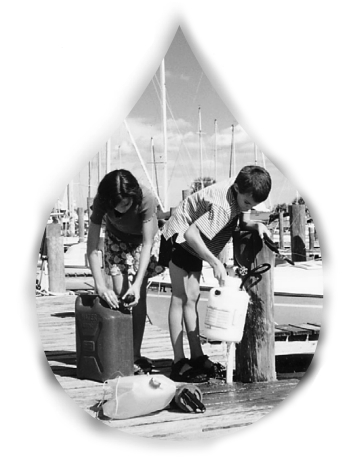
Including showers
So, how long does that amount last us? If we are sailing in remote areas with little chance of refills, our water can last 40 days for the four of us. This includes three freshwater showers for each of us. And, we would still have our 5-gallon emergency jug full of water when we came ashore to fill up our tank. Of course, we would have a large pile of clothes to wash as well.
But that’s not how it always was. There was a time when our 35-gallon tank had to be filled every three or four days. A time when we didn’t bring any extra water jugs filled for an emergency. A time when a shower for one consisted of using several gallons instead of the half gallon that we each use now. We were naive back then — babies in the game of water conservation. It has been three years since we left to go cruising.
How do you get 46 gallons of water to last an average of 40 days for a family of four? Rather than approaching conservation as a problem of scarcity, we like to see our conservation as a form of cherishing a beautiful and useful gift. It is one gift that we have to use, so we might as well rejoice in its use. The following rules are what we have learned from our own cruising and from other sailors.
Editor’s note: Theresa explains how her family lives on about a quart of water a day per person which, as she says, is about the amount each person needs to consume to stay healthy. This achievement is all the more remarkable when compared with the normal planning figure of one gallon per day per person, with a 50-percent reserve. This second figure may be a better planning figure if you’re going offshore where rainwater will be your only source of resupply, and you cannot accurately predict how long your voyage will take.
Golden rules of water usage:
- Don’t restrict your drinking
- Make every drop count
- Reuse it until you can’t ever use it again
- Use sea water whenever possible
- Enjoy it!
Water is too important for your body, especially when you are actively sailing, to restrict your drinking. In order to stay healthy, each person aboard should consume 32 ounces (1 quart) of water a day from any source by eating or drinking. Only in dire circumstances should drinking water be rationed. Daily, the four of us do drink a quart of fresh water each. Sometimes our consumption is less when water comes from other sources like fresh fruits and vegetables, juices we have brought, milk from tetra packs, or other foods.
Here are some ideas on how to conserve water in the galley, a main location of freshwater use and conservation.
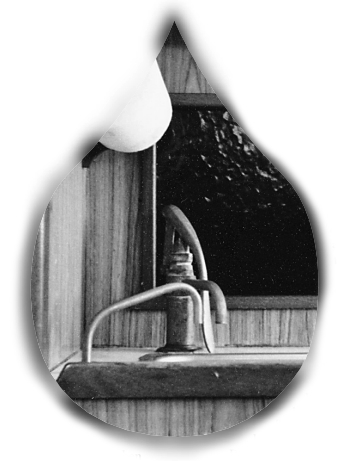
Install a hand pump for your fresh water (See photo, this page). Controlling the amount of water coming out of your faucet is one of the most important ways to conserve water. Foot pumps and pressurized faucets are more difficult to regulate than an old-fashioned hand pump.
A saltwater pump is wonderful to have aboard for water conservation. Rinsing the sink, your hands, your cans before opening them, or the countertops with sea water can save an enormous amount of fresh water.
Catch the dribbles
Keep a clean cup under your hand pump to catch any dribbles or over-filled cups. Always have it nearby so that more water can be added or withdrawn when measuring, cooking, or drinking.
Potatoes can be boiled in sea water. Pour the hot salt water into your wash basin, and you’ll have hot water for dishes that night. Give the potatoes a light rinse with fresh water, and they’re ready to use.
Pouring off water you just cooked spaghetti in? Pour it into a basin to be used again. Incidentally, only use fresh water to cook pasta. It becomes a sticky, slimy mess when cooked in salt water.
Wash fruits and vegetables in sea water that has a tiny bit of bleach added to it, instead of using your fresh water. Then let them dry thoroughly in the sun before stowing.
Reuse the water in canned foods whenever possible. If you’ll be cooking rice, you can add your canned-vegetable or canned-meat water to the water for the rice. It will flavor the rice and save you some fresh water.
When using your pressure cooker to bake bread or to cook rice or puddings, some recipes suggest you put your mixture in a separate bowl inside a pressure cooker atop a few inches of water. Substitute salt water for that outside water.
Washing dishes can be one of the most water-expensive chores aboard a boat. In warm climates we wash and rinse dishes in sea water. If we dry our dishes immediately with a towel, the salt buildup is not noticeable. The warm air seems to help finish the drying. In cooler climates, washing and rinsing in sea water doesn’t work for us as well. At those times, we wash in sea water and rinse in a little fresh water. Warming sea water on the stovetop in one of the pots from our meal with the addition of a little detergent helps begin the cleaning process. When it comes to rinsing the dishes, we pump a little fresh water into the sink, then use a clean cup to scoop and pour over the larger dishes to rinse them.
Seawater wash
Away from a water supply, we usually bathe with sea water. If the water is unsafe to swim in, or when we are underway, we use a bucket of sea water to get us wet. We lather up with an inexpensive shampoo — bar soap doesn’t lather in salt water. Then we rinse with a few buckets more. My daughter and I, with our thick hair, used an amazing amount of fresh water when we washed and rinsed our hair in the old days. Now we wash and condition our hair with buckets of sea water. We then quickly rinse our hair with a little fresh water from our portable shower — this helps prevent the terrible affliction of stiff, unmanageable hair we call “Barbie Hair.”
After our bath, we towel off immediately to keep the salt water from building up on our skin. We keep a few towels aboard just for saltwater use and wash them whenever we get to a port. If the towels get to be too cardboard-like, we bring out a few new ones. Then on a windy day, we hang the old towels up in the rigging. The wind will beat out most of their stiffness.
But, after a week of daily seawater baths, we start to yearn to be freshwater clean. That’s when we bring out our portable shower. We use an insecticide sprayer for our shower. By buying it new, we were sure that it had never carried any chemicals. Pumping up the pressure allows us to get a pressurized shower while using very little fresh water. When we are conserving fully, we only use the fresh water to rinse off. It feels wonderful! Especially after an overnight passage. Warming up the water a little on the stove before filling the shower allows us to enjoy a hot shower. Also, painting the spray bottle black allows you to warm your water on deck on a sunny day.

Twelve showers
As mentioned earlier, we keep a 5-gallon jerry jug of water for freshwater showers. If we are very careful, we can get 12 showers out of the 5 gallons, plus what the sprayer holds.
Our laundry is usually done when we are in a port, close to a water supply. We wash our clothes when we are away from a port only if we have extra fresh water and our tanks are full. This often happens when we catch rainwater. We have tried several times to wash our clothes in sea water and rinse in fresh. When it came to rinsing the clothes, it seemed as though we were using more fresh water to rinse out the salt residue than if we used all fresh water for the whole process. So now we wash and rinse in fresh and reuse whatever we can.
The first bucket of soapy wash water gets reused right away. Then the first rinse becomes the wash water for a second load. The second bucket of wash water gets reused. Then the second rinse water becomes the wash water for another load. We continue this until our wash is done or until we can’t spare the water.
Now that you have saved all of that extra gray water, what do you do with it?
- Wash down the decks with your water to get the salt buildup off your boat.
- Pour soapy wash water into the bilge to help keep it smelling fresher. Pump it out after an hour or so of soaking. Make sure to use water without any debris. We once got a grape lodged inside one of our bilge pumps. I never knew grapes could become such deadly projectiles.
- A little soapy wash water can also be used in the head to reduce odors. Let it sit in your pipes for an hour or so before pumping it completely out. When cruising in sea water, it seems to help the head to get a freshwater treatment once in a while.
- Water any plants you have with it.
- Rinse yourselves with it.
- Soak stained clothes in it.
- Rinse the salt buildup on your stanchions with it.
- Rinse the salt buildup on the standing rigging with it.
- Wash your dishes in it.
A cruising friend once said, “If you can’t see your hand in a basin of gray water, you know you’ve reused it enough.”
Conserving fresh water has become very important these days even on land. We hear the call to conserve in every news medium. Many states have severe shortages of water at certain times of the year or even all year long. Maybe the way to teach our society about water conservation is to put each person aboard a boat provisioned for a week with 10 gallons of fresh water and no hope for a refill until the week is over. Living aboard a boat for even short periods can quickly teach conservation of all kinds: space conservation, tool conservation, storage conservation, and especially water conservation. Think of the changes that could take place if we all thought about the loss of each drop or dribble of sweet fresh water down the drain.
As a family of four, the Forts have sailed more than 10,000 miles aboard Lindsay Christine, their Mercator Offshore 30 sloop. Their cruising has taken them along the West Coast of the U.S. (including Alaska), Mexico, and Central America as well as the western Caribbean. They currently sail part-time on the east coast of Florida.
Thank you to Sailrite Enterprises, Inc., for providing free access to back issues of Good Old Boat through intellectual property rights. Sailrite.com