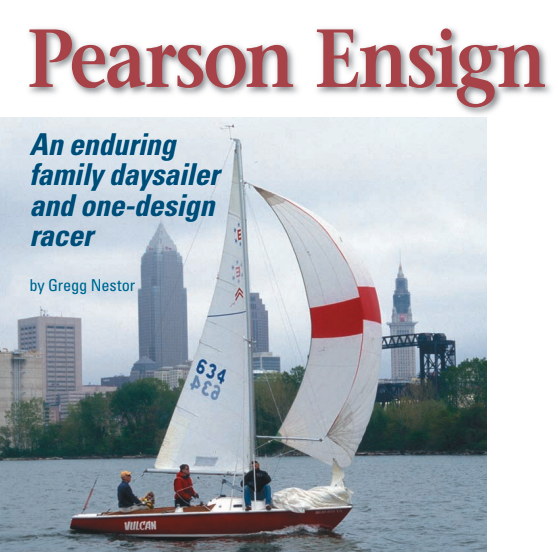
An enduring family daysailer and one-design racer
Issue 56 : Sept/Oct 2007
In 1962, Pearson Yachts of Bristol, Rhode Island, introduced the 22-foot 6-inch Ensign. Noted naval architect Carl Alberg developed the boat from the Pearson Electra, one of his previous designs. The Electra had been marketed as a compact cruiser with (albeit minimal) overnight accommodations. However, potential buyers had been less than enthusiastic. So the company decided to make a concept change: the Electra’s cabin was significantly reduced in size and the cockpit was increased accordingly. The end product was the Ensign, a big daysailer and one-design racer, which immediately found a niche. The boat’s stability, drive, and maneuverability made for a “Little Big Boat,” as it was soon dubbed, and the rest is history.
Pearson Yachts continued to manufacture the Ensign until 1983. Over its 21-year production run, a total of 1,775 Ensigns were built. Even though production ceased, the boat’s popularity did not wane. For the next 18 years, the only Ensigns available were those on the used-boat market, but interest was so high that in 2001 Ensign Spars of Dunedin, Florida, began building new Ensigns on a semi-custom basis.
Ensign Spars was founded in 1995 by Ensign sailor and enthusiast Zeke Durica. Originally, it was a part-time business that just made replacement masts and booms. Soon, however, the company was supplying a variety of parts and even refurbishing old Ensigns. After rescuing the original molds from a Texas field, Zeke entered into a unique arrangement with the Ensign Class Association and became the official licensed builder of the new Ensign Classic, which started with hull number 2000.
Today, Ensigns are the largest full-keel, one-design class in the United States. There are approximately 45 active fleets scattered among 20 states. Fleets are concentrated in Maine, Massachusetts, Long Island Sound, the Great Lakes, and Texas. In 2002 the Pearson Ensign was inducted into the American Sailboat Hall of Fame.
Design and construction
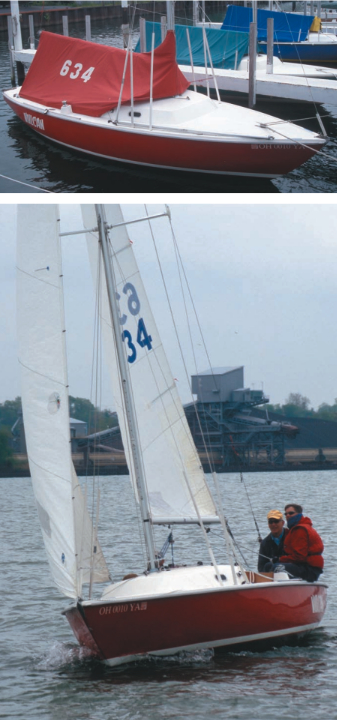
The Ensign exhibits all the classic Alberg touches: a flat sheer, low freeboard, slab-sided topsides with relatively firm bilges (for a 1960s full-keel hull form), and long overhangs. The boat’s most distinctive features include a long cockpit with teak coamings and a short cuddy cabin.
Both the original Pearson Ensign and the Ensign Classic are laminated to the same rugged scantlings. The hulls are solid hand-laminated fiberglass and the decks are cored. While the original boats employed end-grain balsa as the core material, the Classics incorporate closed-cell foam. Pearson pioneered the use of balsa as a core material. While it has its merits — light weight and excellent compression strength — balsa has as its primary drawback the potential to delaminate from the fiberglass skins if water-soaked. The use of modern closed-cell foam has some of the benefits of balsa without retaining this draw- back. Sealed in the lazarette, as well as beneath the cabin sole and behind the keel trunk, additional closed-cell foam imparts positive flotation to the Classics. The hull-to-deck joint is an outward-facing flange that is chemically bonded, mechanically fastened, and covered with a one-piece vinyl rubrail.
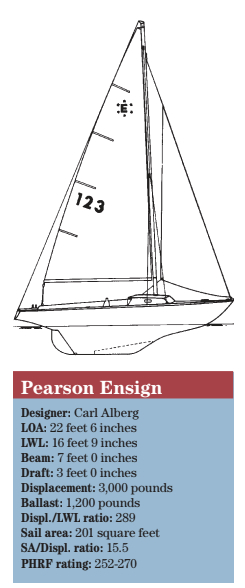
The Ensign sports a full keel with an attached rudder. The original boats were fitted with wooden rudders. On the Classic these wooden appendages have been replaced with rudders made of fiberglass. Both the Ensign and the Ensign Classic displace 3,000 pounds, including 1,200 pounds of internal lead ballast, and draw 3 feet. That’s a ballast-to-displacement ratio of 40 percent.
Notable feature
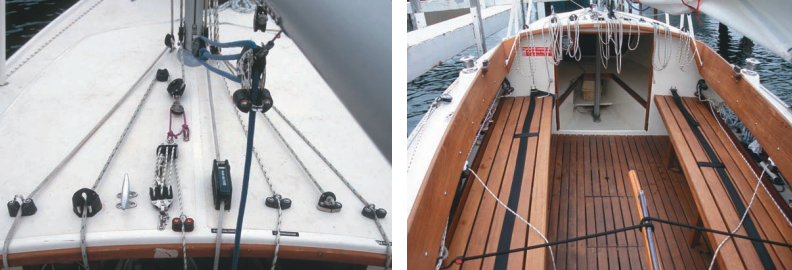
The boat’s most notable feature is its generously long and deep cockpit that’s surrounded by teak coaming boards. It measures a whopping 8 feet 8 inches long and can easily accommodate six to seven crew, making it an ideal family daysailer. When raced, the spacious cockpit ensures that the usual crew of three or four can move about completely unencumbered.
Needless to say, one won’t be buying or owning an Ensign for the cabin accommodations. While the doorway to the cuddy cabin is wide, the cuddy itself is just over 5 feet long and 6 feet at its widest and sitting headroom is a mere 3 feet 10 inches. The cuddy does contain short V-berths, however all other cruising comforts are optional: a portable toilet, small table, V-berth cushions, and cabin doors. Even when fitted with these amenities, the cuddy is simply a place to get out of the elements, to take a break after a long day of sailing, or stowage space for gear. To cruise (weekend camp) with an Ensign, a boom tent is mandatory, since most activities, including cooking, will take place in the cockpit.
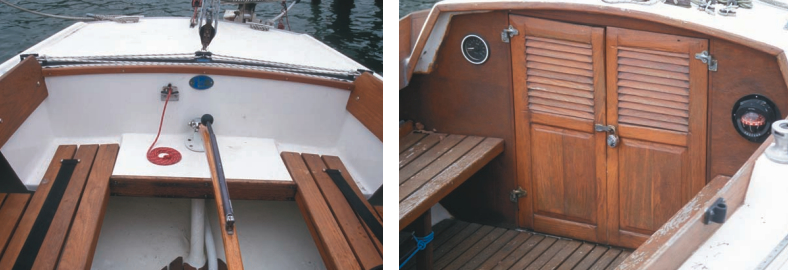
Additional eye-appealing features include a pair of fixed oval portlights that naturally illuminate the cuddy, teak seats, and a teak floor grate in the cockpit. For a reduction in price, as well as a reduction in maintenance, the Ensign Classic can be purchased with fiberglass seats and flooring. Overall, the finish work of the Pearson Ensign is very good and that of the Ensign Classic is excellent.
Rigging
The Ensign has aluminum spars and a fractional rig with a sail area of 201 square feet, comprised of a 140-square-foot main and a 61-square-foot jib. The standing rigging includes a pair of cap shrouds, fore and aft lowers, a headstay, and an adjustable backstay. The mast is keel-stepped. Single-speed headsail winches are mounted on fiberglass pedestals, with the 1-inch tracks located outboard. The mainsail features end-boom sheeting that terminates at a traveler, which is situated forward on the lazarette. The halyards are external, the outhaul is internal, and all control lines are led aft to cam cleats mounted on the coachroof. Additional standard rigging includes a Cunningham, boom vang, and spinnaker halyard and pole control lines. The laminated wooden tiller exits the cockpit sole just forward of the lazarette.
Underway
The Ensign has an easy motion in a seaway and the full keel gives it good directional stability. The boat revels in a stiff breeze and steep seas and is reluctant to pound even when sailing hard on the wind. While these attributes, along with the boat’s forgiving sailing qualities, make for an outstanding family daysailer, its easily driven hull and nimbleness appeals to the racer. The boat’s PHRF rating is between 252 and 270; however, it’s more fun to race against other Ensigns.
It’s a bit difficult finding similar designs of the same vintage for comparison: the smaller Rhodes 19 keel version rates 258 to 267; an O’Day Tempest 23 rates 243; and the slightly more modern Yankee Dolphin 24 rates 252 to 270. If nothing else, these numbers say that the full-keel Ensign acquits herself nicely.
Things to check out
In addition to typical age-related items, there are several areas to pay close attention to when surveying an older Ensign. They include the balsa-cored deck, the wooden rudder, osmotic blistering, the void in the keel, and the mast step.
Check the deck for delamination caused by a balsa core saturated with water. Pay keen attention to areas around fittings. Delaminated areas will sound dull and hollow when struck with a plastic hammer or the handle of a screwdriver.
The wooden rudders Pearson built in its early days (late 1950s and ’60s) were solid mahogany planks fastened on end by bronze drift pins. Over time, both the wood and fasteners deteriorate from a variety of causes, from hydrolysis to teredo worms to corrosion.
If the rudder is determined to be in sound condition, it can be sheathed in fiberglass and epoxy, thus protecting it and extending its service life. If found to be in bad shape, Ensign Spars will be happy to provide a fiberglass replacement.
While Pearson Yachts had a reputation for above-average construction, with few instances of blistering in its early boats, there have been some reported cases. While these blisters may be cosmetic in nature, if they are not addressed properly additional water penetration is likely to occur.
If you live in a climate in which your Ensign will be subjected to freezing weather during the winter or if the boat you’re interested in buying has lived north of the Mason-Dixon Line, another area to watch is the void in the keel where water can collect, freeze, expand, and finally crack the keel. Many Ensign owners drill a hole each fall as the boat is hauled out, and patch it each spring prior to launch. Every knowledgeable Ensign sailor knows where to drill the hole. Over the years, a few boats have been equipped with threaded plugs at this spot. Other Ensigns have been modified to pump out that cavity from above with the addition of a 2-inch-diameter hole in the fiberglass below the floorboards.
An Ensign sailor tells us that a final area to inspect carefully is the mast step. Pearson used some common wood and plywood (not white oak) under the floor beneath the mast step, according to Pete Wier.
“After many years of being wet and drying out, it rots,” he says. “The mast pressure pushes down on the adjustable aluminum mast step, and it either breaks or the whole floor gives way. The repair isn’t too difficult if the soft floor is fixed before it breaks.” Pete also notes that any original Styrofoam flotation — in the forepeak and under the bunks in the cuddy cabin — is likely to be saturated.
Conclusion
The Ensign is an excellent family daysailer and crackerjack racer. It’s a great boat on which to teach or learn the art of small boat sailing. With more than 1,700 Pearson Ensigns built, as well as new Classics being made today, the selection is almost limitless.
Prices on the used-boat market range from $1,500 to $8,000. Condition and equipment are the determining factors. If you hanker for a new Classic, expect to pay around $30,000 for one that’s pretty well tricked out.
Gregg Nestor, a contributing editor with Good Old Boat, has had a lifelong interest in all things aquatic. Gregg and his wife, Joyce, cruise Lake Erie aboard their Pearson 28-2 and also trailersail an O’Day 222. He has just completed his second book: Twenty Affordable Sailboats to Take You Anywhere.
Thank you to Sailrite Enterprises, Inc., for providing free access to back issues of Good Old Boat through intellectual property rights. Sailrite.com