What you need and how to use it
Issue 56 : Sept/Oct 2007
Fire extinguishers are classified by letters and numbers, depending on the class and size of the fire they are designed to handle. The letter, or letters, indicates the type of fire; the number (usually using Roman numerals) indicates the capacity of the fire extinguisher — the larger the number, the greater the capacity.
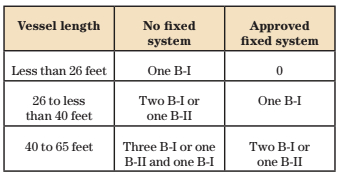
You are likely to see fire extinguisher requirements, established by the U.S. Coast Guard, based on vessel length, as shown in the chart on the facing page.
As an example, D-type fires involve chemical materials, such as magnesium, potassium, sodium, and titanium. For the recreational sailor, however, the on-board fires and fire extinguishers are usually the A, B, and C types. A simple mnemonic device for remembering these three most common fires and extinguisher types is:
A = Ash (those fires that produce an ash, such as wood, paper, etc.)
B = Boil (those fires where the combustible source is something that can boil, for example, a liquid, such as oil, kerosene, diesel, gasoline, etc.)
C = Current (electrical fires)
An extinguisher should only be used on the type of fire for which it is rated. For an A-type fire, water can be used as the extinguishing agent. However, this could be disastrous if used on flaming gasoline or on an electrical fire.
Extinguishers used on recreational boats are usually multi-purpose, such as a type BC or an ABC. These may emit a solid, liquid, or gaseous chemical to quench the fire.
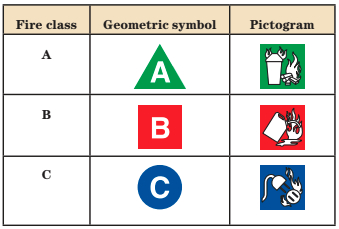
Although there is no official standard for the color of fire extinguishers, in the case of A-, B-, and C-class fires red is often the color of the extinguisher. Extinguishers may indicate the fire-extinguisher type with a letter enclosed in a colored geometric symbol and sometimes with a pictogram. For A, B, and C extinguishers these are:
Extinguishing agents
Water – Water can be used on A-type fires but is unsuitable for B- or C-class fires.
Dry-chemical – The extinguishers that are most commonly seen on recreational boats use a variety of substances and are pressurized with nitrogen. For BC fires, this chemical is most commonly sodium bicarbonate or potassium bicarbonate. ABC-rated extinguishers may use monoammonium phosphate, a yellow powder that leaves a sticky residue. This residue can be damaging to electrical appliances and electronic equipment. Dry chemicals require an immediate, long, and messy cleanup operation but have the advantage that this residue is non-flammable, which can reduce the likelihood of the fire reigniting.
Foam – These extinguishers, usually water-based, are also called aqueous foam. They are rated for class A and B fires.
Carbon dioxide – This non-flammable gas is rated for class B and C fires but doesn’t work well on class A fires. It extinguishes by displacing oxygen and leaves no harmful residue or cleanup operation, making it ideal for fires in electrical and electronic equipment.
Halon – This gas is a class A, B, and C extinguisher when its capacity is 9 pounds or more; smaller units have a BC rating. Halon is a chlorofluorocarbon that is believed to cause damage to the ozone layer. Due to these concerns, the manufacture of halon extinguishers has ceased, however existing systems may remain in service.
FM-200 – This is an expensive halon replacement. It is a clean, gaseous extinguisher that is safe for occupied spaces. It is oxygen-depleting and non-corrosive to sensitive electronic equipment and has an ABC rating. Although not often seen in stores or catalogs, it is available on special order.
FE-241 – Chlorotetrafluoroethane is another halon replacement agent that is considerably less expensive than FM-200. It leaves no residue. However, it can cause health problems if inhaled. It is approved for unoccupied spaces, such as an engine room, and can be installed for either automatic or manual pull-cable discharge. It is ABC-rated.
FE-227 or HFC-227 – Heptafluoropropane is a halon replacement approved for occupied spaces and has an ABC rating.
Halotron-1 – This is newly approved by the EPA and is safe for electrical and electronic fires. It leaves no residue but can cause immediate and serious health problems if inhaled in concentrations above 2 percent. Ratings are for BC in the smaller units and ABC in larger weights.
Halon substitutes are, across the board, less efficient than halon itself, so the containers are considerably larger than the old halon units for the same capacity. As an example, you would need 50 percent more FM-200 than halon to extinguish a fire.
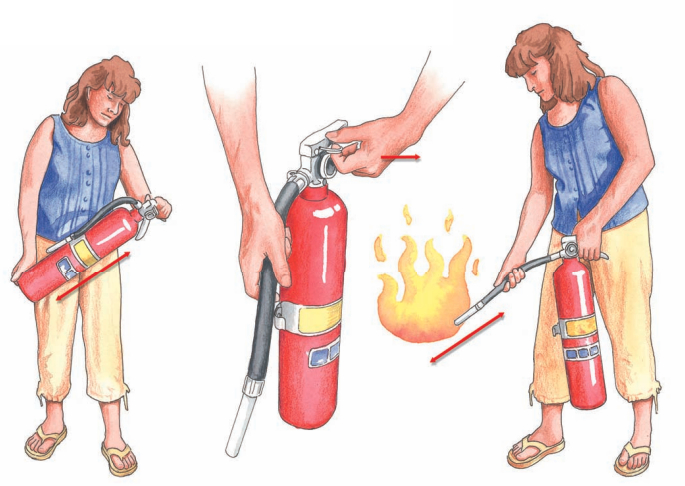
Whenever you purchase any extinguisher, check to see what class ratings are specified, since the weight of the extinguisher can sometimes be a determining factor in the class rating. The basic steps for using a fire extinguisher on board are:
- If it is a dry powder extinguisher, shake vigorously.
- Pull the pin.
- Stand back several feet and aim at the base of the fire.
- Sweep from side to side.
Coast Guard regulations state that all powerboats — and all sailboats with engines — must carry one or more U.S. Coast Guard-approved fire extinguishers.
The pressure and/or weight of your onboard fire extinguishers should be checked regularly — they’re not worth having if they won’t work. Once you have used a fire extinguisher, either have it recharged (if it is a rechargeable type) or replaced. When purchasing a fire extinguisher for your boat, be sure that it is a U. S. Coast Guard-approved type. Also be sure your extinguisher locations on board are well marked and the extinguishers are easily accessible.
Thank you to Sailrite Enterprises, Inc., for providing free access to back issues of Good Old Boat through intellectual property rights. Sailrite.com