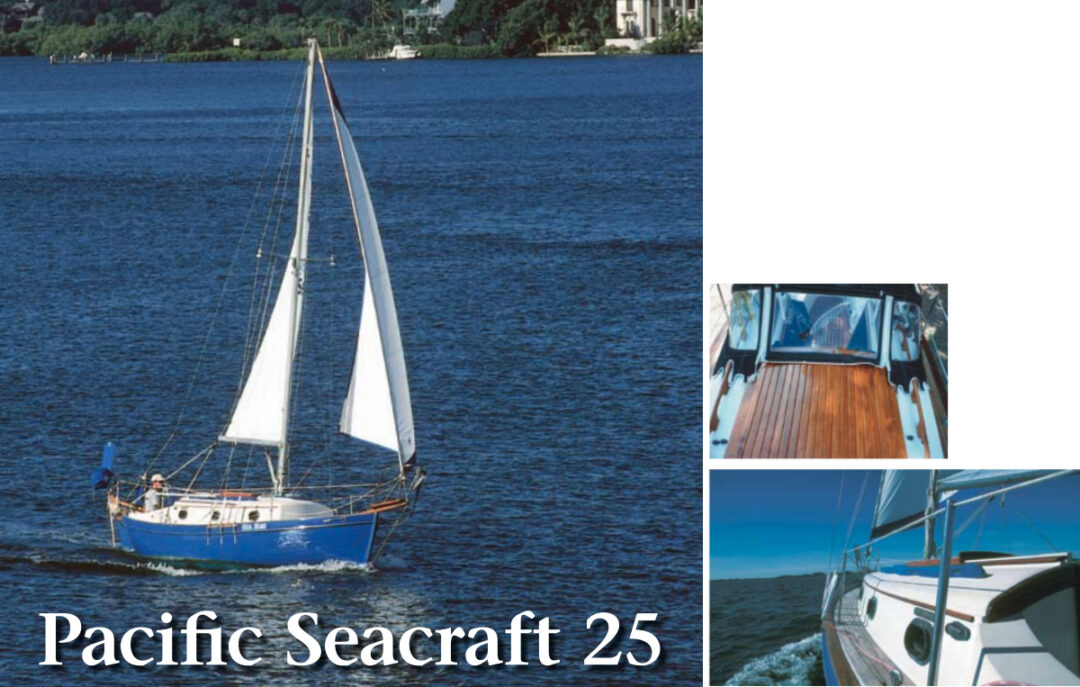
A trailerable deep-sea cruiser with an impeccable pedigree
Issue 35 : Mar/Apr 2004
When I leaf through my picture album, I occasionally chance upon a photo that, even after all these years, takes my breath away. It’s faded nearly to sepia and peppered with saltwater spots, but I see the scene as clearly as I did on that misty autumn morning on the Seattle docks when I clicked the shutter. I see the rusty hulk of the coastal freighter, Taku Maru, 10 days out of Juneau, her cargo crane swinging slowly out over the pier. I see a boat, suspended in the mist, by which I still unconsciously judge all small cruisers: a double-ender of exquisite proportion, her gleaming black hull and crowned house set off by salty teak and bronze fittings. The Pacific Seacraft 25.
In the end, the PS25’s only lasting claim to fame may be that she was the “original” Pacifi c Seacraft sailboat. She was conceived by Henry Mohrschladt, creator and president of the fledgling company, and styled after the well-known no man’s land workboats of the late 1800s. These workboats were equally praised by lobstermen and cod fishermen working the Outer Banks in heavy seas and quarrelsome weather.
The little PS25 that these work-boats inspired was destined to be the forebear of a respected line of offshore cruisers. It is in this small cruiser that we find the roots of the legendary Pacific Seacraft commitment to excellence, a quality leading Fortune magazine, in later years, to name them “One of America’s 100 best products” and stating quite simply, “Pacific Seacraft builds the finest cruising sailboats of their size in the world.”
My wife and I spent several years, including a year as liveaboards, putting thousands of miles under the keel of a 25. Though distanced now by time, her virtues and frailties are yet fresh in my mind. Was she then the ideal small voyaging boat? In the cold hard light of day, I must admit that she was not. Nor is any other boat her size that I am acquainted with. The juxtaposition of small boats on large oceans for long periods of time is fraught with tradeoffs.
Not her forte
Contrary to some accounts, she was not a quick boat . . . certainly not in today’s terms. But that was not what she was about. Neither was she fond of slogging to weather unless driven to it, a fault I laid to her shoal draft and cut-away forefoot. Yet these were the very items I praised when rock-strewn waters called for nimble handling or shallow coves offered a quiet anchorage. Held close to the wind in rough water, she could be somewhat wet, a fault common to her design type and one easily alleviated with a dodger and proper weathercloths.
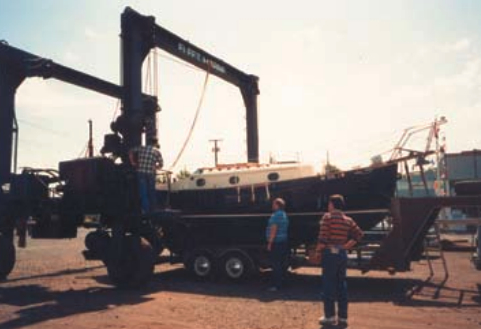
She was designed as an ocean-capable pocket cruiser, one that “could be transported by trailer.” She was pushing the envelope as a viable trailerable boat: one that could be dunked in a nearby lake on the weekends. At nearly 7,000 pounds with trailer, it took a full-size, three-quarter-ton pickup to handle the job. Our boat took half a day to launch and commission for “offshore readiness.” That said, we towed her more than 14,000 miles and splashed her down in both oceans time after time. We covered cruising grounds so varied it might have taken her many years to travel to them on her own bottom. Our longest continuous voyage was from Washington to the Gulf of Alaska and, with the exploring along the way, it took nearly all of one summer, a memorable summer indeed.
The bulk of the PS25 run was manufactured from 1975 through 1980 with our own Raven, hull #257, being the last. Early offerings could appear quite plain: sloop rigged and without the signature Pacific Seacraft bowsprit. Even then, however, they featured the heavy layup and furniture-quality joinery that came to epitomize the breed. Bronze opening ports and heavy bronze deck fittings were standard, as were inboard diesels, Yanmars usually.
The BMW D7 was an option, a wonderfully tough and smooth running little engine with but one glaring flaw: its charging system consisted of an internal flywheel-type magneto that required pulling the engine and breaking apart the transmission case to effect replacement. I’ll not soon forget wrestling it out and dismantling it on the dock in Ketchikan. That it was a one-person job was in its favor, as the distributor assured me it was not an uncommon chore. There was room in the engine compartment for a two-cylinder engine, of perhaps 12 horse-power, and in the tides and currents of the Pacific Northwest I often thought it would have been an advantage.
Four swing-keelers
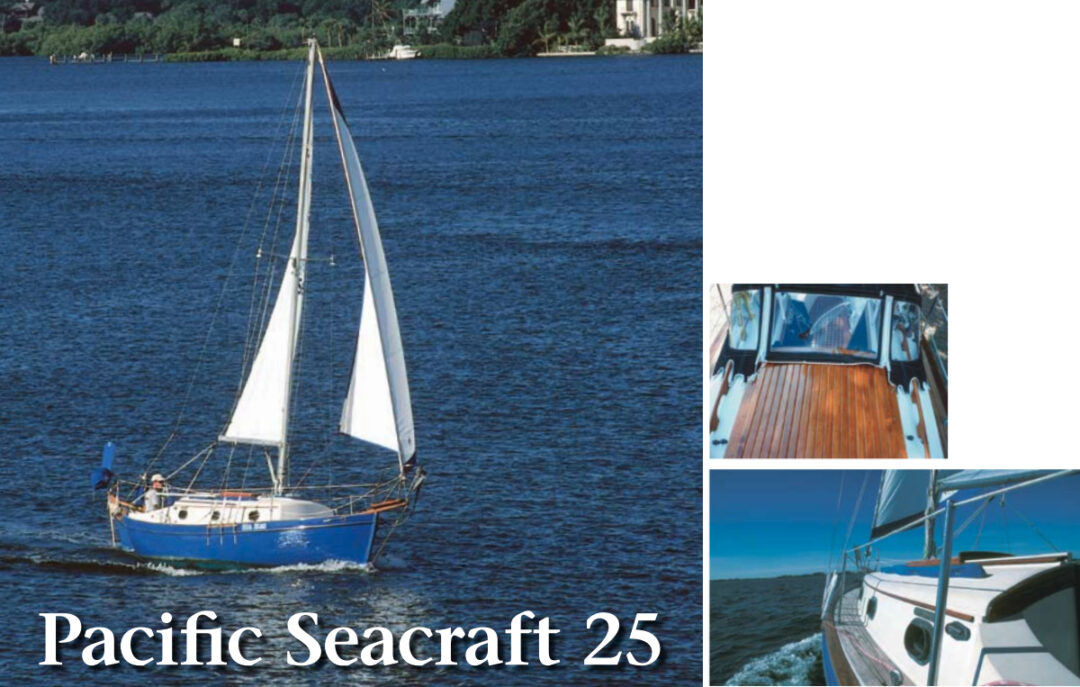
There are a few owner-finished boats out there and only recently we learned of a swing-keel model as well. It’s said that only four were built. Other options included various hull colors, teak seahoods for teak hatches, teak decks, cockpit grates, and cutter rigs (most later models had them) with club-footed staysails. There was even a private-cabin option with a full forward bulkhead and a wonderfully crafted door.
Her massive stern-hung rudder and stout tiller were of a caliber to make a Viking proud; so massive, in fact, that we elected to unship the rudder for trailering, to avoid stress on the gudgeons. It was all I could do to raise it up in place when re-commissioning. It was supported at the lower end by a heavy bronze gudgeon attached near the bottom of the keel, with just enough of a slot left to catch an occasional crab pot, though it was easily pushed off with a boathook.
We judged the cockpit to be of nearly perfect size and shape for a seagoing boat, with wonderfully rounded corners for lounging, a roomy stern lazarette, and spacious port-side locker. The foot-well was not overly deep and proved to be adequately drained. Engine controls fell close to hand, and I thought the kill switch beside the levers a nice touch. A bilge-pump panel, mounted on the opposite side of the cockpit, was easily operated while at the tiller. The floor of the cockpit was removable if one cared to undo the umpteen bolts securing it, though if it was not replaced carefully leaks could ensue. Later models did not seem to have that problem, and engine access in this manner could be a godsend in extreme circumstances. All normal service could be performed after removal of the companionway steps. A removable side panel afforded further room to work.
Low bridge deck
The bridge deck on the boat is a tad low at 9 inches. The cure was to keep at least one of the hatchboards in place when under way (two in rough weather) and to lock them in place, of course. In our early exuberance, we personally examined over a dozen PS25s from one coast to the other and conducted sea trials on a number of them. We never encountered one with water intrusion of the core. Factors in this were her nicely crowned cabintop and deck as well as her sturdy, well-bedded fittings. Nor did blistering of the hull seem to be a problem in any but a few minor cases. Roller furling was rare in those days and considered to be a frou-frou addition not to be trusted. I’m sure many are in place today. A modern 135 roller genny would have made life easier by a bunch.
The boat is heavily rigged with oversized chainplates mounted to the outside of the hull, an arrangement I have always admired. All fittings are well backed by stainless plates and nearly impervious to leaks. The hull-to-deck joint was built to a standard seldom attained at the time: mating flanges, bedded in 3M 5200, through-bolted every 6 inches, then glassed on the inside. When we were in desperate circumstances, it made my heart grow big just to think of it. A staysail stay forward and a stout stainless-steel-wire topping lift aft provided some redundancy for the cutter rig and additional peace of mind.
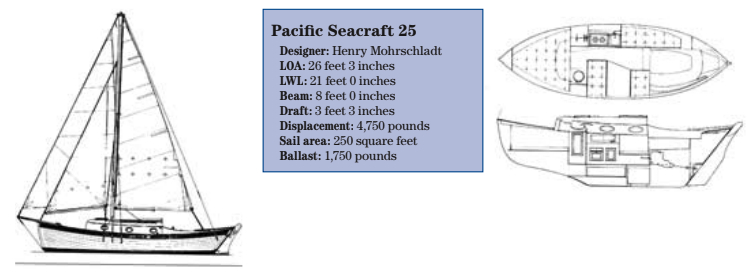
Her keel was wide and flat-bottomed. I recall the time we let Raven dry out on a hard mudflat with only the dinghy oars and whisker poles wedged under her rubrails for support. She sat as solid as a hen on a nest while we did a touch-up of the bottom paint. One of her selling points was the ballast, a 1,750-pound piece of solid-cast, encapsulated lead whose compact mass not only gave superior stability but also left usable space in the bilges the length of the cabin sole.
The deep narrow fuel tank (approximately 20 gallons) was also in the bilge, just forward of the engine compartment, a proper place for a fuel tank in my opinion. Unfortunately, Pacific Seacraft for years insisted on aluminum tanks, and there, deep in the bilge, despite having runners under it, the tank would invariably develop saltwater corrosion and pinhole leaks. This typically occurred at six to eight years, and the job of replacing these tanks became legend in the industry.
Common interior
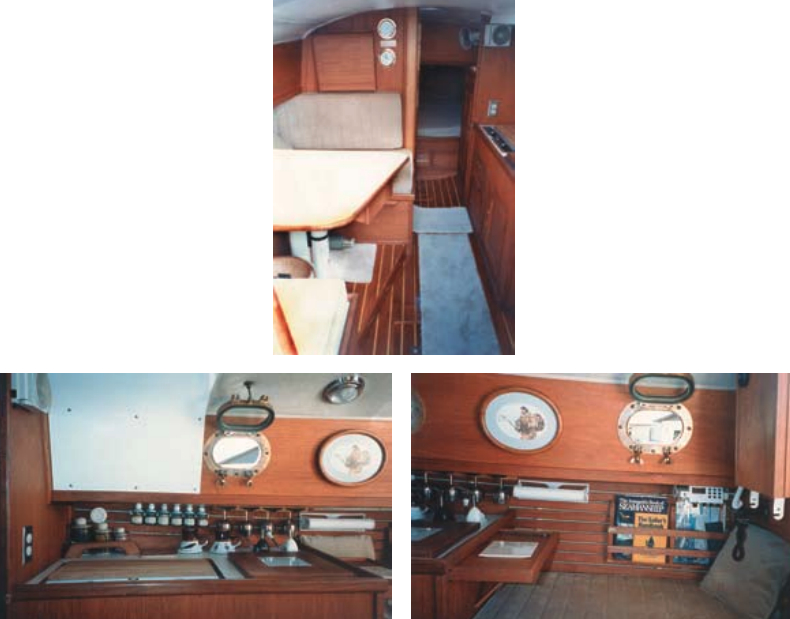
The interior of the boat is well documented and was a common arrangement of the day, though better finished than most. Her headroom of 5 feet 2 inches was always a non-issue for the mate at 5 foot 1 inch. As for me, I have often said that on a small boat one is only below to eat, sleep, or read a book . . . none of which I care to do standing up.
All bulkheads and furniture were stoutly bonded to the hull or deck for superior hull strength, stiffness, and accessibility. It was a labor-intensive method seldom seen in today’s world of fiberglass interior pans. Her portside dinette was well thought out and while now considered old-fashioned, we found it to be cozy and livable. It did convert to a double berth should the need arise. The 14-gallon poly water tank was under the longer of the dinette seats and the so-called icebox under the shorter. To delve into the cooler, one found it necessary to hold up the cushion with one’s head while extracting the required viands. When sailing northern waters, we kept our perishables in the bilges.
The starboard quarterberth was described as a sea berth but, as it shared that side with the galley, most of the legroom was under the cockpit sole. It was a bit like getting into a coffin — not for the claustrophobic. The galley itself was of useable size and well laid out with freshwater and seawater hand pumps. It was available with pressure kerosene or alcohol stove, neither of which I can recommend.
The boat’s headliner was identical to today’s most expensive Pacific Seacrafts and has probably sold more boats for them than any other interior feature. Off-white, of heavy vinyl, impeccably installed with hidden zippers for access to overhead wiring and fittings, it became yet another Pacific Seacraft signature, seldom equaled in the industry. The forward cabin was well planned, with a starboard-side hanging locker and a port-side head. The V-berth proved suitable for those of average stature. We found it to be comfortable, even over a long period of time. While her interior accommodations were in keeping with her size, the addition of a dodger and rain fly could open up the interior of this boat considerably, and I would consider them required equipment for extended cruising.
Handled it with aplomb
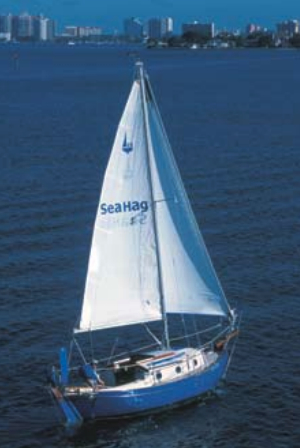
Having sailed this boat for extended periods in severe weather and sea conditions (not intentionally I must confess), I am happy to report she handled it all with aplomb. Her pointy little stern would indeed rise to slice a
following sea with buoyancy to spare. She had a fairly light helm and would track like the proverbial train when properly balanced, this in spite of her cutaway forefoot. Light air did require every scrap of sail, but in anything over 8 knots she moved surprisingly well. It was not unusual to attain hull speed when reaching in 12 to 14 knots of wind. Being conservative, we would normally tuck in a reef around 16 knots. Initially a bit tender, she stiffened nicely at 10 degrees of heel.
Near to my heart was her ability to lie hove to. With a reefed staysail and triple-reefed main, she would present her shoulder to the sea and ride the waves like a duck.
John Vigor, in his excellent book, Twenty Small Sailboats to Take You Anywhere, captured the essence of the PS25 when he called her “sweet natured,” a term I had not previously thought to apply to a boat, but one that fits the 25 so perfectly that it should have been the headline for her brochure. The boat’s willingness and ease of handling saved our bacon on several occasions in our early days. For those enraptured with the traditional singlehanded sailing vessel, she was well suited to the dream.
Brand new in 1980, the Raven, with every conceivable option, sold for a bit over $30,000. A more standard version was nearer to $23,000, up some $3,000 over earlier years. Today, a good used example might be had anywhere from $16,000 to $20,000 depending on upgrades and condition. Quite a reasonable price for a boat that can “take you anywhere.”
The demise of the PS25 was preordained with the introduction of the Bruce Bingham-drawn Flicka to the Pacific Seacraft line. This 20 footer’s standing headroom was only part of her appeal; her masterful use of space and more modern “open concept” interior proved to be the telling factor. I always thought the 25 to be the more elegant and esthetically pleasing of the two. In any case, the Flicka proved a fine addition to the line and worthy to assume the crown.
Some years ago I was informed by the factory that the molds for the little PS25 had been shipped to Japan. Their ultimate fate remains unknown.
Thank you to Sailrite Enterprises, Inc., for providing free access to back issues of Good Old Boat through intellectual property rights. Sailrite.com