Persistence pays off with a solo solution
Issue 90: May/June 2013
Almost every boat manufacturer eventually tries its hand at designing a mast-raising system, with varying degrees of success. While I was with C&C, I was project manager on the Mega 30 and, while with Hunter, I headed the design team under Warren Luhrs that produced the Hunter 23.5 and 26 water-ballasted trailerables. All three of these boats were built with self-contained mast-raising systems.
The goal of every deck-stepped mast-raising operation is that it be self-contained, safe, and easily operated by a small number of people.
These operations always involve two components. One is the mechanism for raising and lowering the mast and the other is a system for stabilizing the mast to prevent it from oscillating from side to side during the process.
As it’s being raised or lowered, the mast rotates around a pin in the mast step or tabernacle. Leverage is provided by a gin pole or by an A-frame pivoting at the deck at a point in line with the mast step or chainplates. Either of these systems is operated by a block and tackle (often the mainsheet tackle) attached at the bow or a line led forward around a block at the stemhead and aft to a cockpit winch. The connection from the gin pole or A-frame to the masthead is inevitably the jib halyard.
Because the pivot point at the mast step is almost always higher than the chainplate pins — due either to the crown of the deck or the mast being stepped on a deckhouse top — the shrouds themselves cannot be used to provide the required transverse support unless the chainplate pins are raised to be perfectly in line with, and on the same axis as, the mast-heel pivot pin. Some boat owners have actually added stainless-steel chainplate structures to achieve this, but the most common solution is to mount lifeline stanchions in line with the mast-heel pivot pin and weld eyes to those stanchions in line with the pivot-pin axis. To these eyes are attached the bottom ends of transverse support wires led to attachment points on the lower section of the spar at a height easily reached from deck once the mast is raised so that it can be disconnected and removed.
When visiting my old friend Danny Klacko at Klacko Spars in Oakville, Ontario, recently, I was intrigued when he said, “While you’re here, I want to show you something on my C&C 27. I’ve been working on mast-raising systems for more than 40 years, and I think I’ve finally developed the absolute best solution for any existing boat with a deck-stepped mast of virtually any size.”
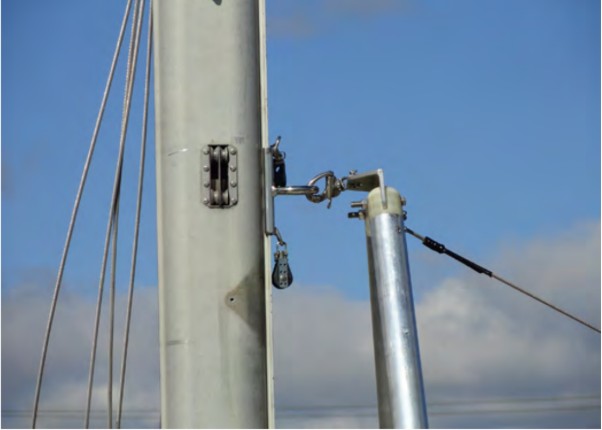
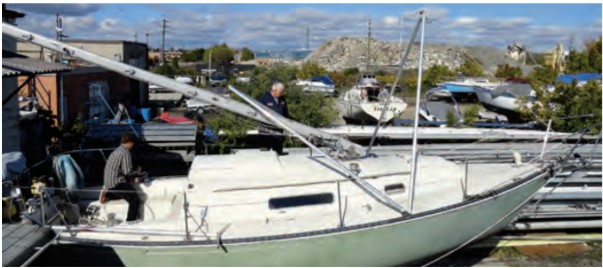
His boat was sitting behind the shop on her trailer with the mast lowered. At the word from Danny, the young man on board started cranking on the cockpit winch and the mast rose from the horizontal to the vertical in less than a minute. At a nod from Danny, the line on the winch was eased, and the mast reversed its trajectory. At all times the mast was completely under control with no evidence of sideways oscillation as it went through its arc.
Articulating A-frames
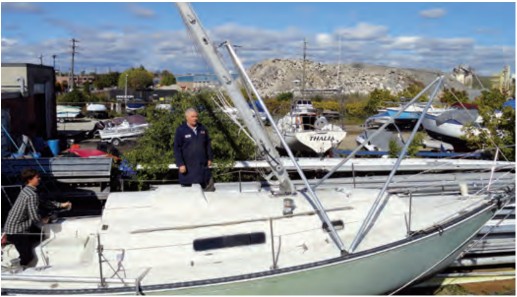
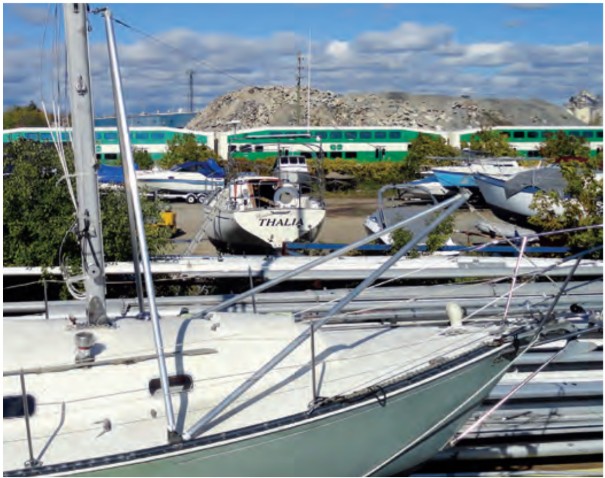
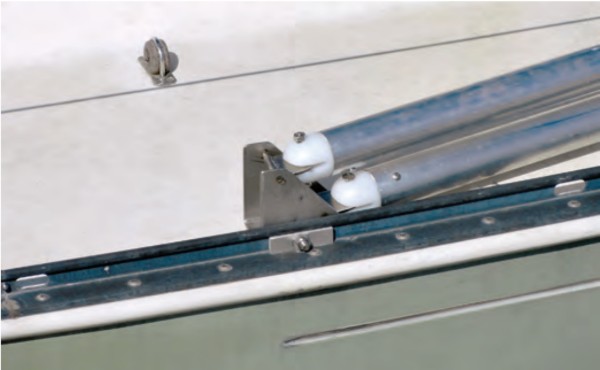
The unique feature of the Klacko system is the use of two connected A-frames mounted on common deckplates port and starboard, with the apex of the aft pair attached to the car on the spinnaker-pole track with a snapshackle.
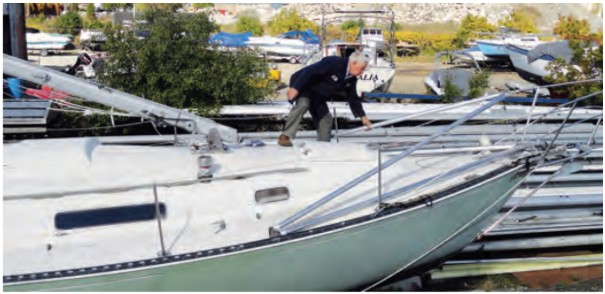
The aft A-frame supports the spar laterally, independently of the shrouds. The apex of the forward A-frame is connected to the apex of the aft frame with a stainless-steel wire. The lifting force is applied with a line led through a block on the stemhead and directly aft to a cockpit winch. When the mast is down, the aft frame is almost horizontal and the forward frame is vertical. As the mast is raised, the frames rotate as well, with the forward frame becoming horizontal and the aft frame vertical when the mast is up.
Once the mast has been raised and the forestay hooked up, the the aft A-frame can be quickly disconnected from the spinnaker pole car and the A-frames folded for storage.
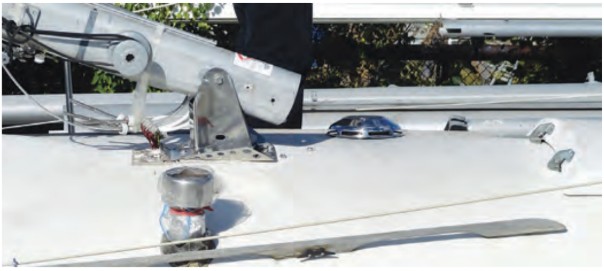
The key to this system is the use of a spinnaker-pole track with a freely moving car. Since the mast and the aft A-frame rotate around different pivot points, the car must be able to move along the track as the mast rotates about its pivot. For sailors who don’t have a spinnaker-pole track and don’t want to install one, a bridle around the mast or even a 12-inch-long link plate between the apex of the A-frame and the fixed point on the mast would work, but neither system offers the same amount of transverse fixity that the spinnaker-pole track and car provide. Mounting a short length of track and a car, even if the boat is not equipped with a spinnaker, is still the best solution.
Danny Klacko, after 40 years of development, freely shares this concept with anyone who would like to copy it.
Rob Mazza is a Good Old Boat contributing editor. A sailor by passion and yacht designer by vocation, his long career around sailboats began at C&C Yachts back when now good old C&Cs were cutting-edge new.
Thank you to Sailrite Enterprises, Inc., for providing free access to back issues of Good Old Boat through intellectual property rights. Sailrite.com