A versatile trailerable that’s as divisive as it is popular
Issue 90: May/June 2013
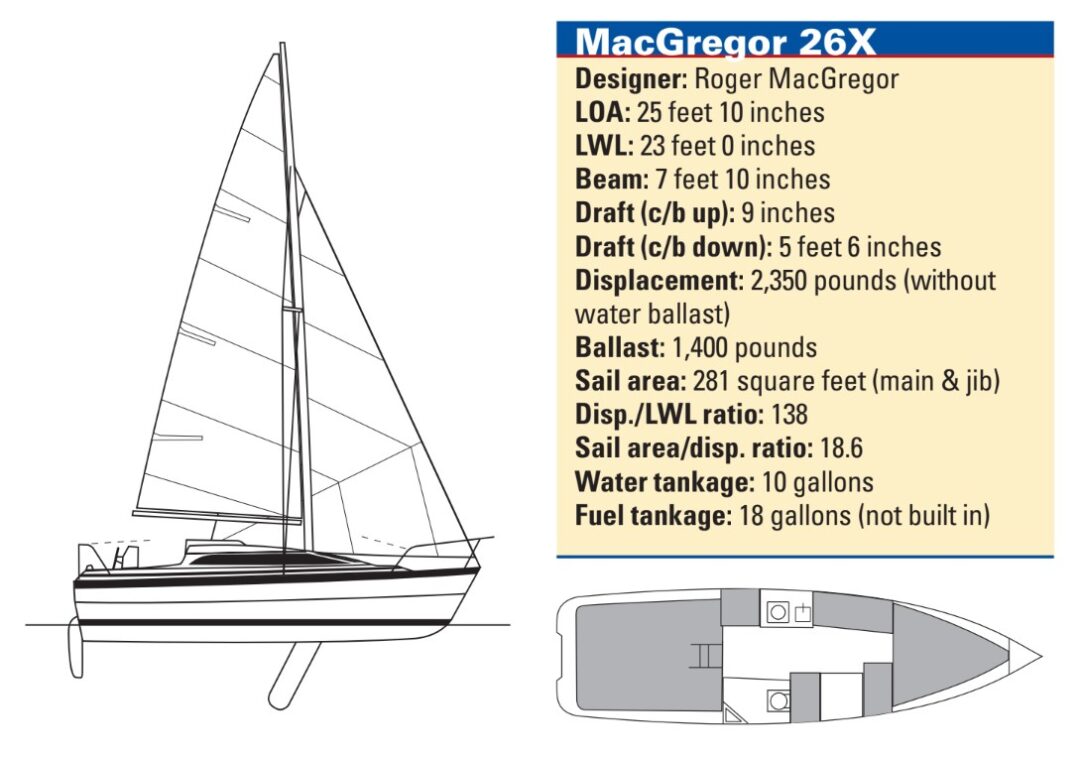
Perhaps there will never be a more controversial sailboat to appear on the pages of Good Old Boat than the MacGregor 26X. It’s a love-it-or-hate-it boat. Those who own them seem to love them; they say the boat fills their needs and they can overlook the its shortcomings. Other sailors are put off by its powerboat aesthetic and what they perceive as a lack of quality. The MacGregor 26X certainly does not look like the typical sailing yacht.
John and Pam Cappitelli of Rockford, Illinois, purchased their 1999 26X in Iowa. John immediately towed it to Fort Myers, Florida, where he obtained a slip in the municipal marina. And that’s where it stayed the first winter, serving as a floating home while John wintered in Florida and Pam commuted back and forth from Illinois when she could get away from work. At the end of the season, John towed it home behind his medium-sized SUV. The following year found them owners of a condo in a high-rise with a slip on the Caloosahatchee River near downtown Fort Myers.
When I met with John in Fort Myers, he had yet to sail the MacGregor 26X. He had previous sailed as crew aboard other boats, but setting up and sailing the MacGregor was a new experience for him. I helped him rig it and get out sailing.
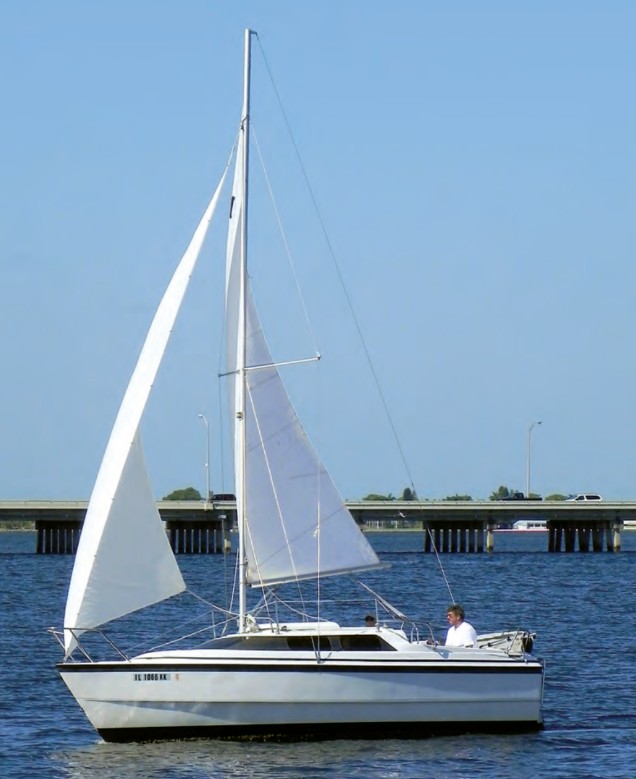
Their slip is near the mouth of the river where it is wide enough to sail all the way out to the Gulf of Mexico. With its 50-horsepower outboard motor, the MacGregor can quickly motor into a stiff breeze or against a strong current for an easy run back. This is the kind of sailing that John and Pam like to do.They have no need for a boat that can take on the roughest conditions because they simply won’t go sailing on very windy days. Nonetheless, the MacGregor 26X can handle much more in the way of weather than what John and Pam put it through. But their use highlights the pleasure of inshore sailing that is all many sailors care to do, and for whom comfort, low overall expense, and ease of maintenance mean much more than offshore capability or performance. Their experience is typical of many MacGregor 26X owners.
History
Roger MacGregor famously wrote his master’s of business administration thesis at Stanford University on boat-building, and soon after, in 1964, founded MacGregor Yacht Corporation. In his business model, employees specialize in one area and do the same task every day. They do not need to be skilled craftsmen to get the job done. Also, there is little variation on a given model. The tasks are repetitive and quickly accomplished. Joinerwork slowly disappeared from the boats and “improvements” in a model often resulted from manufacturing efficiencies and reduced parts costs, such as adopting water ballast tanks in lieu of iron swing keels. MacGregor makes nearly every part in-house, including stainless-steel pulpits and the trailers.
Much of the low cost comes from building just one boat model at a time and purchasing quality materials in very large quantities. Production, from in-house design to tooling, is geared toward labor-saving construction. Consequently, new MacGregors have a very low initial cost. All leave the Costa Mesa, California, factory minimally equipped, although most boats are loaded later with the most popular options by the dealers. Still, MacGregors are best considered kit boats; each one you come across is uniquely customized by the dealer and owners.
MacGregor’s models have ranged from 15- and 36-foot catamarans to the present 70-foot monohull ULDB (ultra-light displacement boat). Early designs were sold under the Venture name. That label was abandoned in 1980, but models such as the Venture 21 continued under the MacGregor Yacht Corp. name. Total production numbers are not readily available, but it is safe to say that no other builder has come close to building as many sailboats of this size. MacGregor estimates 40,000 boats have been produced. Presently, the company is building only the MacGregor 26M (built at the rate of one every four hours) and the new MacGregor 70.
Design
The MacGregor 26X is a scaled up version of the MacGregor 19 water-ballasted powersailer. Both the 19 and 26X are considered hybrids. When it was introduced in 1995, orders so swamped the company that it stopped production of the MacGregor 65 to devote its production space to the MacGregor 26X. Through 2003, MacGregor built about 5,000 26Xs.
It is an unusual design in that it has the volume and general shape of a small power cruiser with a mast, twin rudders, and a centerboard added to make it a sailboat. When lightly loaded, it can attain speeds of 20 knots with a 50-horsepower outboard motor (less than 10 knots with the water-ballast tank full). A minimum draft of 9 inches means it can be launched just about anywhere. Gunkholing possibilities are endless. The un-weighted centerboard extends the draft to 5 feet 6 inches, providing adequate lift for sailing to windward.
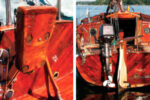
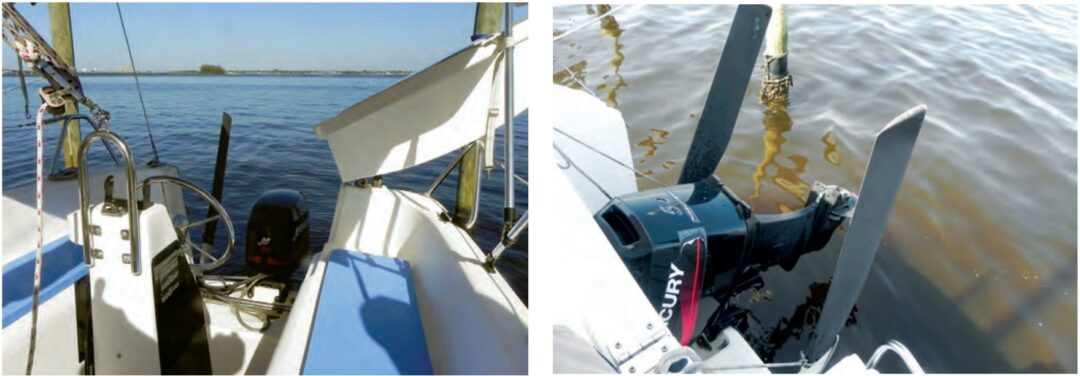
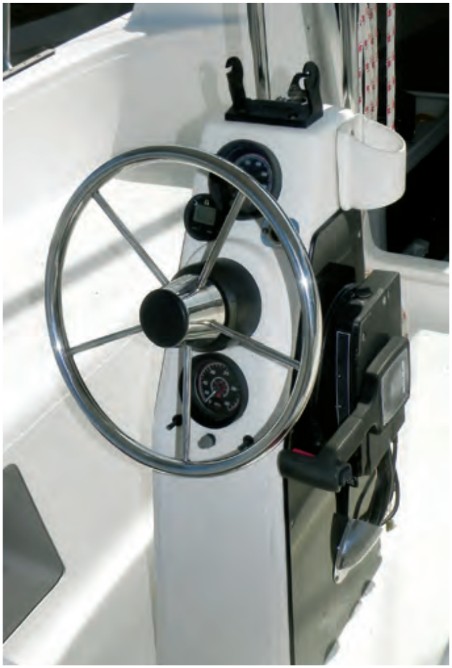
Its twin kick-up rudders, something not commonly found on trailerable boats, are easily raised from the transom swim platform (another feature that’s unusual on small sailboats of the same era). The rudders need to be raised along with the centerboard for high-speed motoring. Before sailing, a large gate valve on the transom must be opened to let in the water ballast. When powering without sails up, the ballast water will drain out if the valve is opened while the boat is making about 6 knots. All MacGregor 26Xs have wheel steering on a pedestal connected to the rudders and outboard motor by a push-pull cable.
Construction
The hull is hand-laid fiberglass cloth, woven roving, and mat set in polyester resin. There is no core. The hull-to-deck joint is shoebox style, sealed with adhesive and reinforced with stainless-steel 3⁄16-inch bolts on 4-inch centers, covered with an extruded aluminum and rubber cap/rubrail. The deck is cored with plywood for stiffness. Inside, there’s a fiberglass molding overhead and a molded furniture pan. There is no bilge. However, sufficient foam is strategically placed in cavities throughout to keep the boat from sinking — a huge plus for a small boat. The 1,400 pounds of water ballast creates enough righting moment for the boat to recover from a 90-degree knockdown.
The nature of MacGregor’s construction often comes under criticism. Inexpensive but sturdy hardware is used, often the same part in many different places. There is little wood inside or out, which some owners consider a blessing, and the exterior and cabin appear somewhat cold and sterile. Black acrylic is used in many locations for panels, doors, and windows.
Deck
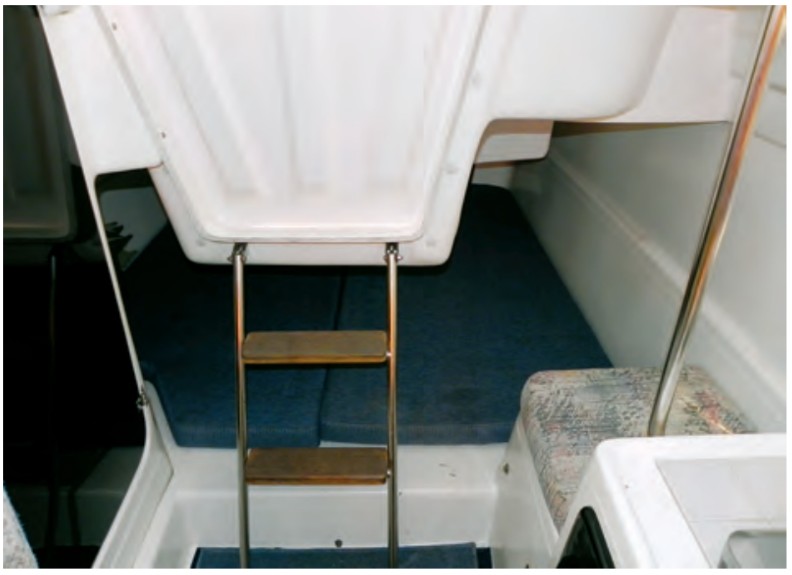
The MacGregor 26X has no sidedecks. The wide flat cabintop has excellent non-skid except in the forward area where it slopes down to the foredeck. Forward, there is a small anchor locker. Single lifelines run from the bow to stern quarter rails. Only the forward hatch and the companionway hatch open for ventilation. The companionway is very large. A one-step (on early boats) or two-step ladder (on later boats) leads down into the cabin. The dropboard for the companionway is one large piece of fiberglass. While this is quite waterproof, it is somewhat unwieldy to handle, and usually ends up being stowed on the large berth just below the cockpit. Many owners add a clear or screened panel to fit in this large opening.
Since the bridge deck is nearly non-existent, the boat needs to be stored so rainwater can drain aft out of the footwell, which opens to the transom. Both cockpit seats are long and comfortable for sitting and napping, but too far apart for bracing while heeled under sail. The hinged helmsman’s seat has a curved rise to place the helmsman in a comfortable position to steer while level or heeled. With a large outboard in place, the swim platform is very cluttered with hardware, but can be accessed with the optional swim ladder. There is no stowage under the seats except for the two open lockers for 9-gallon fuel tanks. The line to retract the centerboard is atop the cabin near the companionway.
Rig
The fractional sloop rig has single aft-swept spreaders, upper shrouds, and inner lowers. The backstay fastens to the starboard side to accommodate passage through the transom. MacGregor uses adjuster plates on the shrouds and backstay; the only turnbuckle is on the forestay. This has proven sturdy and trouble-free. The chainplates are bolted to the hull via a slot in the deck. The mast is deck-stepped in a short tabernacle. Optional rigging includes a gin pole and blocks to make mast-raising a one-person operation at the dock or for passage under bridges. When lowered, the mast rides on the bow pulpit and on a tubular strut that mounts in a hole in the steering pedestal.
A mainsail and 100 percent hanked-on jib were supplied as standard but few boats were sold without an optional genoa, and most also have CDI roller furling. The halyards lead simply to horn cleats mounted on the mast, an arrangement that achieves insufficient tension on the sails’ luffs. Two standard winches are mounted, one each side of the companionway. The mainsheet is attached to the top of the steering pedestal grab bar where the helmsman can easily reach it.
Accommodations
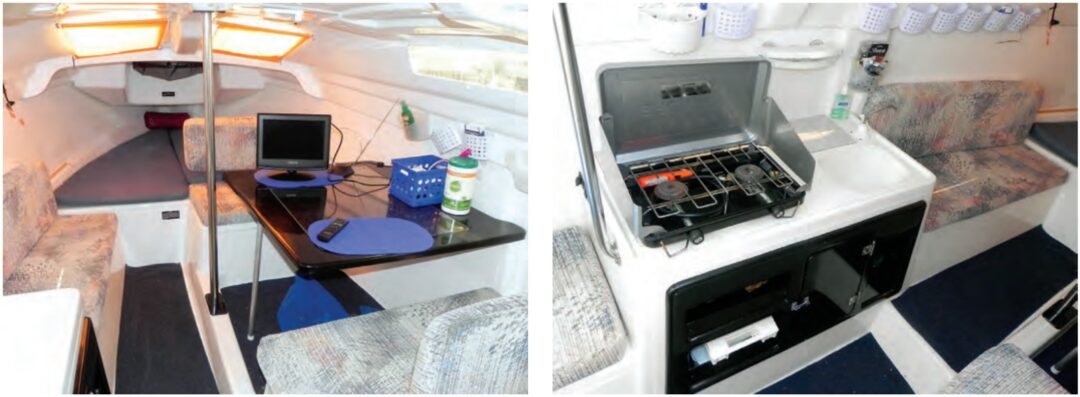
Belowdecks, the MacGregor 26X shines; it is light and airy with 6-foot standing headroom.
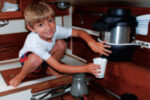
An enclosed head is to starboard of the cabin entrance. To port is a small galley area with storage under. Aft is a huge cave known as the master berth. While it’s more than king-sized, getting in and out of it takes some agility. John and Pam presently use the aft berth as the main storage area for everything large. The stock cushions are thin and soft — adequate, but just barely.
Forward to starboard is a dinette with a drop-down table to form another double berth. The tabletop is covered in clear acrylic and doubles as a chart table. The settees are high enough to allow a comfortable view through the wraparound cabin windows. A 48-quart cooler resides under the aft dinette settee. Opposite the dinette is a short settee. The V-berth is wide and long enough to be comfortable for two adults and is often the berth of choice for a cruising couple because of its accessibility and good ventilation.
MacGregors have underdeveloped electrical systems; a simple fuse-switch panel is mounted near the battery with no battery switch. You get a cabin light, running lights, and a steaming light; after that you’re on your own for improvements.
Under way
As might be expected, getting under way with a big outboard is a simple matter. John leaves the rudders down for slow-speed maneuvering as this adds even more control when docking, which you need owing to the boat’s considerable windage. If the water depth is questionable, the rudders can be retracted without affecting the handling much.
While the MacGregor 26X can be motored without its water-ballast as long as no sail is hoisted, some owners add ballast for motoring when the going gets rough.
One nice thing about sailing a boat with a centerboard and retractable rudders is that, should you run aground, just raising the centerboard will usually get you free.
Some say the 26X is tender, but I don’t find that to be so, except in windy conditions when over-canvassed. With its hard-chine hull form, the MacGregor 26X is initially stiff. The water ballast plays its part once the boat is well heeled.
Despite how it looks to purist sailors, the 26X sails within 45 degrees of the wind and tacks quickly without need of backwinding the jib to get around. Off the wind it sails quite level, with little tendency to wallow due to its shallow deadrise bottom. Hull speed is in the 6-knot range under sail, but one owner reports that he’d hit 12.9 knots sailing downwind in a blow (he was surfing!). Others report the boat is likely to pound in chop and to roll in larger waves.
The steering system has little feedback because of the push-pull cable, and steering with the small wheel requires some effort and can be tiring after a long spell. When the wind pipes up, the weather helm can be quite substantial. If the mainsail is not sufficiently eased or reefed, the boat may run out of rudder, stall, and round up — with the usual ensuing chaos.
The 26X is not a popular racer and the few PHRF ratings are all over the place, from 216 to 273 seconds per mile. For comparison, a Hunter 26 rates 207 and a Beneteau 26 rates 198.
Conclusion
In some respects, the potential speed of the MacGregor 26X under power makes it a safer boat than your average sailboat; should a medical emergency arise, for example, it can go three to four times faster. And long narrow bodies of water can become a joy to sail if you don’t have to beat your way up them. Children enjoy being towed behind on inflatable water toys.
A lot of MacGregor 26Xs were sold and owners don’t readily give up on them. When buying one, condition and equipment are everything. A few owners fit too-powerful motors to attain even higher speeds, and I’d be leery of those boats. The newer M model can accommodate 60 horsepower. Prices range from $11,000 to $22,000 with $14,000 the average.
Overall maintenance issues are few. Early boats had rudder brackets that cracked but most have been replaced with improved versions. Simplicity breeds reliability. Despite an air of flimsiness, these boats don’t break. I would look for mishandling damage. Owners are often novices, and they tend to hit things.
The MacGregor 26X is a true hybrid. Along with having the advantages of trailerability and shoal draft, it can do a lot of things well. It does some things not so well, but any boat has its compromises — this one just has a longer list of them by being two boats in one.
Allen Penticoff is a Good Old Boat contributing editor. He has trailersailed on every Great Lake and on many inland waters and has sailed keelboats on fresh and salt water. He presently owns an American 14.5, a MacGregor 26D, and a 1955 Beister 42-foot steel cutter that he’s restoring.
Thank you to Sailrite Enterprises, Inc., for providing free access to back issues of Good Old Boat through intellectual property rights. Sailrite.com