Maneuvering with the help of a current
Issue 70 : Jan/Feb 2010
Maneuvering a boat in a marina with a strong current running through it often seems fraught with difficulty. A vessel heading across the flow of water moves downstream at an alarming rate, making it difficult to judge the space required to turn it into a berth. And, if you’re swept sideways onto other boats, it’s extremely hard to get under control again. By using a technique called ferry gliding, however, and by planning carefully before you begin, you can actually use the current to help you make a safe and seamanlike maneuver.
I learned about ferry gliding when I was working in the North Sea, where I saw the technique used to bring a fast rescue craft alongside a moving ship.
While the ship maintained its speed and heading, the coxswain of the small boat brought his craft up beside the larger one on a parallel heading and about 20 feet. away and adjusted his speed until the two vessels were stationary relative to each other. Then, by making small alterations in course, the coxswain made the rescue craft “glide” back or forth across the gap, moving sideways relative to the ship.
In this example, both boats were moving through the water, but the technique is equally effective when, due to a current, the water is moving past the land.
The principle underlying the maneuver is that a vessel is controllable and can be steered as long as it is moving through the water. It follows that, if a boat is headed directly against a current and its speed is adjusted to match that of the water, it will remain stationary relative to the land. Any slight alteration in course will then make it move sideways across the flow of water.
Entering a marina
I can illustrate how this technique can be used to bring a boat into its berth by describing the way in which my partner, Magali, and I recently maneuvered Sigfrid, our 34-foot 6-inch steel ketch, into a marina near the mouth of the Rio Guadiana in Portugal. At the time, the tide was rising and the current was running at about 2 knots.
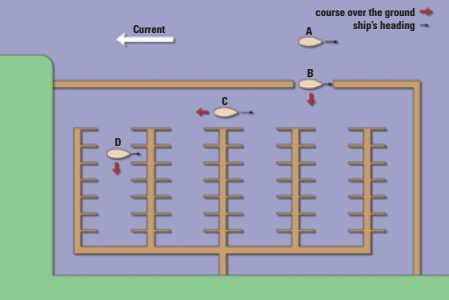
Outside the marina entrance, and a comfortable distance away from it, we turned Sigfrid to face the current and carefully adjusted our speed until we were motionless relative to the pontoons (position A on the diagram).
After giving ourselves a few minutes to get the feel of the boat and ensure that we were properly in control, we altered course a few degrees to starboard. This alteration was just enough to make Sigfrid glide across the current and through the gap in the pontoons that forms the marina entrance (position B).
Inside the marina, we stabilized her heading again before dropping the engine revolutions slightly. As Sigfrid slowed down, although she still had steerageway ahead, she began to move stern first between the pontoons (position C).
At this stage, we had to be patient. All the adjustments to engine speed had to be slight and we had to allow plenty of time for the boat to respond. A large drop in speed could have resulted in our losing steerageway and, with it, our ability to properly control the boat.
When Sigfrid was beside the gap in the pontoons where our allocated berth lay, we increased speed until she was once again stationary relative to the land. In the same manner as before, we changed the heading slightly to make her glide down the gap (position D).
Once she was directly down-current from our berth, it became a simple matter to stabilize her heading again. A tiny increase in speed then made Sigfrid nose forward once more.
Once we were inside the confines of the marina, we never adjusted the heading by more than a few degrees and, although we actually moved astern relative to the land, we always had steerageway ahead. It’s also important to remember that, while you perform this maneuver, the boat is never pointed toward your destination unless it happens to be directly upstream.
Richard Toyne and his partner, Magali Bellenger, have been exploring the western Mediterranean aboard Sigfrid, a 34-foot 6-inch steel ketch, for 10 years. They finance their voyages through Richard’s carpentry work, writing for magazines, and by the sale of handmade jewelry, which Magali produces on board.
Thank you to Sailrite Enterprises, Inc., for providing free access to back issues of Good Old Boat through intellectual property rights. Sailrite.com