Lightning induces a review of current lighting
Issue 82 : Jan/Feb 2012
When a nearby lightning strike zapped my sailboat’s electronics and lights, I learned a lot more about the implications of converting from incandescent lights to LEDs. And when searching for replacements, I was amazed at how many new LED adaptations are coming to market.
When I bought her a couple of years ago, I replaced all the incandescent light bulbs on Prime Time, my 28-foot Catalina, with LEDs (see “New-era navigation lights,” May 2010). About half of those LEDs blew out from the lightning-induced current surge. The lightning didn’t hit my boat, but a lightning strike induces a brief very high voltage surge (but with very low amperage) in nearby conductors.
The technician who replaced the damaged instruments said it is his experience that LEDs are much more susceptible to this kind of surge than incandescents. This may be because each light-emitting diode is itself a tiny electronic circuit. In my lightning damage, those bulb replacements containing multiple LEDs seemed more susceptible to the voltage surge, perhaps because they have more circuitry. Most of the LED replacements that survived were completely contained inside glass in festoon bulbs.
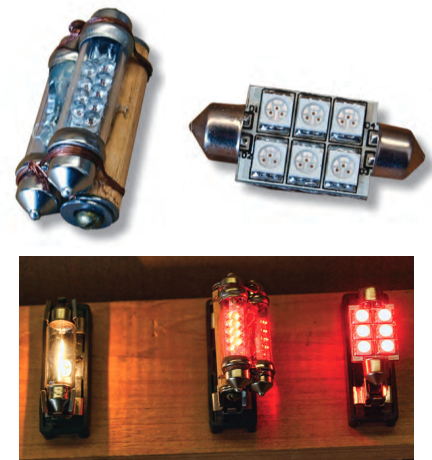
Manufacturers of lighting fixtures love festoon bulbs because they have 360-degree visibility and there’s no socket cylinder to collect moisture and promote corrosion. Some new LED bulbs have come to market since I did my original conversion.
The biggest improvement for my festoon-bulb navigation lights is an LED panel containing six very bright LEDs with a lighting arc of 120 degrees. That’s important because the Navigation Rules require red and green sidelights to be visible through an arc of 112.5 degrees from the bow. To achieve that spread when I did the original conversion, I had to glue together two bulbs (each containing nine tiny LEDs) and wire them to a wooden dowel. Having two bulbs also doubled the brightness.
The price of the new LED panel was $15, more than the cost of two of the old festoons ($5 each). However, the panel increased the arc of visibility of the light and required no painstaking work on my part to achieve the brightness I wanted.
It seems counter-intuitive, but your navigation fixture will be brighter if you put a red bulb behind a red lens and a green bulb behind a green lens. If you use a white bulb, the lens filters out all but the red or green light, so you get only a fraction of the brightness built into the bulb.
Interior lights
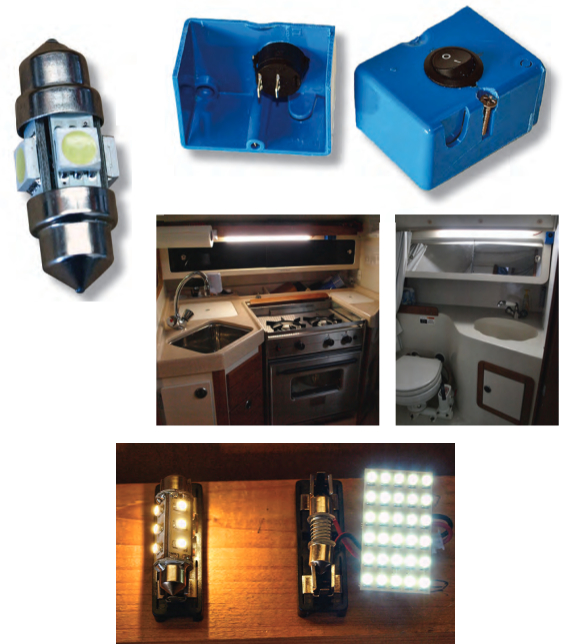
Prime Time had fluorescent fixtures in the galley and the head, and the lightning zapped both. Their replacements are a huge improvement. I used a 20-inch waterproof strip of 30 LEDs with self-adhesive backing ($15) wired to a simple on/off switch ($2).
Prime Time is fitted with six dome lights, each built to hold two white festoons and one red (to protect night vision). A rocker switch selects white or red. In my original conversion, to achieve the brightness I wanted, in each cabin dome light I used a 360-degree festoon bulb with 12 LEDs. They were zapped by the lightning.
In the forward and aft cabin berths, where less light was needed, I used completely contained LEDs in the original conversion. All but one of those LEDs survived the voltage surge.
In the cabin this time around, I replaced the previous multi-LED bulbs with a new at-panel type containing 30 LEDs ($17). The panel plugs into an adapter ($1) that is available for virtually any light fixture made, including festoons. It’s much brighter than the 12-LED bulb was.
Ten-watt incandescent bulbs become too hot to touch 10 seconds after you turn them on. Since LEDs don’t get hot, you can just lay the panel on the lens of the dome light or stick it there with double-sided adhesive tape. If your fixture contains two sockets, you can use two panels if you want really bright light.
A wide selection
LED fixtures are widely available now but you’ll find it’s much cheaper to keep your old fixtures and just replace the incandescent bulbs with LEDs. The only fixtures zapped by the lightning surge were the fluorescents in the galley and head.
Most white LEDs come in cool white or warm white and a few are also available in a color called “natural white.” If you check the specifications, you’ll find slight differences in brightness. The cool white appears brighter to the human eye but may not be. The colors are very similar to those available in household fluorescent tubes.
With the exception of my new masthead anchor light LED, all the new LEDs came from Superbrightleds.com. My masthead light contained a squatty (31mm) 10-watt incandescent festoon bulb. When the technician went up the mast to replace the VHF radio antenna, he also replaced the incandescent bulb with a 360-degree, 4-LED bulb. They’re hard to find. I bought the bulb at Yachtlights.com ($15).
LED replacement lights aren’t cheap. They’re more susceptible to voltage surges than incandescent bulbs but they have a life expectancy of 50,000 hours and use only one-tenth as much battery juice as an incandescent that’s not as bright.
So despite their price and susceptibility to voltage spikes, I still choose LEDs for their brightness and incredibly low power consumption. In my 35 years of sailing, I’ve always been concerned about lights draining the battery while we’re at anchor, which might result in it not cranking the engine the following morning.
Clarence Jones is a writer, news-media consultant, photographer, sailor, tinkerer, and inventor. He and his wife, Ellen, live and work on and sail their Catalina 28 from Anna Maria Island at the entrance to Tampa Bay. Part of the joy of sailing for Clarence is creating and building inexpensive enhancements for his boat.
Thank you to Sailrite Enterprises, Inc., for providing free access to back issues of Good Old Boat through intellectual property rights. Sailrite.com