Silent and stowable, they are easy to love
Issue 82 : Jan/Feb 2012
Shakespeare said it best: “A hatchboard by any other name would still be a nuisance.” Anyway, I think that’s what he said.
It’s late at night and time for an anchor check. What do you have to do? First you slide the main hatch forward, then one by one you pull out the hatchboards and put them . . . where? In the cockpit? Down inside the cabin? There really is no good place.
The next morning, you start to get under way. Do you place the hatchboards on a settee, up forward in the V-berth, under a cushion? Or do you toss them overboard because you’re tired of moving them around?
Enter the hatch cloth.
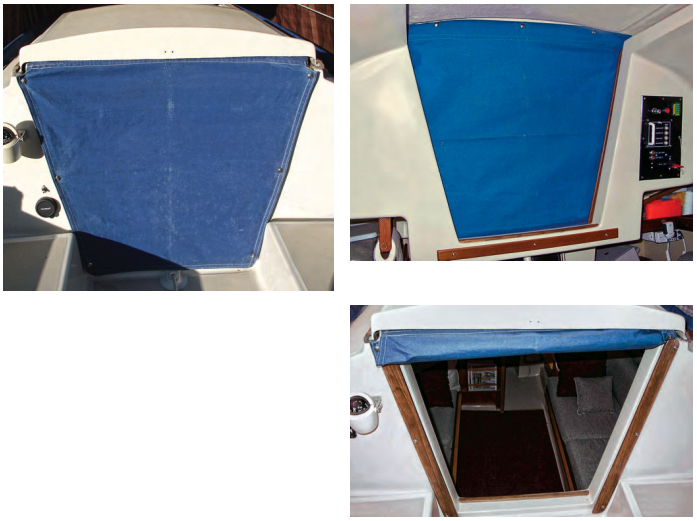
Not long after getting our first sailboat with a cabin and fighting with a one-piece hatchboard — consider that, if you think a two- or three-piece board is hard to stow — we came up with the idea of a hatch cloth: a bit of cloth, a few snaps, and ta-da . . . you’re done!
Now, at night, all you have to do is unsnap the bottom of the cloth and crawl out — no disturbing the sleeping members of the crew when a hatchboard slips off the cockpit seat and crashes to the deck. You don’t even need to slide the hatch back. You can just slip out quietly.
For stowing, nothing could be simpler than just folding the cloth and tossing it below. Yet another advantage is that when it’s raining, the cloth can remain in place to keep the inside of the boat dry, but if you need something from below— like a hot drink on a cold damp day — it’s easy for your mate to slip the drink out under an unsnapped corner of the cloth. Try that with the hatchboard in place.
When we purchased our current good old boat, an O’Day 23, a set of wood-framed hatch screens came with it. Not only were these a little cheesy, but we now had two more items that needed a convenient storage location. The screens found one — in the dumpster. There had to be a better way.
For a couple of years, we did without screens as we cruised the waters of the Paci c Northwest. We stayed in the San Juans and Gulf Island area and found few mosquitoes to bother us. Then, in 2010, we had some extra time on our hands and were able to range farther a eld.
We made it up to Desolation Sound in beautiful British Columbia, where there is a serious mosquito presence. If you have, say, 8-inch opening ports without screens, you don’t have to worry, as the bugs are too big to get through. However, they can and do come through a 36-inch open hatch. As it was quite cool, we just used the hatch cloth for protection, but we knew that in warmer weather we would need ventilation to sleep well at night.
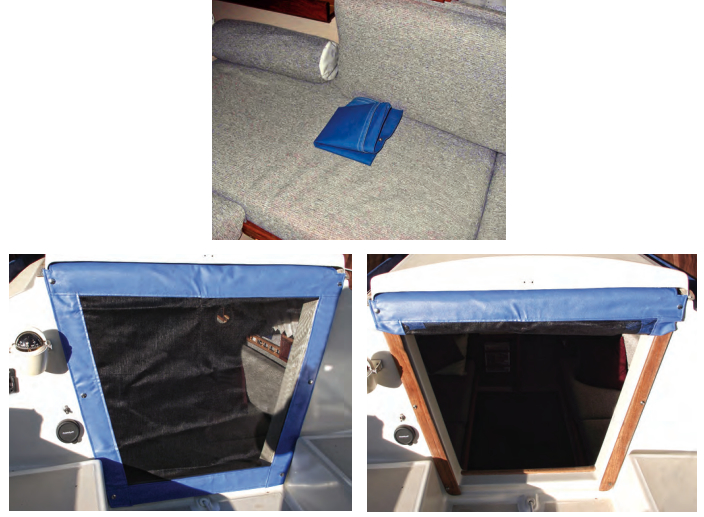
It was time to get out the sewing machine and make a hatch screen. We made a call to Sailrite for some material and within a few days were ready to start. This would be my first experience with sticky-two-sides Seamstick tape. In the past, I either pinned the fabric — real fun pinning through multiple layers of heavy material — or just freehanded the project.
I can now tell you that Seamstick tape is the only way to go. Just stick everything together, making sure it’s just right, then head over to the sewing machine and, in a few minutes, the hatch screen is done.
Next, I went out to the boat, sitting on her trailer in the front yard, to add the snaps. We now have a nice new hatch screen to go along with our hatch cloth and it’s just as easy to stow away.
The next project will be a hatch cover using clear acrylic that will add some light on gray, cloudy, and cool days while keeping the cabin snug and warm.
My advice is simple. Put away those hatchboards and add a simple hatch cloth. Then you, too, can sing a sonnet for a hatch cloth.
Dan Cripe took “early retirement” from the building industry in 2010 and has lots of time to devote to sailing and writing. He and his wife of 39 years, Teresa, have owned a series of boats, all named Fantasy, which they have sailed with their four children at home in Idaho and also on the “big waters” of the Salish Sea. Their current Fantasy is an O’Day 23.
Thank you to Sailrite Enterprises, Inc., for providing free access to back issues of Good Old Boat through intellectual property rights. Sailrite.com