A beamy, shoal-draft cruiser ideal for Florida and the Bahamas
Issue 60 : May/Jun 2008
Island PacKet yachts may Very well be the only boatbuilder owned and managed by a graduate naval architect who builds and sells his own designs. Since its founding in 1979, IPY and its CEO, Robert K. Johnson, have been in the business of producing bluewater sailboats. (For more, refer to the July 2005 issue or read a full interview with Bob Johnson at https://goodoldboat.com/october-2004-island-packet-interview/. Although the firm now specializes in high-end luxury yachts in the 40-foot range, it first made its name with a line of smaller cruisers, which quickly established its reputation for quality, sound construction, and seaworthiness. The first model was the IP 26, a development of the Bombay Yachts Express, a beamy, centerboard Cape Cod catboat-type hull with a barn door rudder and bowsprit. The 26’s lines were based on the Express, but Bob Johnson redesigned the interior, rig, and centerboard. The design concept can be traced even further back to the John Alden-designed catboats of the 1930s. The IP 26 Mk II was a further development of this idea, and one version of it was made with the trademark Island Packet Full Foil keel.
History
The Island Packet 27 was introduced in 1984 as the replacement for the IP 26 Mk II; it was the fourth model sold by the company following the 26, 26 Mk II, and 31. Over the next eight years, 243 hulls were sold until the model was retired and replaced by the IP 29, making it one of the most long-lived boats in the Island Packet line. The IP 27 was, in effect, a “26 Mk III.” The boat was marketed in two versions — a keel and keel/centerboard shoal draft option — and it could be rigged as a sloop, although it is easily convertible to a cutter. Indeed, most IP 27s do carry two headsails. The boat is distinguished by twin backstays, a bowsprit with bobstay, and a long keel.
Design
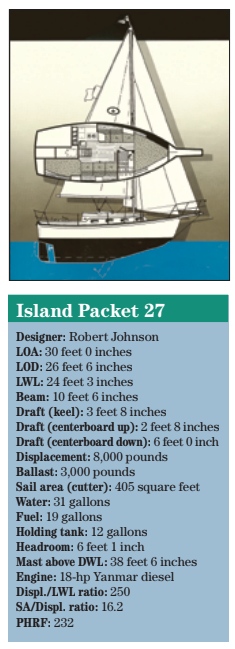
The IP 27 is a capable coastal cruiser. It has been successfully sailed offshore, although three dimensions recommend against that: it is not a big boat and its considerable beam, along with its shoal draft, increase the potential for inverse stability. Referring to the ISO (International Organization for Standards, more commonly followed in Europe than in the U.S.) standards specifying the conditions for which a given boat is suitable, Bob Johnson says the boat is “ . . . right on the cusp between Category A [the most seaworthy] and B, and today only a few tweaks would be necessary to make it Category A.” With a sail area/displacement ratio of 16.2, and a displacement/length ratio of 250, the boat can be characterized as a light-to-average cruiser on the dividing line between an offshore and coastal cruiser. Bob reports that one IP 27 fell off a wave on a passage to Bermuda and rolled over completely, tearing off the entire rig, but the boat recovered and survived, continuing to Bermuda under power.
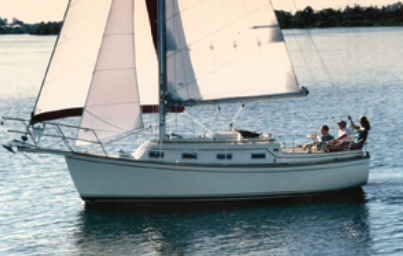
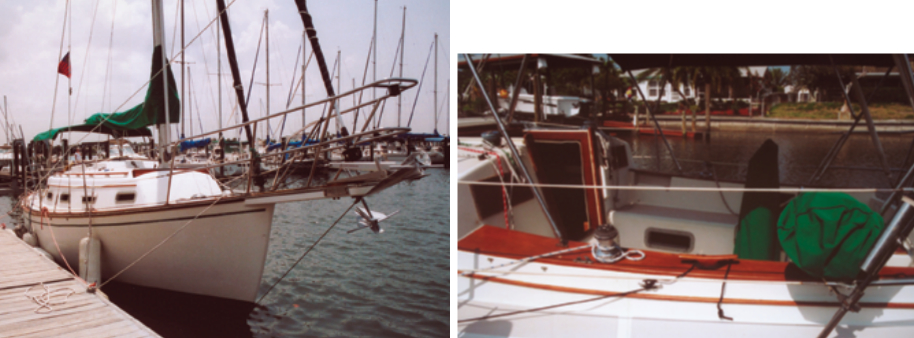
A first look at the IP 27 reveals traditional lines and a salty overall appearance. The trademark IP look is evident throughout, from the café au lait hull color to the rounded-corner rectangular portlights along the length of the cabin trunk. (The original IP 27s had plastic portlight frames until 1986, when they were replaced by aluminum. The following year they were again replaced, this time with stainless-steel frames.)
The boat is beamy with a roomy cockpit, high freeboard, and a traditional sheerline with a lot of spring. Below, the layout is practical and efficient with plenty of storage space and more than 6 feet of headroom.
It is not particularly fast or weatherly, although its performance is more than adequate when one considers its other virtues. A relatively shallow draft in all its configurations makes it particularly convenient for gunkholing and bay work.
Construction
As in most modern fiberglass boats, the deck-cabin-cockpit is molded as a single unit, utilizing a cored laminate construction of hand-laid fiberglass comprised of layers of mat and woven roving saturated with polyester resin on both sides of a core of glass microballoons and polyester resin. A fiberglass headliner is bonded to the underside of the deck. The bowsprit is molded integrally with both the hull and deck with alternating layers of plywood and fiberglass.
The hull is a solid fiberglass laminate made up of alternating layers of hand-laid triaxial roving saturated with polyester resin. Inside, a molded fiberglass structural pan is bonded to the hull; it forms the bed for all interior surfaces and furnishings, including settees, bunks, and the engine bed. The pan is reinforced with a plywood and fiberglass grid. Bulkheads and furniture assemblies are installed so they bond directly to both the pan and interior hull surfaces with multiple layers of woven roving and mat.
The hull and deck assemblies are joined by stainless-steel bolts with locking nuts through a flange molded into the hull and a urethane adhesive sealant.
It is always a good idea to get a used boat hauled out and professionally surveyed prior to purchase. One thing to look for are cracks and leaks along the keel; the IP 27’s ballast is carried internally — iron slugs embedded in concrete. In the event of a leak, salt water could cause hidden corrosion and potential problems. Fortunately, the gentle slope of the leading edge of the keel should tend to rise up over an obstruction and disperse the shock.
Another thing to check for is severe pitting corrosion in the metal water tanks. Pull a sample of the water at the bottom of the tank and, in addition, look into the tank with a flashlight to see if the metal is clean and smooth and if the water is free of sludge caused by metal corrosion.
There is a metal strap that bridges the gap between the keel and rudder to protect the propeller from fouling on lines and from damage due to floating objects. It provides no support to the rudder, so the boat could sail just fine without it. If the strap were damaged in a collision or grounding, it could conceivably bend the rudder post and affect steering, but this seems unlikely.
Rigging
Standard on Island Packet boats are headsails set on roller furlers, though hanked-on sails are available. The genoa tack is at the end of the bowsprit, and the self-tending staysail’s tack is located at the forward end of the deck. A full bow pulpit allows crew to work safely while handling headsails or ground tackle. The mainsail halyard winch is mounted on the mast; all other halyards, sheets, and furling lines lead to the cockpit. A traveler is mounted on a track that runs athwartships forward of the companionway hatch so the mainsheet does not interfere with cockpit activities or a Bimini top.
Five winches are provided for sail handling. The mast is stepped at the forward end of the coachroof with a compression post below to provide support. Inside the mast is an internal guide that secures wiring, and a messenger line is provided to run additional wires or cables. Access to wire connections in the mast is through a removable inspection plate. The mast has a design rake of one mast width. Reefing the mainsail is by the jiffy or slab system and can be accomplished by one person while standing at the mast.
Accommodations
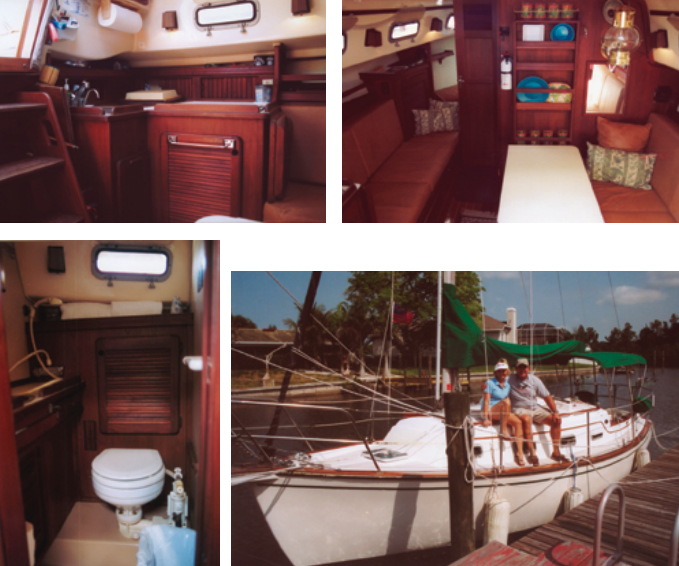
Stepping through the companionway reveals a spacious saloon with a compact galley to port and the electrical/navigational panels to starboard. The galley boasts an icebox; two-burner, gimbaled LPG stove; and a sink with hot and cold water. Six-foot-plus berth/settees line each side of the cabin, and the starboard berth pulls out to convert to a double berth. There is 6-foot 1-inch headroom. A quarter berth on the starboard side extends under the cockpit seat; a portlight in the cockpit footwell provides welcome ventilation.
On the port side, aft of the galley, is a large storage locker accessible from the cockpit. Just forward of the starboard berth is a sturdy, bulkhead-mounted table that folds down and out to seat four.
When the head/shower door opens, it seals off the V-berth. In theory, the boat can sleep five (six, if two can squeeze into the cramped V-berth) but three or four is probably the practical limit, especially on a long cruise. The interior joinery is dark teak, well-built but a bit gloomy. A lighter color would improve visibility and a feeling of more space.
Adequate ventilation and illumination is provided by nine portlights and plenty of stowage is available in every stray corner.
The engine is behind the removable companionway ladder or can be accessed from a hatch in the cockpit sole. The owners of our test boat report that changing the oil is not too difficult, but servicing the fuel filter requires a gentle touch and small hands.
Performance
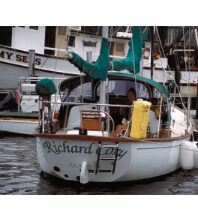
Our test boat for this review was Shamrock, a full-keel version owned by Bernie and Jayna Hamel of Apollo Beach, Florida. Shamrock did not appear to be anywhere near 22 years old. The Hamels are the third owners; the excellent condition of the boat reflects a quality product as well as loving maintenance from all of its owners. The Hamels have owned Shamrock for two years and soon after acquiring her they replaced both furling rollers, did some minor repairs on a spreader, put on fresh bottom paint, and repacked the stuffing box.
The original sails were repaired, and new cushions and other minor interior furnishings were added to spruce up the saloon. The Yanmar 2GM20 diesel engine, also original, required a new exhaust manifold, and several seacocks and through-hull fittings were replaced. They also installed davits. They are planning to replace the mainsheet winch with a self-tailing model (the jib winches are already self-tailing) and to add an anchor windlass.
Our test sail was conducted on Tampa Bay under ideal conditions — a light chop and 15-knot winds — which easily moved the boat to 5 1⁄2 knots over the ground. Calculated hull speed is 6.6 knots, and Bernie said they’ve reached well over 6 under sail and power. They keep the boat’s bottom clean by frequently engaging the services of a diver. Bernie reports that the engine is more than adequate to make headway against stiff winds and heavy seas.
Performance was as advertised, with a gentle, yet solid, feel even when crossing the wakes of powerboats. As expected, Shamrock was not a demon to windward but pointed adequately and sailed comfortably with the wind on the quarter and the beam. Bernie remarked that downwind sailing would be improved with a vang, which they plan to add.
The opinion of the Hamels is that the boat is best crewed by two, although it could be singlehanded by a confident and nimble seaman. Coming about was accomplished without undue problems, but they did confess to being caught in irons a few times until they understood the boat’s idiosyncrasies. They also mentioned that the genoa can foul in the narrow slot between the forestay and inner forestay, so a second crewman is certainly an advantage. We conducted several tacks without incident.
These boats are not often raced; in fact, there’s just one boat listed by the United States Sailing Association, and its PHRF handicap is 232 seconds per mile. That’s about the same as an inboard Ericson 27 at 238 but slower than an inboard O’Day 27 at 204.
The rack-and-pinion steering, standard on all Island Packets, was a delight, although I must confess a bit of clumsiness with it, as I am more familiar with a tiller and the more common pedestal-cable steering. I was impressed with the ease with which the boat steered, almost as if it had a power assist; in fact, to my taste it was too easy! My hosts pointed out that there is a mechanical adjustment allowing the resistance of the wheel to be modified to suit the helmsman’s preference. On a beam reach the boat steering was perfectly neutral, with no trace of lee or weather helm. I removed my hands from the wheel for more than a minute and the boat tracked in a straight line, perfectly balanced. I did notice, as one would expect, that helm response was a bit sluggish at slow speeds, no doubt due to the long keel. Because of the neutral helm, there is a tendency for the helmsman to oversteer after tacking, but this can be anticipated with experience. The aft end of the steering wheel shaft is prepared for installation of an autopilot.
Response under power at slow speeds was a bit awkward, with a noticeable lag between applying rudder and a change in direction. There is also a pronounced torque bias to the prop, causing the stern to swing to starboard when going forward and to port in reverse. An afternoon of practice in a calm marina on a windless day should allow the helmsman to learn the boat’s quirks and compensate for them. This would be particularly important when backing down, because the IP 27 is a bit clumsy in reverse.
Conclusion
Island Packet owners enjoy solid support from the manufacturer. The factory is happy to provide advice to owners, even owners of secondhand boats. A complete factory website and an owner-operated user’s group with its own website gives IP sailors access to authoritative technical advice and connections to other IP sailors. Many social functions are organized and communication between all members of the IP family is encouraged.
Due to the IP 27’s long production run, there are quite a few still on the water. Figures quoted in Island Packet’s website claim typical recent prices for used boats between 78 and 91 percent of their original purchase price. In 1984, the factory base price was $41,950; in 1992, $65,950. Of course, prices for used boats vary enormously depending on the boat’s condition, history, age, and the usual market parameters. We found several for sale on the Internet, including a 1986 for $41,000, and a 1990 for $46,000.
Henry Cordova is a geographer/cartographer who has been a sailor of the military persuasion (U.S. Navy Reserve on the USS Dewey) and of the recreational variety (a San Francisco Pelican and a MacGregor 22).
Thank you to Sailrite Enterprises, Inc., for providing free access to back issues of Good Old Boat through intellectual property rights. Sailrite.com