Singing the praises of a hard, non-inflatable dinghy
Issue 60 : May/Jun 2008
Over the last 20 years i have worn out two inflatable dinghies. As the kids grew, we put lots of happy miles on both of them. Later we were preparing for an extended cruise, we needed a new dinghy. I checked prices on inflatables; most were around $2,000 to $3,000. We decided to put dinghy acquisition on hold for a while.
Many cruising authors praise the virtues of the hard dinghy. Still, we were unconvinced. Then we experienced a bit of serendipity. Kaye had a Walker Bay 8 sailing dinghy so we tried that for a while. It was lightweight and easily stowed on deck. However, it was tippy and too small. A friend on our dock had admired our Walker Bay and had a hard dinghy he wanted to trade. The dinghy was a WaterTender 9.4 made by Johnson Outdoors. We made the trade. As we weren’t going to depart for a year, we had plenty of time to see if it would meet our needs. Here are our conclusions.
West Marine sells the WaterTender 9.4. They are cheap; at $500, they are about a fourth to a sixth the price of a comparable inflatable. These boats are made of a very tough high-density polyethylene, rather than fiberglass. We drag our dinghy over rocks and coral without a second thought. I remember grazing a pier with one of my inflatables and having a mussel shell slice the bow tube. Because the cut was close to the rub strip, it had to be professionally repaired. We have no such worries with our hard dinghy. Polyethylene is impervious to sunlight as well; not needing an expensive and cumbersome suncover is another plus.
Bottom growth
We wanted to be able to leave the boat in the water for extended periods of time and not have to worry about marine growth on the bottom. The previous owner had applied bottom paint without any primer to the hull, and we did the same. Once we rough up the plastic with 60-grit sandpaper, paint adheres reasonably well. Repeated dragging on sand and rocks will abrade the paint, of course, but it can be easily touched up.
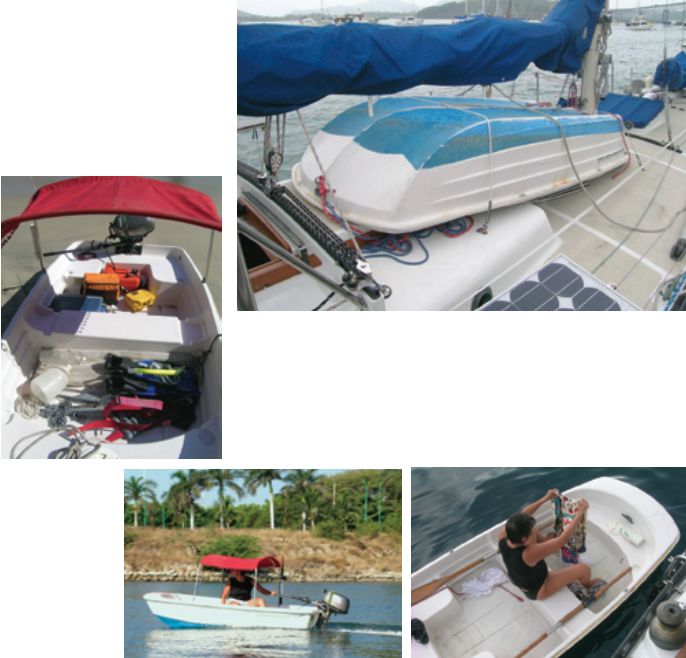
After a tropical downpour, Kaye does our laundry in the dinghy. The front bilge is the wash cycle, and the aft bilge provides the rinse.
The deck up forward deflects spray, making for a dry ride in a chop.
The WaterTender weighs 106 pounds. A comparable inflatable with an inflatable floor will be about 70 pounds, while an RIB of this size weighs in at 135 pounds. In Mexico, most cruisers with heavy inflatables fit transom-mounted wheels on their boats to drag them up on the beach. The wheels are heavy, expensive, hard to stow, and ugly. We have not felt the need for them, as our dinghy slides more easily on the sand than an inflatable does.
The WaterTender has a “tri-hull configuration,” like a Boston Whaler. This gives the boat good stability. I weigh more than 200 pounds, but the boat is still stable when I am standing as far outboard as possible.
The hard dinghy is much more capacious since there are no tubes to take up space. A typical 9- or 10-foot inflatable has an interior beam of only 27 inches, while our hard dinghy has an interior beam of 50 inches. In one area the inflatable wins the comparison, however. Johnson Outdoor rates this dinghy’s capacity at 480 pounds, and I think that is about right. A comparable inflatable will be rated at something like 800 pounds capacity.
Not self-bailing
Another disadvantage of the Water-Tender is that it is not self-bailing. Moreover, since the reserve flotation is in the seats, it cannot be modified to be self-bailing. This eliminates towing it in anything more than benign conditions. I am not a big fan of towing a dinghy in rough stuff anyway; it is better to haul it aboard and not have to worry about it.
A hard dinghy is more easily driven than a comparable inflatable. Our little 8-hp outboard will get us up on a plane with both of us aboard. My GPS says I am doing 15 knots when alone. For the same reasons, the hard boat is more easily rowed as well. We have proper oarlocks instead of the rubber ones found on some inflatables, and the boat glides easily under oars.
We have noticed rust weeping from under the rubbing strip. I guess the fasteners that attach the liner to the hull are corroding. It is unsightly, but so far we haven’t detected any separation. Since we are the second owners, we have no idea how long the boat has been in use.
Polyethylene will not bond to epoxy or any other glue that I know of, but you can still modify it. I made an anchor locker. I got a round plastic hatch and cut a hole in the front seat. I found a big block of rigid foam inside. A sharp knife allowed me to cut the foam into pieces small enough to remove through the hole. I added a cleat. Having access to the interior allowed me to get to nuts on the back and through-bolt the cleat. My newly created anchor locker holds 100 feet of 3⁄8-inch nylon rode and a folding anchor.
Dinghy dining
One night we attended a potluck gathering on the beach with several other cruising couples. There wasn’t any place to set up on the wide beach, so we put our little barbecue on the foredeck of our beached dinghy. Because it has three spacious seats, the others put their contributions in the dinghy, which became our buffet table.
In the tropics, the sun really beats you up on long dinghy trips. Before we left home, we had a canvas maker bend a couple of 7⁄8-inch stainless tubes for us to make the bows for a Bimini for our dinghy. We took the bows to a welder and had 5⁄8-inch rods welded to the ends of the tubes. These rods fit in the oarlocks. Our dinghy has two sets of oarlocks, but I have noticed that the newer WaterTenders only have one set. However, if you wanted to follow our example, Johnson Outdoor sells additional sets. Our Bimini top is a rectangle of Sunbrella, which is hemmed at both ends and has a zipper at one end. The tubes go in the hems.
The tubing of the Bimini also provided a site for a pole holder. I got some PVC tubing and attached it with a banding tool, although hose clamps would work just as well. Of course, there are many commercially available pole holders that attach to tubing.
Inflatables are wonderfully soft and easy on the hull of your boat. We were worried that the hard dinghy would chafe and make marks on our hull, but the soft plastic rub strip has not done so. However, it is noisy when it bumps against the hull so a couple of fenders solve that problem.
I have done some research and found a similar boat by Pelican International. The Scorpion 10 is 11 inches longer, 6 inches wider, and weighs the same as the WaterTender. Moreover, it has a self-bailing drain. The price is comparable; I would probably go with this boat if I were going to replace our present dinghy. The problem is, ours just won’t wear out.
Bob Steadman and Kaye Nottbusch have been cruising from Los Angeles to the Caribbean over the past three years. Bob is a professional cinematographer and the two have produced a DVD, Cruising with Bettie. It is available from TheSailingChannel.com
Thank you to Sailrite Enterprises, Inc., for providing free access to back issues of Good Old Boat through intellectual property rights. Sailrite.com