Experiencing the value and beauty of simplicity
Issue 60 : May/Jun 2008
In the early 1960s i tooK a JoB in California. My wife, Dori, and I bought a house in Belmont, a small town in the hills overlooking San Francisco Bay. From our living room window we viewed hundreds of sailboats darting over sparkling waters. On Sunday afternoons we visited the waterfront, which was lined with marinas filled with sloops, yawls, ketches, and schooners.
Dori was an avid reader and an accomplished writer, but she had never read Joshua Slocum’s Sailing Alone Around the World, the book that had so captivated me as a boy. I bought her a copy and she immediately understood my passion.
We met sailors who had sailed through the Golden Gate from islands in the South Seas, from the Orient, and from archipelagos on the opposite side of the globe. We heard tales of white sand beaches and coral shores lined with palm trees where summer is eternal. We read of storms and tempests and dismastings and shipwrecks. We met sailors who had experienced adventures like those in books I read when a boy. I had dreams of sailing off to some remote island paradise. Dori had similar ideas and we studied boat plans and read of adventures on the high seas. We decided to build a boat.
I knew nothing of boatbuilding, little about sailing, and less about navigation, but I have always believed that somewhere there is a book that will teach all one needs to know on any given subject. We spent weekends in boatyards and talked with cruising sailors and “live-aboarders.” We made friends with backyard boatbuilders and peppered them with questions.
Encouraging advice
I studied Howard Chapelle’s Boat Building, a volume written in 1941 and devoted to the amateur boatbuilder. I was seduced by the very encouraging first sentence of his preface: “Any man having a fair amount of skill with carpenter’s tools can build a boat . . . ”
Our building space was as limited as our budget. We were familiar with the story of a man who built a boat in his basement and had to tear his house down to remove it. Many boatbuilders rent space in a boatyard, warehouse, or barn, but to avoid the extra expense we decided to choose a boat that would fit in our backyard. It would save money and the work would go faster if the project was close at hand.
My job as a college teacher was not a lucrative one, but Dori was having success as a writer. She financed our boat by writing true-confession stories. They were easy for her to write and they paid well.
Our home in Belmont was on a hillside, so I first called a trucker and was assured he could haul our boat and get it to a boatyard. He specified, however, that because of our driveway configuration and slope, our boat could be no longer than 30 feet and weigh no more than 10 tons.
We searched for information about naval architects and came upon William Atkin. His boats are not only beautiful, but they had also proven to be seaworthy and easy to handle in all kinds of weather. His boats have made passages all over the world.
Just the right size
Dori and I fell in love with plans for a small Atkin schooner he called Little Maid of Kent. She was the right size: 30 feet long, with a beam of 10 feet and a draft of 5. Her modest sail area of 438 square feet could be handed by one person if need be. She sported a jib on a saucy jutting bowsprit, a gaff-rigged foresail, and a mainsail that extended 5 feet over a taffrail with turned stanchions. She was a smart-looking little ship, and we set about to build her.
Our three-year project began in 1967, that “Summer of Love.” The radio in our little boatyard eased our labors with lyrics from Scott McKinsie’s “If you’re going to San Francisco . . . summer time will be a love-in there.” The mood in the Bay Area seemed auspicious, for ours was a labor of love.
I selected the finest oak, spruce, and fir I could find. I journeyed to Port Orford, Oregon, to select prime cedar for planking. I planed, sawed, and fastened each plank with tender care. I caulked her with oakum and cotton and payed her seams with white lead. I made a pattern for her 3,000-pound ballast keel and had it cast in a foundry in Oakland.
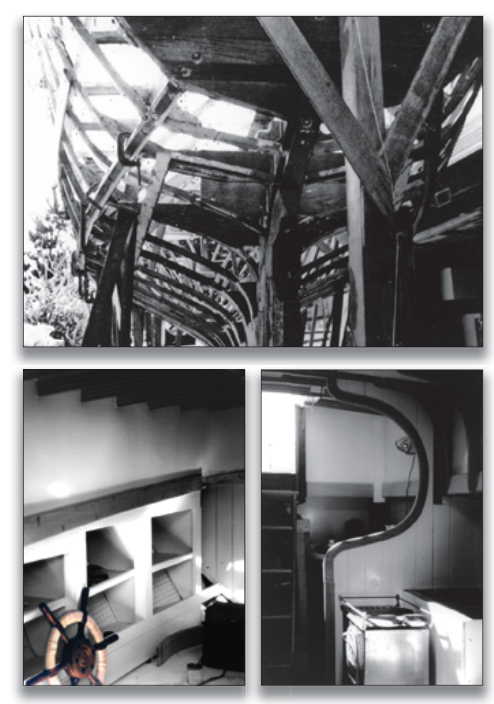
Hatches and companionway doors were of birds-eye maple and walnut, the interior of mahogany and teak. Sunlight streaming through an etched-glass skylight and eight brass-rimmed portholes bounced off varnished cupboard doors and green tile surrounding a small wood-burning stove. We covered the bunk cushions with green velvet.
Built for cruising
In our starboard galley we installed a gimbaled three-burner Primus stove with a small oven. On the port side we built an ice chest. A sink with a hand pump provided fresh water from two 30-gallon tanks stowed under the bunks. Shelves and cupboards with heavy-duty latches and leeboards kept dishes and utensils secure. We were building a cruising boat and expected to encounter heavy seas.
We nestled a small hand-start diesel engine under the cockpit. We didn’t expect to use it on long passages but felt an engine would be handy for getting in and out of port. Plans called for a tiller for steering, but when a friend presented us with a wheel made by his father in the 1920s, we promised to use it. The wheel took up less room than a tiller so we had a roomy cockpit that comfortably sat four on varnished oak benches covering two 20-gallon diesel tanks.
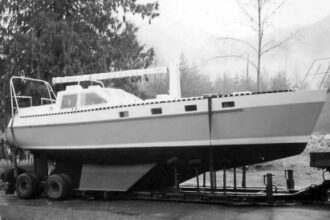
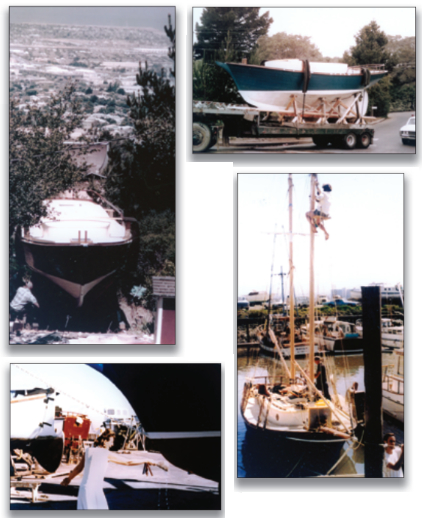
In August of 1969 I called the trucker. It was time to haul our boat down to a boatyard. Neighbors began to gather when they saw two large semis with Lo-Boy trailers loaded with counter-weights and a forklift parked on our narrow street. Without being notified, police, a fire truck, and three newspaper photographers appeared. One neighbor lady, who seldom left her house, decided to skip As The World Turns when she saw the excitement. She showed up dressed in nightgown and robe with curlers in her hair. When she saw what was going on, she went back home and returned with a chair and a bottle of wine. She found shade under a tree and sat all afternoon quietly watching. A newspaper report said it was the most exciting event that happened in Belmont that summer.
Removed tree
One of our trees had grown and was now overhanging our driveway. The trucking crew made short work of it with a chain saw. They scurried about and laid steel plate and pipe rollers under the boat’s cradle.
To the strains of The Mommas and the Poppas singing “California Dreamin’ ” a diesel-powered winch mounted on a trailer slowly inched the 8-ton load up a 30-degree slope. The song seemed appropriate. For Dori and me, this was indeed “The Dawning of the Age of Aquarius.” By late afternoon, our boat was securely strapped to a Lo-Boy on the street. I held my breath most of that afternoon. When the boat was safely loaded, I treated myself a tumbler of Scotch.
The next morning, the truckers returned and led a parade of police cars and onlookers out of the hills of Belmont, down through winding narrow streets to Pete’s Harbor, where we stepped the masts and bowsprit. We stayed several months at Pete’s and continued working on our boat.
Inspired by the turn-of-the-century voyages of Captain Slocum, we wanted this adventure to be as trouble-free and simple as possible. To that end, we decided against complicated electronics, troublesome winches, and expensive gear. We wanted old-fashioned rigging we could repair at sea. We rigged her with deadeyes and lanyards instead of turnbuckles, hung baggy-wrinkle instead of rubber chafing gear, and used kerosene-fueled running lights instead of battery power. We sought simplicity, self-reliance, and solitude.
Invoked a blessing
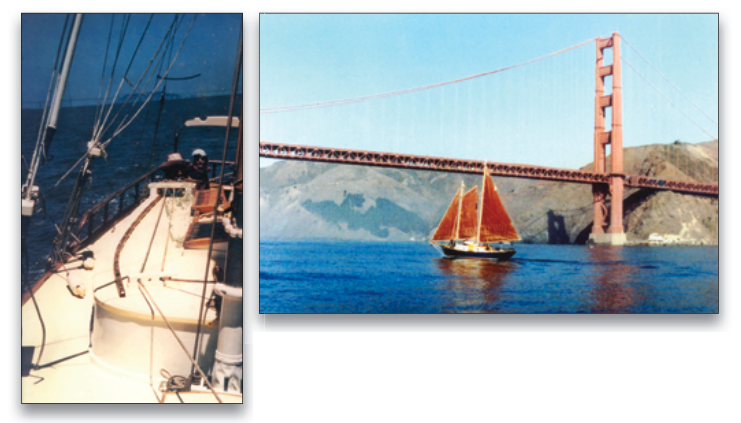
We outfitted our schooner with dark red sails. She turned out to be a beautiful boat. At her launching, Dori christened her Miranda, after the daughter in The Tempest, in order to invoke the blessing of someone whose father had influence over the elements.
We were given a small dinghy and named it Calaban from the same play. It behaved according to character — it, too, possessed an evil spirit. It was heavy and awkward to stow. Calaban refused to hold a straight course when rowed. When towed, she skewed from side to side, then came up rapidly and slammed into the transom and fell back with a jerk that was meant to break her free. On one occasion she turned sideways, filled with water and dove to the bottom. She finally sank, out of sheer spite as far as I could tell. There was no remorse on my part. We replaced her with an inflatable dinghy.
We spent all summer in boatyards and at anchor in Sausalito, ordering and installing equipment and learning to sail our boat. At the same time, Dori spent hours cranking out true confessions. We took navigation classes and learned how to find our position with a sextant. We read every book we could find related to cruising under sail and made many friends on boats preparing for similar adventures.
We took week-long cruises into the Sacramento River Delta region, practicing sail handling, navigation, and anchoring. The delta is prime cruising ground. It provided opportunity to signal draw, swing, and lift bridges and to anchor in sheltered coves filled with crawfish and lined with ripe berries ready for picking. We came to love our little ship and our life living aboard her.
Need to singlehand
If we were to accomplish our dream of long passages to romantic islands, it was obvious that each of us must to be able to sail Miranda alone. We heard of many cruises that were ruined because the man made all decisions while the woman was assigned galley duties. In an emergency, either one would be in trouble. Dori learned to hoist a sail and set an anchor and I perfected recipes I still enjoy. We both studied seamanship and honed our navigation skills and were anxious to head for blue water.
In early September 1970, Miranda left the Gate and headed south. We explored Baja and mainland Mexico. We crossed to Hawaii and finally returned to San Francisco in the summer of 1972.
We were escorted out to sea by dozens of dolphins leaping in our bow wake and were greeted the same way when we made landfall. We witnessed the birth of a whale in Bahia Magdalena and had a whale stay alongside for two hours when we were a thousand miles offshore. We ate flying fish picked from our scuppers and read by the light of phosphorescence at night.
Miranda behaved beautifully all the way. She took care of us in heavy seas and in shoal-filled waters. With her wheel lashed and her sails properly trimmed, Miranda held a steady course for days on end.
We have many stories of adventures at sea and in hidden Mexican coves, but some of the most memorable times were those days when we labored to create Miranda and watch her come to life. We came to appreciate Atkin’s seaworthy design and to understand the value and beauty in simple, uncomplicated, trouble-free equipment.
For many years, Irle White built river-boats at his home on the Kootenai River in northwest Montana. Since his retirement from Eastern Washington University in 1994, he has pursued his hobbies: woodworking, fishing, model-making, and writing.
Thank you to Sailrite Enterprises, Inc., for providing free access to back issues of Good Old Boat through intellectual property rights. Sailrite.com