Peace of mind for pocket change
Issue 81 : Nov/Dec 2011
The battery-operated wireless burglar alarms widely available now for doors and windows can provide an easy and inexpensive way to protect the cabin of your sailboat. I think they are a better solution than a lock. A serious thief can do real damage getting into your boat if the cabin is locked. Both serious and spur-of-the-moment thieves will likely move on to another boat if they see a warning sign that your boat has an active alarm.
The simplest alarms have a magnetic switch inside. Closing an alarm-equipped door, window, or hatch positions a magnet close to the switch on the alarm. The magnet keeps the switch open. Opening the door, window, or hatch moves the magnet away from the switch, which closes and triggers the alarm.
Other types of alarms use a push-button switch that requires contact. When the door or hatch is closed, the button is pushed in and the circuit is open. Examples of these are the buttons that control door-activated lights in cars and refrigerators. When the door opens and the button pops out, it closes the circuit and turns on the light or the alarm.
An alarm that’s activated by motion sensors won’t work for a boat that’s afloat. The constant motion will cause lots of false alarms.
There are some major technical differences to consider between alarm models, as well as the way you install, arm, and disarm them. You’ll be happier with the result if you choose an alarm that fits your boat and the way you use it.
Magnetic-switch alarms
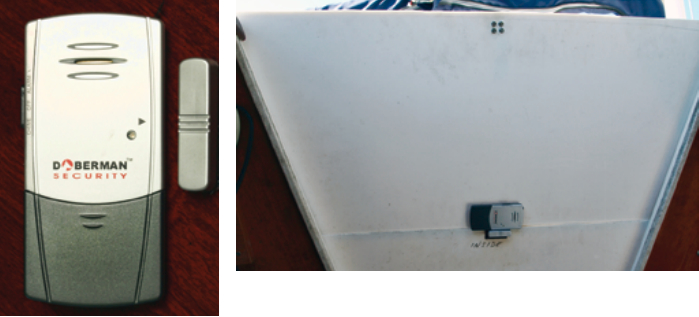
Large home-improvement stores sell a variety of magnetic-switch alarms. All come with double-sided self-adhesive tape with which, in a home, you would attach the components permanently to a window or door and to its frame.
A boat is different. Most companionway dropboards are confi gured so you would have to remove and replace the magnet and alarm components every time you use them. It makes more sense to use sticky-back Velcro instead of the self-adhesive tape.
With the simplest alarms, you could stick the alarm at the bottom edge of the top dropboard in your companionway. Then you could use Velcro to attach the magnet to the top edge of the next dropboard down. The placement of the Velcro on both dropboards makes it easy to place magnet and alarm in the right position for them to work properly. You can even do it in the dark.
You put the alarm and magnet in place, turn it on, and slide the hatch cover closed. If a thief were to open the hatch slide and start to remove the top dropboard, that would trigger the alarm.
It’s a good idea to make a sign warning that an alarm is armed. That will scare off most thieves. Besides,
without it, you might forget and set off the alarm yourself the next time you start to enter the cabin. For my boat, I printed a sign on heavy card stock and weatherproofed it on both sides with wide transparent packaging tape.
Instant or delayed alarm
In choosing an alarm, think about whether a delay between the time the companionway dropboard is moved and the alarm sounds is a good thing. It’s convenient, as it gives you time to disarm it, but a cool, experienced thief might use that time to defeat the alarm.
When they’re turned on, the Doberman SE-0101, the GE 45115, and the Intermatic SP-440B (all these alarms are available online or at home-improvement stores) go off immediately if the alarm and magnet move apart. There’s no keypad and no code to arm or disarm the alarm. Each has a simple on/off switch.
To arm these, first put your companionway dropboards in place. Then stick the alarm and magnet to the Velcro and reach down with the companionway hatch open and turn the alarm on or off. Then slide the hatch closed.
The GE 45117 gives you a choice about the delay, but there is no quick on/off switch. Setting or disarming the alarm requires punching in a four-digit code of your choice. It has two modes, “Home” and “Away.”
“Away” mode gives you 45 seconds to place the two components together after you’ve used the code to arm it, and 30 seconds to turn it off when you return to the boat. You can move the alarm away from the magnet and use that delay time to input the four-digit code.
“Home” mode has zero delay before it goes off. You use the keypad to arm it with the alarm and magnet placed side by side. If the magnet moves, the alarm sounds immediately. In this mode, to prevent the alarm from sounding, you have to punch in your code with the alarm in place before you remove the companionway dropboard.
The GE 44117 is larger and heavier than the other models with magnet switches. In my tests, its magnet seemed to be stronger, and it doesn’t have to be as close to the alarm when it is in operation. The instructions say it can be up to 1/2 inch away from the alarm case.
Other combinations
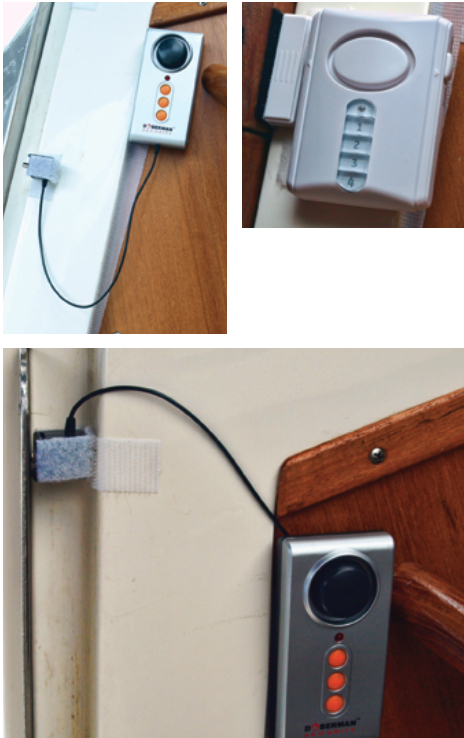
Another model worth considering is the Doberman SE-0114, designed to alert parents in a house with a swimming pool if a child opens a door to the pool area. It uses a contact button rather than a magnet switch, has a three-number keypad, and is powered by two AAA batteries. Its loudness is rated at 100 decibels (db).
Because of its design, the alarm itself doesn’t have to be attached to a companionway dropboard. The contact button must be placed so it is depressed when the dropboard is in place.
If you punch in the three-number code, the alarm is disarmed. But then it beeps every 30 seconds to remind you it’s not armed. This is to warn parents that a door is open and kids can get to the pool without triggering the alarm. Re-arming is very simple: close the door or hatch to depress the contact button.
If you use this alarm on your boat, you don’t want to be nagged every 30 seconds that the companionway alarm is not active. I found a way to keep the button depressed with the companionway open. I put a strip of Velcro in the dropboard channel, which is conveniently just wide enough to hold the sensor in place with the button depressed until it’s time to close the hatch and arm the alarm again.
Batteries
The Doberman SE-0101 and the GE 45115 use “button” or “disk” batteries, which are expensive, have a shorter life, and provide less muscle than AA or AAA batteries.
The GE 45117, rated at 120 db, is louder than the others in this group and uses three AAA batteries.
The GE 45115 is also rated at 120 db, but closing the hatch quickly when the alarm sounds silences the alarm. Most alarms, once triggered, will continue to screech, even if the hatch is closed, until you turn them off.
The Doberman SE-0101 is rated at 95 db. It is the smallest and lightest of the alarms I tested. The Intermatic SP-440B is rated at 90 db and uses one AA battery.
Some of the alarms will beep or flash periodically when the battery needs to be replaced. Some have a battery-condition test button.
Remote control
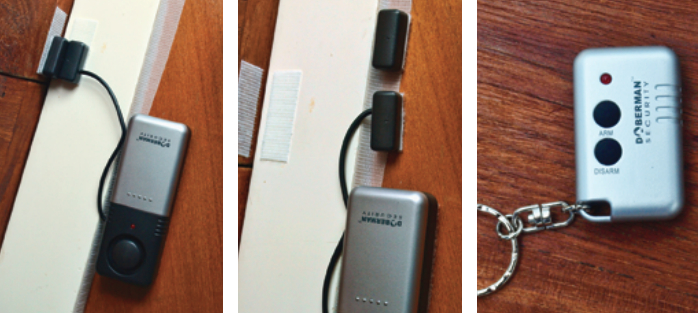
Instead of having the switch built into the alarm itself, the Doberman Tool Box Alarm SE-0205 uses a magnetic switch that’s separate from the alarm and connected to it by a wire. This makes placement of the switch on the companionway dropboard much easier and the lightweight magnet and switch are less likely to be dislodged accidentally from the Velcro on the dropboards. And, depending on the way your companionway is built, you might be able to mount the alarm so you don’t have to move it each time you insert or remove the dropboards.
The SE-0205 is powered by three AAA batteries and its loudness is rated at 100 db. It has a remote to turn it on and off from a distance. The remote works like a garage-door remote. There is no code to remember and no delay. Just touch the remote’s “arm” or “disarm” button.
While I would prefer not having to use the remote to operate the alarm, I found this model best for me because of its convenience, loudness, batteries, and because it gave me a wider choice of places to mount the alarm and leave it there.
In fact, I would prefer not needing an alarm at all, but having one gives me peace of mind. And the price was right.
Clarence Jones is a writer, news-media consultant, photographer, sailor, tinkerer, and inventor. He and his wife, Ellen, live, work on, and sail their Catalina 28 from Anna Maria Island in the entrance to Tampa Bay. Part of the joy of sailing for Clarence is creating and building inexpensive enhancements for his boat.
Thank you to Sailrite Enterprises, Inc., for providing free access to back issues of Good Old Boat through intellectual property rights. Sailrite.com