Issue 6 : May/Jun 1999
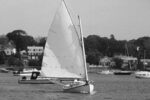
The late Carl Alberg was one of the pioneer designers of mass production fiberglass sailing yachts, and his 28-ft Triton design, introduced in 1959 by Pearson, was produced by the hundreds, 700 or so actually. In fact, the Triton was the nation’s second production FRP yacht, preceded only by the Rhodes Bounty sloop. From that beginning, Alberg went on to create numerous other designs for various companies, including Pearson, Allied, Cape Dory, Bristol, Ryder, Whitby Boat Works in Ontario, and I am sure many other less-well-known builders.
The Alberg production designs included craft from 16-foot daysailers to oceangoing yachts of more than 40 feet LOA. I know that Kurt Hansen of Whitby Boat Works crossed the Atlantic in one of his own Alberg 37s, and many other Albergs have made extensive voyages in waters all around the world.
Generally the Alberg designs have a distinct family resemblance, characterized by husky displacement, a high ballast ratio, relatively narrow beam, long overhangs, a flattish sheer line, cutaway full keel, and a rig with the mast well forward, producing a small foretriangle and a large mainsail. Both the Ariel and Commander are very much a part of this family and anyone familiar with the design would probably recognize their Alberg lineage across a wide harbor on a foggy day.
Because of their narrow beam, the Albergs tend to heel quickly, making some people believe they are tender. However, once the boat heels far enough that the high ballast ratio gets to work, she stiffens up and settles down to handle the breeze very nicely indeed. And of course, once she does heel to a reasonable degree, the long overhangs immerse and the sailing waterline lengthens to increase the potential speed. (The theoretical top speed of a displacement hull is 1.34 times the square root of its waterline length, as you may know.)
The Commander’s displacement/length ratio of 360 does put her in the “very heavy” category today and will tend to limit her top speed somewhat due to increasing wavemaking resistance as she approaches theoretical hull speed. However, her husky displacement will also ease her motion in heavy seas, and she will not be bouncing around like a cork in a bathtub, as some modern, beamy, ultralight yachts tend to do. Along with her heavy displacement, the Commander has a good sail area/displacement ratio and should perform well in light air despite the wetted surface of her full keel. I expect that anyone who has a 150-percent genoa on his Commander will have no trouble keeping the vessel moving along very nicely indeed when the wind is soft.
Although they may not shine at club racing today against more modern designs, Commanders are still comfortable cruisers for their size with an easy motion in a seaway. These are boats that can handle the weather and the waves with aplomb, thanks to their Carl Alberg heritage.
Thank you to Sailrite Enterprises, Inc., for providing free access to back issues of Good Old Boat through intellectual property rights. Sailrite.com