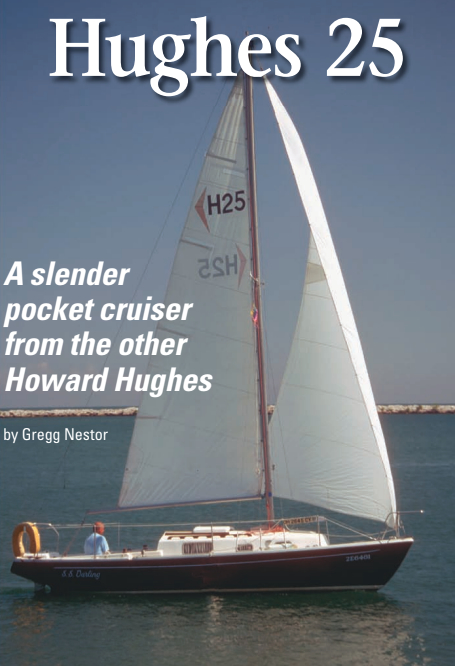
A slender pocket cruiser from the other Howard Hughes
Issue 49 : Jul/Aug 2006
Hughes Boat Works Limited was the largest Canadian sailboat manufacturer for several years, building a total of approximately 3,500 sailboats. One of its earliest models was the Hughes 25, which was designed by Howard Hughes and went into production in 1968. Described in company literature as “Our Swinger! A fast, pretty, family boat . . . ”, the Hughes 25 is a versatile pocket racer/cruiser with sweet lines and surprising performance.
In 1963, brothers Howard and Peter Hughes of Willowdale, Ontario, formed a partnership to build dinghies ranging from 8 to 16 feet in length. Their venture was successful, and in 1965 they relocated Hughes Boats to the Toronto suburb of Scarborough. There they began building larger sailboats. These included the Hughes 24 (using tooling purchased from Tanzer), the Hughes 27 (designed by Howard), and the Hughes 38 (a Sparkman & Stephens design). On Feb. 23, 1967, Hughes Boat Works Limited was formally incorporated and registered with the province of Ontario. In 1968, the company relocated to Huron Park (Centralia), Ontario, where larger manufacturing facilities, including a test tank, were located. Our review boat, the Hughes 25, along with the 22 and 29 (designed by Howard) and the Hughes 38 and 48 (designed by Sparkman & Stephens) all went into production in 1968.
In 1969, the company was bought by U.S. Steel and the name was changed to Northstar Yachts Limited. The brothers stayed on with the company until 1971. Between 1971 and 1975, Northstar introduced six Sparkman & Stephens designs ranging from 25 to 38 feet and a pair of boats (24 and 30 feet) designed by Bruce Farr. All of these models were racers, and one won a quarter-ton world championship. Despite the boats’ pedigrees and racing prowess, however, on Dec. 10, 1975, Northstar Yachts Limited was formally listed as canceled/inactive by U.S. Steel.
Howard Hughes purchased Northstar Yachts in 1977 and renamed it Hughes Boatworks Inc. Deciding to focus on family cruisers rather than racing, he sold the Farr-designed tooling, modifi ed several of the Sparkman & Stephens designs, and also began molding hulls for Tartan Yachts. Business was good.
Around 1979, Howard bought Columbia Yacht Corporation, renamed it Hughes-Columbia, and relocated its production facilities to Canada. Seven new models, called Hughes-Columbia, were soon introduced using designs by Alan Payne and Bill Tripp Sr. Production of the five Hughes models (the previously reworked Sparkman & Stephens designs) continued simultaneously.
Unfortunately, prosperity did not last. Hughes-Columbia went into receivership and the factory was closed in 1982. This was largely due to the debt incurred by the acquisition of Columbia Yachts and compounded by a deep recession and high interest rates. With interest rates around 18 percent, sailboat sales plummeted. Aura Yachts purchased the business but was unsuccessful in making a go of it.
Howard Hughes again entered the picture and bought the assets after the failure of Aura. He began building a custom 41-footer in an Orangeville, Ontario, facility. Fire destroyed the plant in 1991 and the insurance company turned out to be fraudulent, leaving Howard emptyhanded. At this point, most tooling for the boats had been moved outside of the plant, where it remains to this day.
The phoenix arose from the ashes no more.
Design and construction
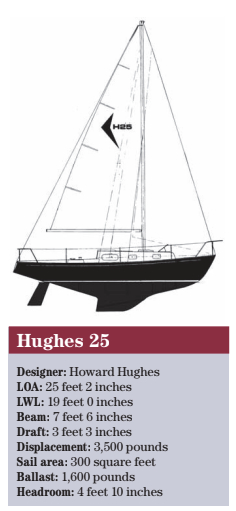
The Hughes 25 has a relatively straight sheer that harmonizes well with the low chin of the bow and the relatively long counter with reverse transom. The cabinroof line increases slightly in height as it runs aft. Matching-height portlights complete and complement the boat’s traditional aesthetics.
The boat has a fin keel with a long, tapered leading edge and some dead- wood aft fairing into the hull. The rudder is a balanced spade raked aft. In the late 1960s each of these appendage types was thought to increase speed but have since been dropped in favor of more vertical keels and rudders.
Beam is a lean 7 feet, 6 inches. Coupled with just 3 feet, 3 inches of draft, it makes for a tender hull form. The displacement/length ratio is a moderate 234, and the sail area/displacement ratio is a whopping 20.8.
The hull and deck are constructed of fiberglass. While the hull is a solid hand laminate, the one-piece deck molding is a fiberglass sandwich with a core of end-grain balsa. End-grain balsa is extremely light and highly resistant to crushing. It also affords good insulation against heat, cold, and sound. The downside is that if it gets wet, it turns into mush and delamination of the skins occurs.
The hull-to-deck joint is a box joint, where the deck fits over the hull much like the lid on a shoebox. The hull and deck are bonded with adhesive and mechanically fastened with pop rivets on 2-inch centers. On the outside, the joint is covered with an aluminum rubrail.
The interior structure is a one-piece fiberglass pan that incorporates all berths, the countertops, and the cabin sole. Wooden ribs that have been fiberglassed to the hull along with the bonded-in pan and fiberglass headliner complete the structural package.
All deck fittings are through-bolted and most are set with aluminum backing plates. The fin keel has 1,600 pounds of lead ballast mounted externally with 1⁄2-inch stainless-steel bolts. The spade rudder is solid fiberglass molded around a stainless-steel rudder post. Tiller steering is standard.
On deck
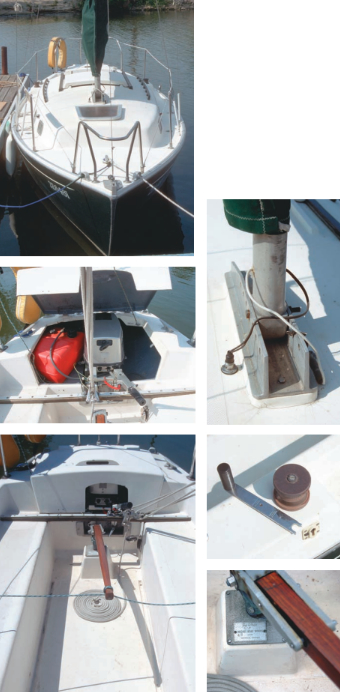
The narrow foredeck is relatively free of clutter except for a central cleat and a pair of large closed chocks. Its surface and that of the 9-inch-wide sidedecks is molded-in non-skid. The stainless-steel bow pulpit is connected via single lifelines and 23-inch stanchions to the stern pulpit. Even though there are 4 feet of teak handrail on the cabintop and a molded-in toerail, the combination of outboard shrouds and narrow sidedecks makes fore and aft movement challenging.
On top of the cabin, forward of the mast, is an opening hatch that leads to the V-berth below. On the cabin sides are six fixed portlights. Four smaller ones are forward and two larger ones are aft. There is no sea hood protecting the sliding hatch at the companionway. Making one would be a good upgrade.
The cockpit is a generous 7 feet long and features 10-inch coamings that provide good back support. The boat’s narrow beam translates into a narrow footwell that affords good bracing when heeled. There’s a bridge deck and a pair of scuppers connected to bronze seacocks to remove water from a pooped cockpit.
The relatively long counter houses a lazarette, which incorporates an engine well and stowage for a 6-gallon fuel tank. This arrangement places the propeller aft of the rudder and makes for easy maneuverability.
Stern docking hardware includes a pair of 8-inch cleats plus a pair of closed chocks.
Belowdecks
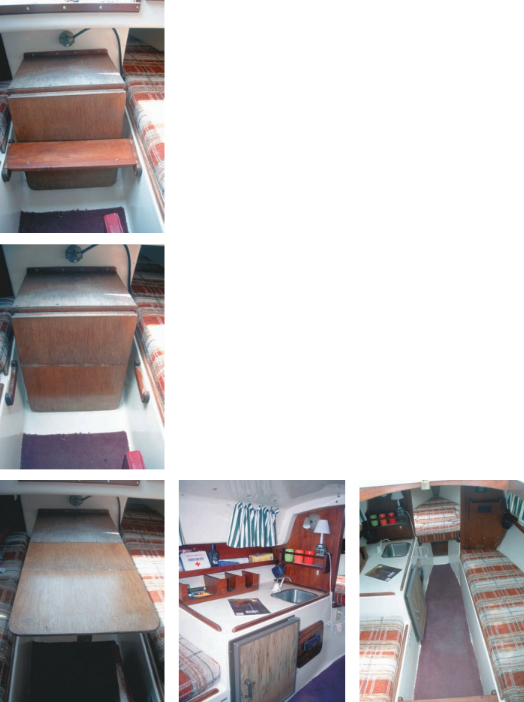
The Hughes 25 was offered in two interior configurations, each with berths for five. Both arrangements incorporate a V-berth separated from the main cabin by a bulkhead. Interior Plan A features opposing settee berths in the main cabin, followed by an aft galley to port and a quarter berth to starboard. Our review boat was configured with Plan B, fitted with two quarter berths and a single starboard settee berth. The port settee berth was replaced with the galley and a seat. All berths are a minimum of 6 feet long.
In both layouts, the galley consists of a single stainless-steel sink with manual pump; a 4-cubic-foot front-loading icebox; a teak rack for glasses, plates, and silverware; and a space for a cooktop. The potable water tank holds approximately 3 gallons and the sink drain is connected to a bronze seacock. The table, a fold-up affair, is an integral part of the companionway steps.
Beneath the V-berth are three stowage lockers and the portable toilet, which is plumbed to a deck pump-out fixture. Even though the V-berth and head are forward of a full bulkhead, there were no factory provisions for a privacy door or curtain.
There’s plenty of stowage beneath the settee berths, plus along the 10-plus feet of fiddled shelving situated outboard and above both sides of the main cabin.
The majority of the interior surfaces are off-white gelcoat. The bulkhead and table are marine plywood veneered in teak. The trim and accents are solid teak. The sole is carpeted. Headroom in the main cabin is 4 feet 10 inches.
The rig
The Hughes 25 is a single-spreader masthead sloop with a 145-square-foot mainsail and a 155-square-foot foretriangle, yielding a total sail area of 300 square feet. The mast and boom are aluminum extrusions with internal sail tracks.
The mast is stepped on deck. In an unusual but very helpful feature, the cast aluminum tabernacle features seven fore-and-aft mast positions so weather or lee helm can be corrected. The tabernacle also allows for fore or aft raising and lowering of the mast. The standing rigging is 5 ⁄32-inch 1 x 19 stainless-steel wire and with single uppers, double lowers, and a single backstay. The boom is fitted with worm-drive roller reefing.
Sail controls consist of two 9-foot, 6-inch genoa tracks and cars situated on the port and starboard toerails. These lead the sheets to small sheet winches and their associated cleats. Mainsail sheeting is end-boom and is connected to a traveler aft of the tiller. All halyards are external, double-braided Dacron and cleated at the mast.
Under way
The Hughes 25 is a very satisfactory first cruiser. Its large cockpit and roomy interior make for a comfortable pocket cruiser. Its 3-foot 3-inch draft allows for gunkholing. Initially, the boat is tender and quickly heels, but as soon as it reaches 15 degrees or so it stiffens up nicely. This is typical of boats designed to the CCA (Cruising Club of America) Rule. These boats have shorter waterlines, but as soon as the boat heels, the sailing length increases, along with an increase in boat speed. The low wetted surface area and high-aspect-ratio sail plan also make for speed.
When the winds pick up above 15 knots or so, it is prudent to take a tuck in the main. Forget the roller reefing and install slab reefing.
The combination of a fin keel and spade rudder makes the boat responsive and able to point well, while the outboard shrouds take some of that gain back by limiting the sheeting angle.
At present, only four Hughes 25s are being actively raced, mostly in fleets around the Great Lakes’ regions of Canada and the U.S. Their PHRF numbers vary only a little — between 225 and 231. That’s quite a bit quicker than the very similar Cape Dory 25 at 261, and slower than the much more modern J/24 at 171. A Catalina 25 averages around 225. Given its age, the Hughes 25 acquits itself quite well.
With the engine in a well and the propeller aft of the rudder, maneuverability under power is good.
Things to check out
The newest Hughes 25 is more than 30 years old, and age-related issues should be readily apparent. One of the most insidious problems is delamination of the balsa-cored deck. This is caused by water that has found its way into the core through a damaged outer fiberglass skin or from beneath poorly bedded hardware. Regardless of how it got inside, this is not good. Delaminated areas sound dull and hollow when struck by a plastic hammer or the handle of a screwdriver.
A small area of delamination can usually be fixed or, if allowed to dry out, left alone. However, extensive delamination must be addressed and can be costly. The cost for a major repair of this type is probably more than the value of the boat. If you don’t want to do it yourself (since your hourly rate costs you nothing), it’s better to keep looking for another boat.
Check for mast compression. Look for signs of cracking, bending, or movement in the supporting bulkhead beneath the mast. Investigate the hull-to-deck joint. This box joint can be easily damaged by a side impact with a dock or piling. Look for gelcoat cracks, a damaged aluminum rubrail, or a waviness to indicate that such an impact may have taken place.
Summing up
The Hughes 25 is a responsive racer and coastal cruiser. If you race, it’ll be competitive. If you cruise, it’ll be reasonably comfortable and dry. If you’re a novice, you’ll find that the Hughes 25 is easy to handle and quite forgiving. The boat performs well in light air, but benefits from a reef when the winds pipe up. Its lines are appealing and the size of its cockpit is generous. You can pick one up for about $2,500.
Thank you to Sailrite Enterprises, Inc., for providing free access to back issues of Good Old Boat through intellectual property rights. Sailrite.com