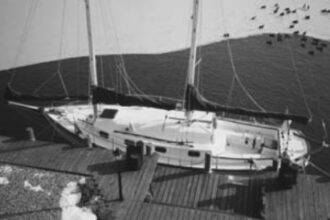
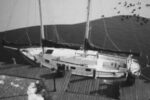
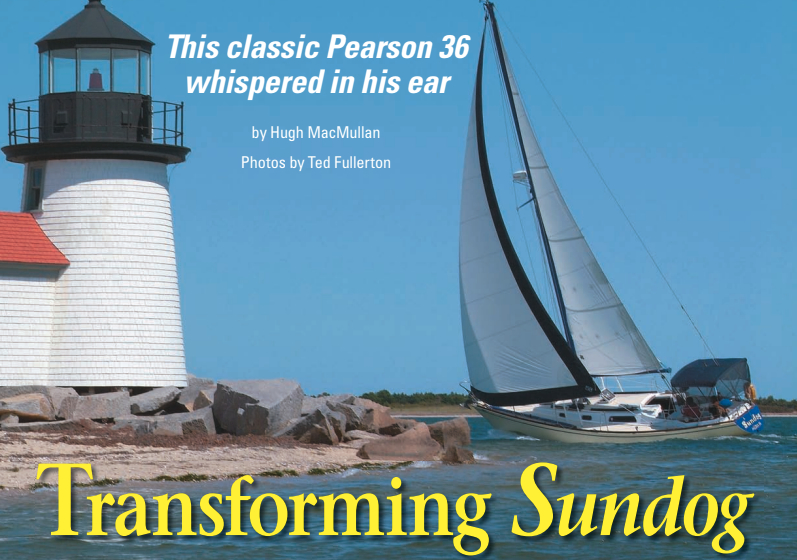
This classic Pearson 36 whispered in his ear
Issue 49 : Jul/Aug 2006
Zora Neale Hurston nailed it when she wrote, “Ships at a distance have every man’s wish on board.” True. But do boats have wishes also? Surely Sundog’s wish in July 2002 must have been to be owned and sailed by Ted Fullerton, a cheerful graduate of the I’d-better-do-it-myself-because-no-one-else-will-do-it-right university, a perfectionist who kept Sundog, a 1973 Pearson 36, virtually at his side while he lovingly made her better than new.
Ted had just sold his Wianno Senior Knockabout 25, Sandpiper, a 1928 beauty, in order to be a more responsible small-business owner and to care better for Magnum, a golden retriever he’d inherited from his father. It was his intention to be boatless for three years. But even the best intentions are sometimes difficult to honor. Two days after the sale of Sandpiper, he ran into an acquaintance at a convenience store, a woman who told him, “I have to sell my boat,” and asked for his help. Ted agreed to check out the boat and give her his suggestions. He had a friend who might be interested.
The next day, Ted and the boatowner took the boat for a sail. The boat was in poor condition. Ted noticed the liberal use of house paint and duct tape. The battery was dead — they needed a jumpstart to leave the mooring — and after the motor began vibrating badly, Ted shut it down. But he noticed that the boat sailed well in brisk conditions. He managed to pick up the mooring singlehanded under sail in Wharton Creek on Chesapeake Bay.
Sense of wrongness
You already know what happened next. What led to the purchase, as Ted remembers it, was how well the boat sailed, her ample headroom below (he is 6 feet 4 inches tall), and his perfectionist’s sense of wrongness about how the boat was being maintained.
The rest of us know, don’t we, that the boat whispered in his ear, “We’d be good together. Look at how we managed that mooring pickup. We belong together, don’t you think? You could name me Sundog, after Magnum and your favorite atmospheric phenomenon. If you fix me up, I’ll sail fast for you, I’ll point well.” Ted had been boatless for the grand total of eight days . . . $6,000 sealed the deal.
Ted’s sailing and boatowning credentials were nearly as laudable as Sundog’s Pearson pedigree deserved. Ted’s parents were Star racers. That’s how they met. His father built and raced iceboats. Ted’s first sail occurred when he was 2 weeks old. When he was 4, in 1962, Ted’s family purchased an Olson 35.5 at the New York Boat Show. They sailed it for months every summer in New England. A favorite family photo is of Ted, a 6-year-old capitalist, collecting trash for tips in the family dinghy in the Cuttyhunk Harbor.
Ted was 15 when he first bought his very own boat, a 1934 19-foot Chris-Craft runabout. It cost him $25 and an assurance to the seller that he and his buddies would remove it from the VFW parking lot where it had died. One of his father’s sailing friends gave Ted fiberglass resin and fabric, and he glassed the boat’s bottom with it . . . his first major repair job. He bought the Wianno in 1992 for $2,500. Ted says he “did everything and then some” to it, upgrading his personal repertoire of old sailboat rehabilitation skills. He sold the boat in 2002 for $25,000 to someone who admired all the varnish.
Giant list
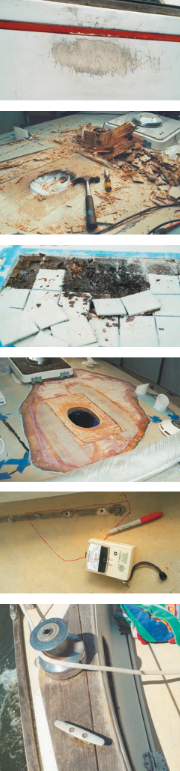
The first thing Ted did after buying Sundog was to make a giant list of everything that needed to be done to the boat. First, so he could easily singlehand her, he installed a Raytheon 4000 Autohelm. At the Annapolis Sailboat Show, he bought additional instrumentation, including wind speed, depthfinder, knotmeter, and a chart plotter, as well as a new mainsail, a 150-percent jib, sailcovers, and a Bimini.
He fretted over the vibrations under power and determined that there was nothing wrong with the engine, a Yanmar diesel with only 80 hours on it. Instead, he decided that there were repairable structural issues with its installation. While tackling that issue, he also installed a new battery box and two new batteries. He replaced halyards and sheets and painted the boat the colors he was considering.
That November he had her hauled and trucked to a spot behind Upper Bank Studios, his photography business in Media, Pennsylvania. He bought and assembled a giant prefabricated RV shed around the boat, adding adequate propane heat and lots of light. This enabled him to work throughout the winter. And so it was that during the 10 months between November 2002 and August 2003 Sundog and Ted really got to know each other.
During this time, Ted:
- Purchased a moisture meter and identified six major problem areas in the deck. After getting a $23,000 quote to fix the deck, Ted fixed it himself.
- Pulled all deck hardware and sent it off to be re-chromed.
- Replaced all exterior wood (teak toerails, winch bases, trim, and grabrails) and built two new Dorade boxes.
- Made new hatchboards for the companionway.
- Installed new cowlings.
- Made Sunbrella Dorade box covers, grabrail covers, and wheel covers.
- Made Sunbrella winch-base and winch covers with magnets instead of snaps.
- Installed new stanchions and lifelines.
- Installed new portlights.
- Repaired hull damage discovered while replacing the toerails.
- Stripped the boat’s bottom and applied seven barrier coats.
- Refilled and reglassed the damaged skeg.
- Installed inboard tracks and rollers for jib sheets.
- Purchased ash rollers for shrouds.
- Installed a new Edson steering column, including new cables.
- Sanded, primed, and prepared Sundog for painting.
- Found and hired a skilled marine spray painter from Oxford, Maryland, to paint Sundog’s deck and hull. Warned about a yellow hull’s issues with bad luck and durability, Ted decided nonetheless to Awlgrip her a Fighting Lady Yellow.
- Sanded, primed, and painted Sundog’s mast and boom a bright royal blue.
- Devised and painted Sundog’s unique stern logo.
- Reinstalled the newly chromed deck hardware.
- Epoxied (six coats) and varnished (seven coats) all exterior wood.
- Installed a new oversized stainless-steel sink.
- Installed new interior lights.
- Purchased 35 yards of moss green Ultrasuede and found a seamstress who would recover the interior cushions for him.
Sundog went into the water in Essington, Pennsylvania, in August 2003. She and Ted sailed to New England. For three weeks, they sailed to Nantucket, Martha’s Vineyard, Cuttyhunk, and Padanaram, Massachusetts, reprising Ted’s childhood summers. During this time Ted learned Sundog’s approach to sailing and revised his to-do list. By mid-October, Sundog was hauled, trucked, and back under the shed. It was boatwork time once again.
That winter, Ted:
- Installed a rudder reference guide to enhance the Autohelm’s performance.
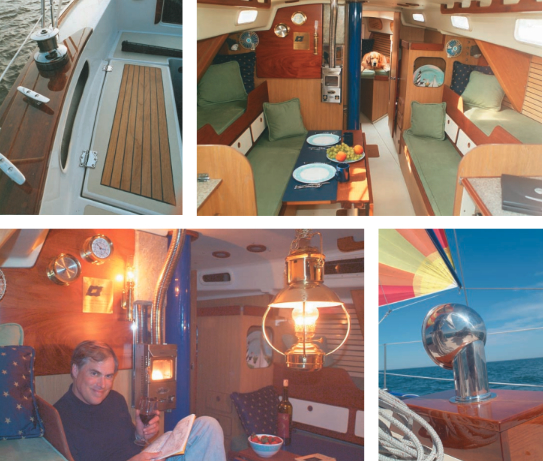
- Installed a propane fireplace.
- Insulated the cabin and installed varnished ash strips on interior surfaces.
- Cleaned, sanded, and oiled all the interior teak.
- Replaced all the interior Formica.
- Carpeted the interior of most storage spaces.
- Installed a stainless-steel-and-teak swim ladder (at his mother’s request).
- Installed a ship-to-shore radio.
- Installed a satellite radio.
- Built a birch cabinet to house the ship-to-shore and satellite radios.
- Purchased two additional batteries and installed them in a specially fabricated box in the engine compartment.
- Reinforced the engine box with a floating structural beam.
- Installed a raw-water washdown system.
- Painted the interior.
- Installed a new 42-gallon fuel tank with a fuel polishing system.
Ted and Sundog had a full season of sailing in the summer of 2004. She turned heads in Block Island, Cuttyhunk, Martha’s Vineyard, Nantucket, and Padanaram that summer. Ted’s favorite compliment was delivered by an old-timer in Padanaram — home of Concordia Yachts — who reckoned the Pearson had “the best-looking varnish in the harbor.” Ted’s favorite moments of sailing were when Sundog twice sailed faster than theoretically possible boat speeds, managing more than 10 knots under spinnaker.
The next winter, Ted:
During the winter of 2004-05, Ted got around to the smaller items on Sundog’s wish list. That year he:
- Installed exotic anaconda marble behind the heater flue.
- Installed a mahogany panel with barometer, tide clock, and Pearson plaque next to the fireplace.
- Installed a wine rack in a bit of space he found under the nav station.
- Made an oversized coffee-cup holder, a replica of one he had admired on a Hinckley.
- Replaced the head.
- Added a ship’s lantern and clock.
- Re-routed the mainsheet, spinnaker halyard, and uphaul through a teak-based triple-rope clutch in order to access a new winch just forward of the wheel.
Last winter (2005-06), Ted:
- Added a Raytheon 6000 Autohelm, leaving the 4000 Autohelm in place as a backup.
- Installed a new front hatch.
- Added a dodger with a fly to the existing Bimini.
- Installed a maple cabin sole, with teak accent strips.
- Purchased a light shade for the hatch.
- Installed a deck-mounted light prism to light the head.
- Replaced the acrylic on the center hatch.
- Reinforced the forward keel bolt bulkhead.
- Fabricated and installed a teak cowling shutoff.
Including the purchase price, Ted has spent about $48,000 on Sundog. He’s also logged about 2,200 personal manhours on “getting it right,” as well as developing invaluable relationships with folks who invariably went out of their way to help. He awards the Fullerton Above-and-Beyond Award to Dennis Johnson at Mobile Marine, Cheryl Gerfin at Defender Marine, Winston Savage at Raytheon’s Tech Support, and Paul Linehan at Jamestown Marine. Sundog is at last 100 percent Ted’s boat, with all of his wishes aboard.
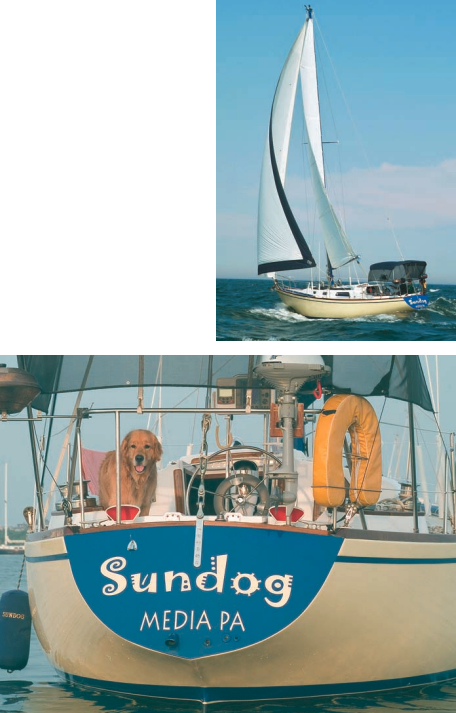
A better-than-new Pearson 36 — a yellow and blue beauty — will be in New England every summer from now on. If you see a tall guy with a golden retriever aboard, you’ll know she’s Sundog.
Thank you to Sailrite Enterprises, Inc., for providing free access to back issues of Good Old Boat through intellectual property rights. Sailrite.com