Age and patience make up for fading youth and verve
Issue 84 : May/Jun 2012
There comes a tide in the affairs of men that, taken at the flood, sucks them swiftly away from the sea and boats and strands them for the best part of two decades on the reefs of Marriage, Career, Home, and Bringing Up Children.
William Shakespeare said it a little differently, but it’s probably what he meant. In other words, if you want to go cruising or voyaging, your realistic choices are either to do it while you’re young, before you start a family, or else afterward, when you’re older and your family has grown up and fled the nest.
There are, admittedly, some brave souls who choose the middle course. They go cruising with small kids and crates of books for home-schooling, but they’re a small minority and deserve medals for bravery. I admire their spirit, but it’s not a practical scenario for most couples.
For those who set out early in life, cruising never seems to present many problems. The young and penniless who set forth in overblown dinghies or leaky old wooden tubs can put up with any amount of discomfort and deprivation. Young men, especially, seem OK with not being able to shower and shave every day, and some even wear their underwear for two days in a row.
But for those more cautious individuals who wait — those who try to keep the dream alive while they’re stranded on the reefs mentioned above — things become more difficult. By the time such sailors and their partners are free once more to fulfill their adventurous dreams, they are 50-plus and faint-hearted. They no longer have the zeal or the devil-may-care attitude that carries the youngsters over all obstacles. Many of them retire and buy motor homes. They search disconsolately in RV parks all over the country for the freedom and satisfaction that eludes them. And, sadly, they never find it.
What they don’t realize is that it is indeed possible to start cruising in the golden years of life. It’s never too late to pack it all in and sail away — either from port to port along the coast or clear across oceans to fascinating foreign anchorages — provided you’re fairly sane and reasonably healthy.
Age is its own asset
Contrary to what many people believe, age itself is not a major barrier to cruising under sail. If you can climb the companionway steps, you’re probably fit enough to sail the boat. And there’s nothing like living aboard a small yacht to make you fit and keep you fit.
In any case, those whose tread upon the foredeck is no longer cat-like, or whose capacity for grinding winches no longer rivals a gorilla’s, can make up for it with experience, simple cunning, and large doses of patience.
Tom Andersen, a New England cruiser I once met in the British Virgin Islands, tells of a 40-foot yacht that arrived one day from Venezuela with an elderly couple on board, both in their middle 70s.
Tom watched with fascination while the man wrestled to free the pin of an old and very rusty shackle on his anchor.
“I would have taken a hacksaw to it and replaced it in five minutes with a brand-new $2 shackle,” said Tom. “But not him. He was obviously prepared to fight.”
Eventually, Tom started to make polite conversation, as cruisers do, and remarked that there always seemed to be something to do on a boat.
“Yes, it’s true,” said the old-timer. “If this old bitch didn’t keep me so busy, I would have died peacefully years ago.”
There are many sailors in their 60s and 70s cruising the oceans of the world these days, aided by modern materials, modern technology, and designs that make handling easier. In fact, there are people over 60 years old who race around the world singlehanded, bless their hearts.
Many years ago, in Durban, South Africa, I met a French-American sailor named Jean Gau, then in his 60s, who also was racing singlehanded. He, however, was racing the clock. He had to get back to his job in New York as chef at the Waldorf-Astoria.
During his circumnavigation in his Tahiti ketch, Atom, he had been drastically delayed in the South Sea Islands. “The girls — in grass skirts, you understand — the girls, they swim out to your boat and ask . . . um . . . if there is anything they can do for you,” he told me. “Anything.”
Well, naturally, Jean got a little distracted and delayed. To make up time, he sailed an 80-day non-stop passage westward across the Indian Ocean to South Africa.
That beats hunting for a spot in an RV park, doesn’t it?

Fear not the tempest
One particular hurdle that stops many late starters in their tracks is simple fear of the sea. “Will I be able to handle the boat in heavy weather?” they ask. Well, gales are a normal part of life at sea and should be no cause for undue worry in a well-found modern yacht. Eric Hiscock, the famous British author and circumnavigator, was cruising well into his 70s with his wife, Susan. He was a natural worrier in his younger years. He suffered from anxiety that bad weather might overtake his 30-foot sloop and he might not know how to deal with it. “Fortunate indeed is the man who early in his sailing career encounters and successfully weathers a hardblow,” he wrote. It took him far too many years of unnecessary worry to realize that even in old age he would be fully able to handle his boat with confidence in gale-force winds.
Then, of course, there is the fact that gales are rare if you plan wisely and aim to be in the right places at the right times. Voyagers taking the trade-wind routes around the globe report having to cope with winds over 28 knots only 2 percent of the time. So cruising is not mostly about being at sea and facing storms. World cruisers spend at least five to six times as long in port as they do at sea, in which case cruising becomes mostly about new faces, new places, beautiful landfalls, the thrill of exploration, self-sufficiency, independence, and the indescribable satisfaction of achieving your cherished dreams.
There are no age barriers among cruisers, either. They all belong to a select group whose roots go back to the earliest days of civilization. They are a close-knit brotherhood of the sea. They form part of a noble tradition with its own literature, language, insignia, customs, rituals, rewards, and penalties.
Their team spirit is understandable when you think how many people — all experts in their own fields — are required to navigate a large ship across an ocean. Yet one or two perfectly ordinary people, aged from their teens to their 70s, can, and do, sail small yachts through those same seas, facing exactly the same hazards of wave and weather, and doing all the work themselves, from engine maintenance, through navigation, to cooking breakfast.
Finally, the cherry on top is that most late starters have saved up a bit of money by the time they’re ready to go cruising. They can afford some of the luxuries they couldn’t have aspired to in their impecunious youth. We’re talking newer boats, better sails, electric winches, colder beers, and more interesting trips ashore.
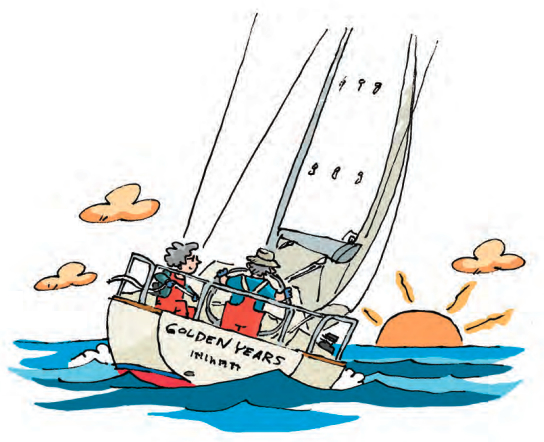
They always say you can’t take it with you; but they’re wrong. You can, if you go cruising in your golden years.
John Vigor, a former newspaper columnist and editorial writer, is the author of 12 sailing books. He is a sailing and navigation instructor accredited with the American Sailing Association. He writes three boating columns a week on his blog, www.johnvigor.blogspot.com.
Thank you to Sailrite Enterprises, Inc., for providing free access to back issues of Good Old Boat through intellectual property rights. Sailrite.com