Could she be the classiest Cal 25 ever?
Issue 70 : Jan/Feb 2010
I have always loved boats, the sea, and being by water. I dreamed of one day owning a classy sailing vessel that would have a luxurious, rich, homey feel but I never thought I could afford such a boat.
A man with boat fever spends a lot of time in marinas and eventually I came upon a boat whose lines caught my eye. She was for sale at a most reasonable price. Sinfonietta is a 1969 Cal 25. She was scum-covered and grungy but sound and seaworthy. I was told the owner had been trying to sell her for several years and was “highly motivated,” so I arranged for further inspection and a sea trial.
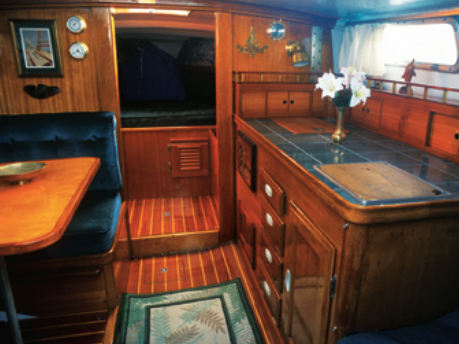
When my sons Corey and Larry and I went below for the first time, we knew instantly she was for us. Her thick fiberglass hull, solid mahogany interior, and comfortable layout immediately welcomed us with a feeling of warmth and coziness. She seemed to beg us to stay aboard and give her a new life. Her interior was in good shape. Now here, we agreed, is a “real boat” with the potential to be special. We fell head-over-bank-account in love with each other.
I struck a sweet deal with the owner. I then had to move her over three mountain passes and down more than 700 miles of highway from the West Coast, but by the end of September 2000, she was docked in her new home in Dayton, Montana. Over the next few summers, I cleaned her up and worked on improving my boathandling abilities. Since I spent much of my time teaching the Scouts of Camp Melita Island as they earned their sailing merit badges, true reconditioning didn’t begin until the fall of 2003 when I obtained a trailer that enabled me to haul Sinfonietta 90 miles south to my personal boatyard at my Missoula home.
The project list begins
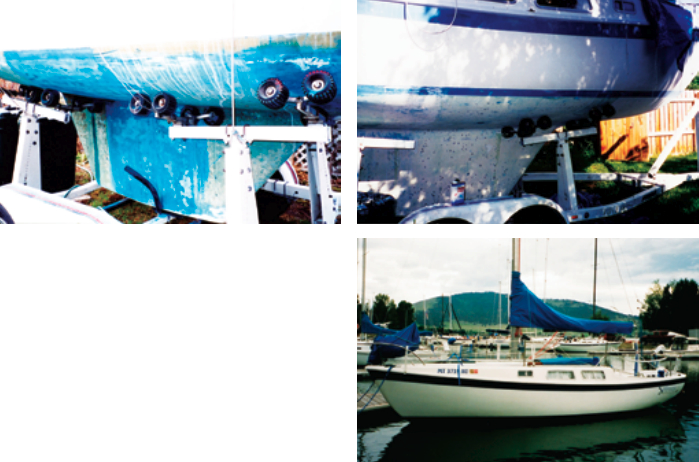
First, I went over the entire boat making a project list. Fortunately, except for some wood rot in the pop top and companionway, she was structurally sound. After some Internet travels, I arrived at a color scheme. It entailed changing her boot-stripe and sheer-stripe trim from sky blue to deep sapphire blue. But her bottom was a neglected mess of old paint and blisters so, first, we scraped, sanded, and filled holes, then applied a barrier coat followed by a red Teflon-based bottom paint.
Her aluminum mast was down and we buffed it using a scouring pad on a disc sander then brought it to a shine with metal polish. I was able to effectively and inexpensively clean her bronze fittings with a cleanser suggested by a former Navy man. He referred to it as “Atomic Joy Juice.” It’s made of lemon-flavored Kool-Aid mixed into a paste with a little water and vinegar.
I re-bedded her leaky windows using RV putty from the local RV supply store. This was very effective; the windows have not leaked in the five years since they were re-bedded. I also re-bedded all her fittings with Dolphinite.
Instead of painting her topsides, I decided to recondition her gelcoat using a technique I read about. It
involved multiple wet sandings using several grades of sandpaper, starting at 400-grit and ending with 1,500-grit. This was followed by power buffing with rubbing compound and finishing to a bright shine with wax and Seapower Super Poly Boat Polish.
All this hands-on work bonded me with my boat, and my love continued to grow. I removed, stripped, and finely sanded her exterior wood. I then applied teak oil and allowed it to dry. Over the winter, I added up to 11 coats of varnish following the guidance Rebecca Wittman gives in her Brightwork, the Art of Finishing Wood.
The nonskid was so worn that I chose to paint the deck and cockpit area with gray deck paint to compliment the blue trim. During the four years that have passed since that project was completed, the deck has received three coats of paint in total and shows little wear, although it has been well used.
I replaced all the standing rigging the first year. Then, over the course of the next three years, I replaced the running rigging, using solid blue, white, and some red line to add a vibrant splash to the color scheme. A final addition was a brand-new mainsail.
Reflecting on her interior
While redoing the exterior is straightforward, upgrading the interior is another matter entirely. I wanted Sinfonietta to have a luxurious ambiance in her cabin. But what exactly does this entail? I did extensive online research, particularly on Yachtworld.com, looking at every Cal 25 I could locate, gathering ideas for interior improvements.
Using the boat for three summers prior to renovation also gave me a good idea of what changes made sense and what amenities I wanted. That first fall, I exchanged the old pumped-overboard head for a Porta Potti — Flathead Lake is too pristine to risk an accidental discharge. I plugged the through-hull permanently.
As I used her, I learned that my sailing habits primarily involve daysailing and the occasional weekend aboard. Because it worked for my lifestyle, I removed the freshwater bladders under the V-berth and chose to carry 5 gallons of drinking water on board. I tend to wash what few dishes I dirty in a bucket of lake water. I freeze water in milk jugs and keep them with the perishables and beverages in a carry-aboard cooler that fits neatly under the companionway step. This eliminates draining and gives me great dry-food storage in the old icebox in the galley.
Instead of the alcohol stove, I use a simple one-burner propane camp stove in the cockpit or on the galley top when it’s cool.
When I’d slept aboard, I learned that the tired foam didn’t cushion me satisfactorily and, in our warmer Montana summers, the vinyl upholstery was tacky and stuck to my skin. As I used the boat, I noted ideas for changes in my growing project list.
Inspiration from the classics
My primary sources of inspiration for redoing Sinfonietta’s interior are yacht-style books I’ve pored over and added to my library. Volumes 1 and 2 of The World’s Best Sailboats by Ferenc Máté, Classic Yacht Interiors by Jill Bobrow and Dana Jinkins, and Welcome Aboard: Inside the World’s Great Classic Yachts by Matthew Walker have been particularly helpful. With their aid, I chose upholstery and wood as the basis for her décor. I considered color first. While viewing the classics, I noted that emerald green blends with brass and rich wood in a very pleasing and relaxing manner. I determined that the upholstery should set the tone while tied into additional cabinetry designed for utilitarian purposes and effect.
Choosing fabric is a long, involved, touchy-feely process. The color and effect have to be just right. I wound
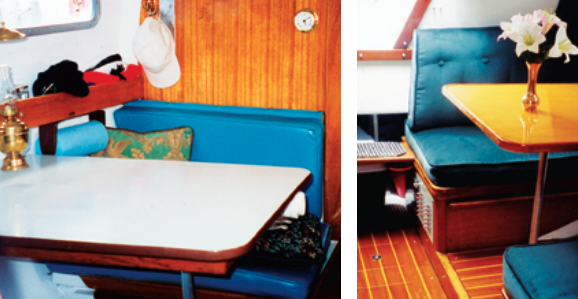
up using three different fabrics in the same color scheme. For the saloon/dinette fabric, I chose a stain-resistant velveteen velour for its soft smoothness. The seat cushions are tucked and buttoned on their vertical surfaces only, so the flat areas won’t collect dirt. The V-berth fabric is more substantial. It’s water-resistant and its pile doesn’t allow bedding to slip. To cover a section of the starboard quarter berth, which is also the floor of the sail locker, I chose vinyl. I eliminated the port quarter berth and converted that area into a substantial cockpit locker. I replaced all the cushions with thicker closed-cell foam.
After the upholstery phase was complete, I made cardboard mockups of cabinetry for the starboard galleytop and to go alongside the portside dinette table. I added stowage capability and class to these with a brass-and-wood fiddle rail. My neighbor Jeff Schroeder is a kitchen refinisher and he fabricated them for me, as my abilities are limited to finish work. Together, we looked at wood and chose lyptus for its grain and coloration and for its similarity to the wood that was already aboard. A year after completion of the saloon/galley cabinets, Jeff built Sinfonietta a new dinette table and cabinets for the companionway bulkhead. I designed the cabinets to hide instrument backs and to be easily accessible for cockpit items like sunglasses, lotion, and binoculars. We chose lyptus once more for the cabinets, and white maple with lyptus edging for the table to better reflect light and brighten the cabin.
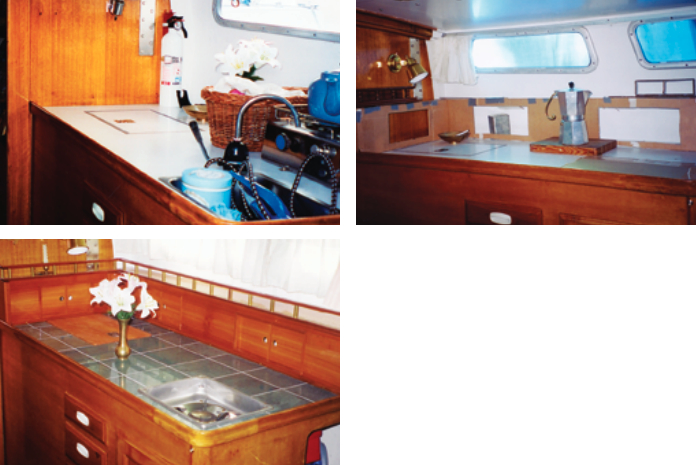
The next project was the galley top. We put a new cabinet where the old alcohol stove had been. Since I didn’t need the sink, I removed its plumbing and cut a hole in the center to mount the single-burner bottle-propane unit. When I need it, I attach the stove’s bottle from behind a sink cabinet access door. When it’s not in use, I hide the burner under a fitted chopping-block insert.
After more research with kitchen remodelers and suppliers, I chose polished porcelain tiles from Brazil for the top surface because of their durability and sea-foam-green color. These tiles are extremely hard, nonporous, impervious to heat or cold, and cannot be scratched by sharp knives. The surface is easy to wipe clean and will not stain or absorb oils. Since I was covering such a limited area, the steep cost of the tiles was not an issue. Smallis beautiful when dealing with high-priced luxury items.
After the cabinets and galley top were installed, I gave the remaining interior wood fresh coats of varnish. I took all removable items, such as doors, drawers, and trim, indoors over the winter months so I could strip and render them as brightwork. I lined the drawers with green felt for extra classiness and for the heck of it. I repainted all white interior surfaces with water-based, mold-resistant paint. I used bright-white topside or bilge paint for ease of cleaning and to provide light in the interiors of lockers, storage areas, cubbies, and bilges. I replaced old screw-in light-bulb fixtures in the V-berth, head, and galley with halogen reading lights and added wood trim strips spaced across the cabintop to create a more expansive feel within the cabin.
Several years went by and, as the majority of the work neared completion, I looked for refinements with which to add “icing to the cake.” There was nice carpet on the cabin floor, but all those classic yachts were graced with teak-and-holly soles. Sinfonietta needed a sole too. In my travels to the West Coast, I found a teak-and-holly veneered plywood. Jeff carefully fit and reinforced the five sole pieces for me and I finished them with 11 coats of varnish before installing them. Sinfonietta’s sole now shines brightly below.
As I used the boat, I found that the interior was a bit dark unless I raised the pop-top. Newer boats are fitted with clear ventilation hatches to add light, but these are pricey to retrofit to an older craft. My easy, inexpensive fix was to mount and seal a clear acrylic panel into a cutout in the forward hatch. Voilà! Not only does it provide ample light, but I can see the stars at night while lying in my berth.
Artworks in a work of art
Wherever I have wandered I have found treasures, such as artwork or books, to bring home. I treat Sinfonietta herself as a work of art and embellish her with objects that speak to my appreciation of creativity. Mounted on her port saloon bulkhead is a bronze Tibetan gargoyle face, a Northwest-coast salmon carving, a framed boat print procured at the Port Townsend Wooden Boat Festival, and a matching brass barometer and clock. Wood and stone carvings live among cups and crystal behind the fiddle rail. I search for vintage silverware and ceramics to outfit her galley. The V-berth holds home-crafted cushions, each uniquely hand-stitched.
Other than the cost of new cabinets, upholstery, and rigging the upgrades were relatively inexpensive since they mainly involved my time and labor. However, there is no point in trying to total hours, as they need not be tracked. Time devoted to family members or energy expended in “mucking about in boats” is not to be tallied. Sinfonietta is a cherished family member, whether she is sailing on the water or resting at home in my yard.
All in all, the return for this devotion to a dream comes in pride of ownership. The sense of relaxation and enjoyment she gives my family and those who encounter her provides me with plenty of pleasure and reward. To see visitors light up with awe, appreciation, and surprise as they step into her cabin tells me I have transformed a classic Cal 25 into the luxury boat of my dreams. I am content with a job well done.
Insatiable boat fever
As I completed the project, my boat fever did not subside. It was amplified. My desire to have a “place by the sea” fueled an increased drive to walk the docks and cruise the Internet searching for another right boat at the right price. This one was to be my “home away from home.” My boys insist that I must have checked out more than 300 boats since finding Sinfonietta. Yet they also agreed that this due diligence ultimately paid off.
In 2007, I acquired another boat that seemed right for my family. She, too, is a classic plastic craft and kin to my Montana boat. She is a 1969 Cal Cruising 36. She was a bit haggard, weather worn, and wanting care when I lucked upon her. But, this time, I knew what I desire in a boat and what my capabilities are.
I am employing the expertise I gained with Sinfonietta to recondition and upgrade her bigger sister in a similar fashion. We’ve christened the 36 Sognare, which translates from Italian as “to dream.” A labor of love has begun once again. However, this is another story.
Chris Roberts is a nationally known photographer of American Indian powwows. He is a traditional dancer and has been a powwow participant for more than 40 years. He lives in Missoula, Montana, where he is a Sea Scout skipper and teaches sailing using Sinfonietta during the summer season on Flathead Lake. Chris also enjoys photographing and writing about maritime subjects. His company, Meadowlark Media , offers a large variety of American Indian DVDs, books, and calendars as well as a broad assortment of DVDs on maritime topics.
Thank you to Sailrite Enterprises, Inc., for providing free access to back issues of Good Old Boat through intellectual property rights. Sailrite.com