Making the most of what you have
Issue 80 : Sept/Oct 2011
Sometimes, being realistic about your boat’s limitations and embracing them with whole-hearted and simple adjustments can reap a host of benefits. We have a short list of modifications that have worked for us.
Better dishpan plan
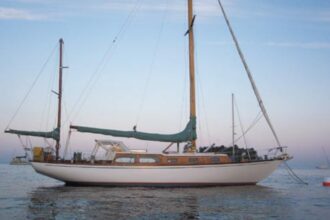
The galley sink on our boat, a 30-foot Albin Ballad built in 1973, is an optimistic notion at best. Like the sink on many smallish production boats, its diminutive size limits its usefulness to dispensing drinking water, hand washing, brushing teeth, and serving as a general catch-all for loose items while under way.
Full-scale dishwashing for our family of four is out of the question given the limitations of the sink and the surrounding area. We’ve found that a plastic dishpan, half again as big as our sink, carried into the cockpit works much better. Dirty dishes accumulate there and eventually get washed right out in the open.
If we are tied up at a marina, we use water from a dockside faucet to conserve our limited supply. With luck, it has already been preheated by the sun, something that our onboard water supply never is.
When we are at anchor in relatively pristine surroundings, we wash with salt water and rinse sparingly with fresh water from a 5-gallon Coleman jug stored in our lazarette. Dirty water is discretely drained into the cockpit scuppers and chased with a couple of extra buckets to sluice things down, thus cleaning the boat and the dishes in the same operation.
Doing dishes in the cockpit may raise a few eyebrows on neighboring boats, but it gives us the elbow room and surface area to set up an efficient production line that is a stunning achievement in family cooperation in this day and age.
Icebox drain diversion
The dollhouse-sized sink in the galley, now relieved of any serious scullery duty, was nonetheless originally fitted with a saltwater spigot activated by a foot pump in addition to a similar freshwater spigot. We don’t have any need now for saltwater in the galley, so I reassigned the plumbing to make improvements on two other fronts.
Any day I can eliminate a hole in the bottom of my boat is a good day. I have removed the saltwater intake seacock and capped the through-hull fitting, reducing our operational through-hull fittings to two, a raw-water intake for the engine and a drain for the galley sink. That’s one less thing to worry about.
I connected our icebox drain, that originally ran into the bilge, to the old saltwater foot pump. We can now pump melted ice water into the sink from where it drains overboard. If I am feeling unusually frugal and conscientious, I rinse my hands with it in the process.
No longer is there anything normal about having water in my bilge. And no longer are there slimy gelatinous globules of liquid lettuce lurking beneath my floorboards. As one of my mentors in the field of marine survey is fond of saying, “Nothing good ever came from having water inside your boat.”
Ice enhancement
With our icebox runoff beneficially redirected, I turned my attention to making the most of the ice. We are always amazed at the variability of the price of a block of ice in the Salish Sea of Puget Sound. It can range
from $2 to $5 a block from one port to the next. Our opinion of each port is tempered by this cold hard fact.
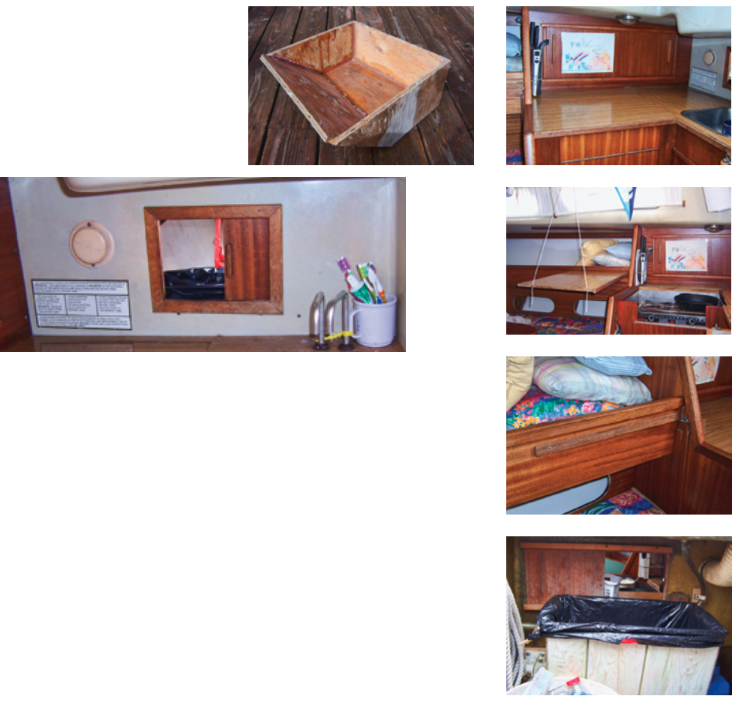
One solution that gives us a leg up at the beginning of each cruise has been to make customized ice blocks molded to perfectly fill the bottom of our icebox. I fashioned a rough plywood box that replicates the bottom 6 inches of our icebox, lined it with plastic, and placed it, filled to within an inch of the rim with water, in our chest freezer at home. The resulting block of ice is like permafrost. It routinely lasts five or six days, whereas the blocks from the store typically last two to three days at best. Extra insulation is also on my to-do list, but this article is about simple changes that spring from reorienting and adapting to existing features of the boat.
Additional counter space
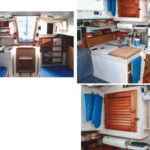
We have about three square feet of countertop in the galley . . . as long as we’re not cooking. The stove resides under this precious surface, and when we want to use it, the countertop must be removed.
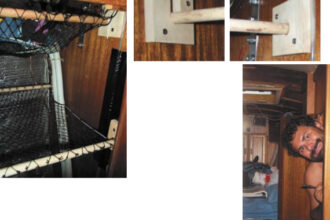
To preserve this work surface, I rigged up a way to hang it from the overhead grabrail with one end secured to the pilot berth bulkhead next to the galley. I cut three inconspicuous slots in the removable countertop and fastened a short rabbeted batten above the back of the starboard settee. With the addition of a nylon cord looped over the overhead grabrail and knotted at each end, the transition is complete.
While this is not quite as good as the original standard-height solid work surface, it restores most of what was otherwise lost. This modification took less than an hour to accomplish. There was minimal impact to the boat and practically no investment.
Trash can storage mod
Trash management is another area where the token galley often falls short. Everyone needs a trash can. It should be large, easy to access, and out of the way.
We have a sliding access panel in the aft galley bulkhead that communicates with the starboard cockpit locker. When we bought the boat, there was no evidence that this had been used as a trash portal, but it defies my imagination that it could be intended for anything more useful. The trick is to make the most of it by fitting the biggest trash bin possible into that space.
After a couple of attempts at using commercially available plastic trash cans, I finally attached a light wooden framework that supports a 30-gallon plastic trash bag to the back of this bulkhead. It’s easily accessible from the cabin and the cockpit, thus making removal and replacement of the bag convenient. This works so well I wish I could install one in my house.
Pragmatism rules
A common-sense approach to boating shouldn’t be a radical concept, but as I look around at other boats — and as a marine surveyor I see a lot of them — I don’t see much evidence of common sense. Perhaps most boats don’t get lived in enough to force the issue, and the standard solution to any inconvenience while boating is often to buy a bigger boat. That is the easiest and most expensive option, but even taking that step doesn’t necessarily solve the problems. I feel I have a better boat because I take a pragmatic approach and we have amazing adventures for a fraction of what some of our peers on the water have invested. Isn’t that what sailing is about?
Tony Allport is a SAMS marine surveyor. He lives on Anderson Island, in southern Puget Sound and sails extensively with his wife, Ann, and children, Alden and Claire, on their Swedish classic 30-foot Albin Ballad sloop, Pleiades. He is also known on the island as a skilled cabinetmaker and for his excellent pies.
Thank you to Sailrite Enterprises, Inc., for providing free access to back issues of Good Old Boat through intellectual property rights. Sailrite.com