He’s a jack of all trades and master of most
Issue 46 : Jan/Feb 2006
Renaissance man was not a term in use when Good Old Boat contributing editor Don Launer was growing up prior to World War II. It was not a concept during his service as a sergeant/radio operator and repairman in the war, nor when he studied for an electrical engineering degree afterward.
It was not a term when he joined ABC as a television engineer and moved through the ranks to the title of engineering supervisor. At ABC he served at the leading edge of the television-broadcast revolution as it moved from simplistic live black-and-white broadcasting to an entirely different medium with instant satellite transmissions and real-time news and worldwide special events.
From the age of 11, Don knew he wanted to be in broadcasting. He got his ham license, studied for the job, and was at the right place at the right time as television broadcasting got its wings. He led the technical teams that covered special news events such as presidential conventions, missile launches, and — for 20 years — all the Olympic games. He has two Emmy Awards on his mantel for Olympic coverage. That is one facet of the man who was unknowingly the prototype for the term “Renaissance man” long before the term caught on.
Many would be satisfied with the combination of technical expertise and creativity involved with this career, but there’s more to Don. He has the skills of a concert pianist and still plays daily on the piano his family owned when he was a boy. He tends an herb garden. He is a rather expert winemaker. But there’s more.
Built a brick house
The year Don and Elsie Launer’s second child was born, Don bought some books, a concrete mixer, and 28,000 used bricks. He knocked the old mortar off each brick and built the home in which he and Elsie (and the two children during their formative years) lived for 33 years until his retirement from ABC in 1989.
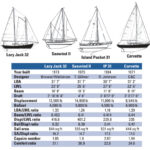
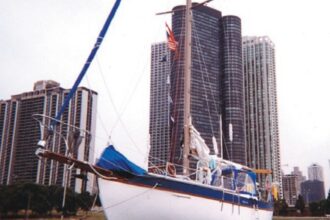
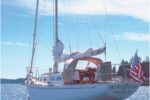
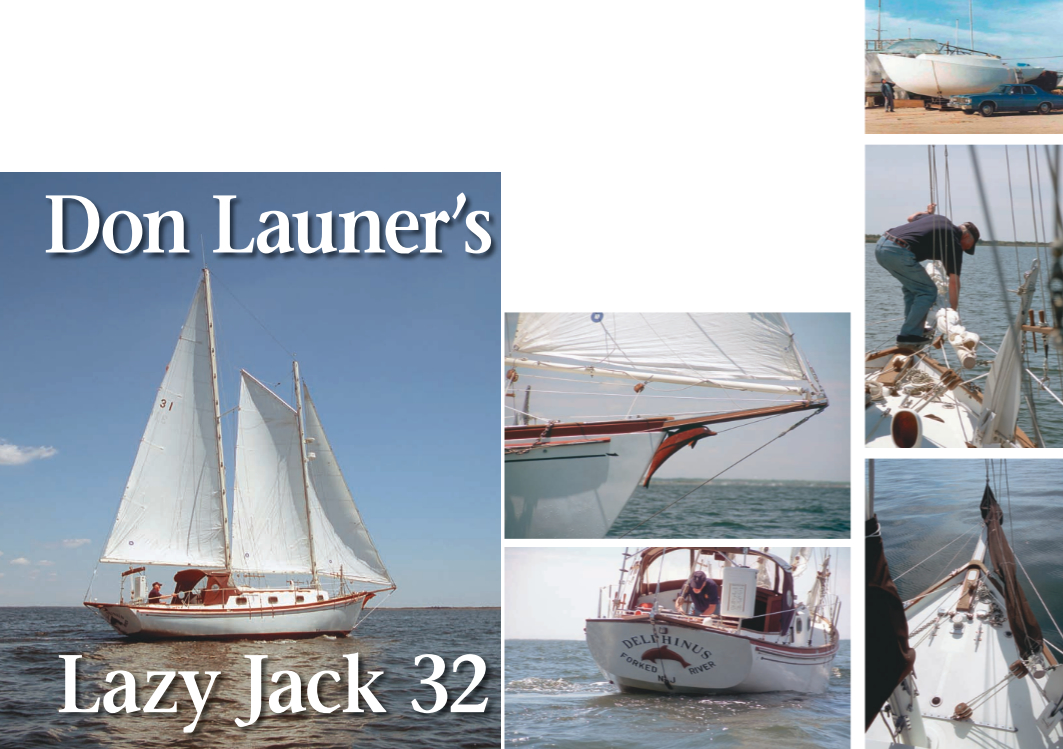
It shouldn’t surprise any of us that this master of many trades also built his Lazy Jack 32 schooner from a bare hull, should it? That boat, named Delphinus after the constellation, is the focal point of the home on a waterway that he and Elsie share in Forked River, New Jersey. The boat-building project was conceived in the late 1970s as Don began contemplating retirement. He had sailed a number of boats as a youth and raced in a fleet of Lightnings in his 30s, although he gave up racing when he realized that the intensity of weekend racing does not provide a good escape from a stressful work week.
As a family man, Don has owned more than 18 boats during his life, including a 17-foot Picnic boat and a 22-foot Rhodes, both by General Boats (see his article in May 2005). Then there was an Essex 26, one of the few center-cockpit models in that size range. The family made some memorable cruises on these boats, but as retirement loomed, Don says, “ I wanted to retire with a good cruising boat. I began looking for a salty-looking shoal-draft, keel/centerboard boat with comfortable accommodations.”
He was unmoved by everything he saw until a friend showed Don a drawing of Ted Brewer’s Lazy Jack schooner. He knew immediately that he had found his retirement boat. Boatbuilder Ted Hermann, on the North Fork of Long Island, N.Y., had commissioned this design and was building the fiberglass schooner at the time. In all, 35 hulls were created before Ted Hermann ceased production. Don’s is hull #31. Since the boat was in production at the time, Don could have had a completed boat delivered, but what would our do-it-yourself Renaissance man rather do?
Old and crusty
When he decided that this was the boat and that he’d like to do the finishing work himself, Don was warned that Ted Hermann was “a crusty old New Englander.” Undaunted, he visited the boatworks and, following a tour, announced that he’d like to buy the boat as a bare hull. Ted Hermann, realizing no doubt that some do-it-yourselfers gave an entire line of boats a bad name, lived up to his reputation by replying, “I don’t know if I want to sell it to you.” In retrospect, Ted must have thanked his lucky stars many times to think that Don Launer bought and finished one of his boats. The excellent publicity he’s created for it is immeasurable. For examples in Good Old Boat, see Don’s articles in November 2000 about the club-footed jib and January 2001 about sailing a schooner.
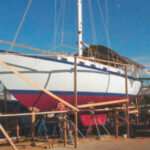
Ted then ran Don through an interrogation about boat construction that lasted an hour and a half. Don smiles as he recalls the day. Apparently he passed the review because Don was allowed to purchase a hull. That hull was delivered in December of 1980. It was nothing more than a hull with a deck resting loosely on it. The fiberglass liner that established some of the interior furniture, particularly in the galley, was there. And the lead ballast had been installed. The ports had not been cut out and nothing else had been done. The rest was up to Don.
He worked a miracle and made it look easy, of course. By May, just five months later — while working full time, remember — Don had the schooner ready on the outside and launched her. Three months later, in August, he had her rigged and took his first sail. It took another year or two to complete the creation and installation of interior systems and furniture. The moment at which this sort of work is completed is harder to pinpoint. The work continues indefinitely, and maintenance begins where the installation projects end. In fact, they often overlap.
Nothing’s square
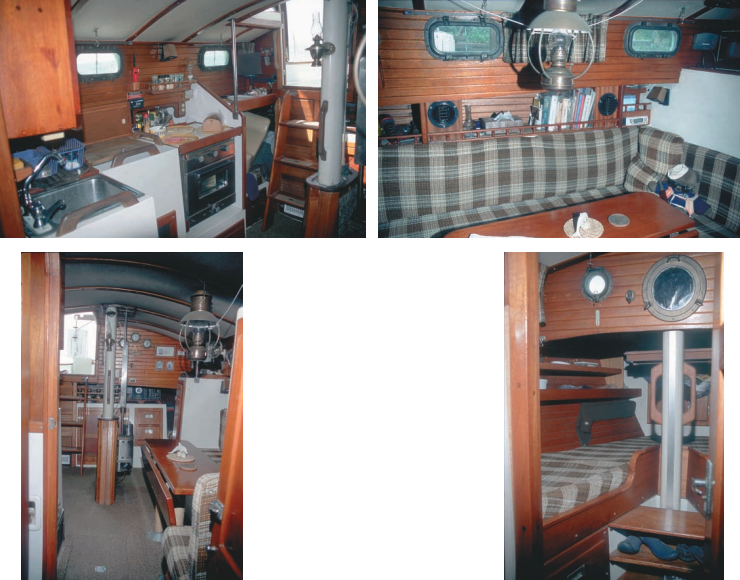
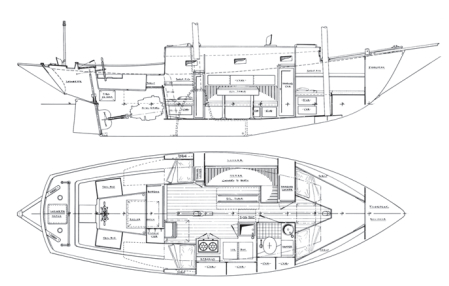
“The interior is the most difficult,” Don says. “Nothing is square or rectangular. Boats are composed of compound curves.” Don says he remained true to Ted Brewer’s interior layout “with very few changes.” He was able to copy Ted Hermann’s patterns for bulkheads and other interior wooden parts. That really helped to move the interior work forward. He used mahogany through-out the interior.
Delphinus was endowed with many modern conveniences uncommon to sailboats her size in the early 1980s: a freshwater shower in the cockpit as well as another in the head compartment, a built-in air conditioner with a seawater heat exchanger, heat supplied by electricity at the dock or by kerosene while cruising, a kerosene stove, a heat exchanger to heat water with the engine, pressurized hot and cold water throughout the boat, refrigeration and a freezer with ultra-insulation, a 12-volt washing machine, cable and telephone when tied up at the dock, a hi-fi . . . you get the idea. This was to be a thoroughly modern and infinitely comfortable cruising machine.
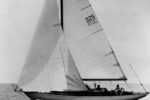
Delphinus sails like a charm. Her schooner rig looks complicated, but she is easily singlehanded. Her sails are boomed and self-tending. The skipper intones “ready about” to no one in particular, puts the helm over, and goes on his merry way. There are no lines to tend and there is no wild grinding on winches. In fact, this schooner, in classic tradition, has no winches.
As a sailboat, she has no bad habits to speak of. After sailing with Don, Jerry Powlas wrote the following glowing report.
Seemed too small
“Thirty-two feet on deck seemed small to me for a schooner. I was expecting something cutesy that had a schooner rig for all the wrong reasons and suffered for it. Wrong. At 14,000 pounds this is a heavy boat that rode well in the short chop of Barnegat Bay. Under sail she was stiff, making her a good platform to work on. The schooner rig kept the sail area low and, combined with a fairly beamy hull, made her utterly stable. While she had a belowdecks autopilot, it was almost unnecessary. Don could bring her to close hauled and simply let go of the wheel while she sailed along straighter than most autopilots and many helmsmen could steer most boats.
“After that demonstration, I began to think a schooner rig made some sense even in a boat this small. But Don was not done showing off. As mentioned, tacks were done without tending sheets. Then he dropped the jib and foresail and hove to. He said, ‘She’ll hunt a little.’ She pointed into the wind with the main sheeted down hard to the centerline. Hunting was imperceptible. Dead nuts into the eye of the wind! (My sloop heaves to maybe 60 degrees off the wind.)
“Later, Don hove to and set an anchor. He made it look easy. He struck the jib and foresail and, when the boat headed up and started backing down all by herself, he let the anchor down, paid out the proper scope, cleated off, and let the boat slowly back down and set her anchor. Later, he reversed the process and sailed off the anchor without the engine. There is no question that this is an easier boat to sail than a sloop or cutter.
“There was no need to reef sails the day we were out with Don but, as he explains it, at some point as the wind pipes up the foresail is taken in. When there is too much wind for the main and jib, the main is reefed. When that won’t shorten sail enough, the main and jib are lowered and the foresail is raised by itself. Crews of the working schooners called this ‘being in foresail harbor’ because the boat was so stable.
“The bottom line is that the Lazy Jack 32 is a cruising boat with lineage from the working schooners. The rig complements the hull perfectly. This may be the perfect rig for safe, easy, shorthanded sailing. It sure seemed like it that day.”
Singlehanded sailing
Don will turn 80 later this spring. But age will not prevent him from sailing, something he does primarily singlehanded and with great ease. In Delphinus he has created a boat that will allow him to sail safely and comfortably for years to come. For more on that topic, see Don’s article, “Drifting into Old Age,” in May 2003.
Delphinus carries 30 gallons of diesel in two tanks and has two water tanks: a 30-gallon tank and a 9-gallon emergency supply to get a careful crew through until the big tank can be replenished. She has a Sealand MSD, a combination macerator and holding tank that uses formaldehyde rather than chlorine. And there’s also a holding tank that can carry 25 gallons and operates as a standard holding tank. It can be emptied at a marina or at Don’s dock, where he is able to pump out at the dockside facility he designed and built himself. That shouldn’t amaze anyone, should it?
Nor should it surprise anyone that Don busied himself with the creation of a cruising guide to the New Jersey waters that he calls home. Called A Cruising Guide to New Jersey Waters, this guide, first published in 1995 by Rutgers Press, is now in its revised and rewritten edition, which came out in 2004.
Earlier in his love affair with all things sail, Don spent several years studying naval architecture through Ted Brewer’s correspondence course. Ted’s school is no longer in business, but Don gained a real appreciation for what goes into boat design, along with a respect for Ted Brewer. Perhaps this educational program formed the foundation necessary to pass Ted Hermann’s tough oral examination in order to qualify for the purchase of an unfinished Lazy Jack hull. All things are related.
When Don decided that he’d like to write for boating publications, this energetic sailor decided that the U.S. Coast Guard captain’s exam would give him more credibility as an author. So naturally he took and passed the six-pack certification. These days, Don is indeed the contributor to a number of marine publications including Good Old Boat. We’re proud to have him as a part of our team.
Thank you to Sailrite Enterprises, Inc., for providing free access to back issues of Good Old Boat through intellectual property rights. Sailrite.com