A shoal-draft schooner for family cruising
Issue 46 : Jan/Feb 2006
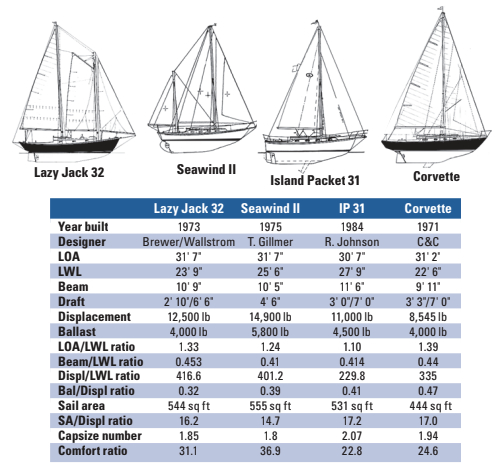
Finding three similar boats for comparison purposes is never simple, but finding three to compare with a keel/centerboard schooner was impossible. So here we have two keel/centerboarders, one a cutter and the other a sloop, and a full-keel ketch to round out the group.
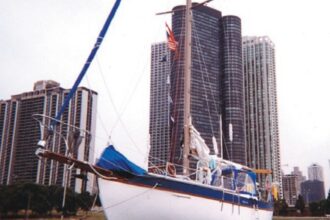
The Lazy Jack 32 began life as the brainchild of builder Ted Hermann and designer Dick Ketcham. When Dick passed away, Ted brought what preliminary drawings had been done to Bob Wallstrom and me and commissioned us to design the boat. Naturally, we had our own ideas on hull shape, rig, and other details. It was these, given the builder’s requirements for her basic dimensions — specifically her shoal draft — that eventually developed into the Lazy Jack 32.
The design was created with coastwise family cruising in mind and with absolutely no pretensions of bluewater voyages. In that respect, I believe the Lazy Jack 32 has been successful. She has proven to be well-suited for coastal and Caribbean waters and has developed a cult following of dedicated owners. These boats have crossed the Gulf, cruised as far as Venezuela and, despite their modest ballast ratio, have withstood some rather severe weather. Indeed, the Lazy Jack appears to have done everything her designer and builder desired of her and done it well. The table compares this little schooner to three very different yachts in her size range.
Tom Gillmer’s Seawind II is definitely more of a deep-water boat than the Lazy Jack. With her husky displacement, good ballast ratio, and a ketch rig of moderate area, she is obviously intended for world voyaging. She is certainly as capable as any boat of her size. Given good seamanship and condition, you could take her anywhere. On top of that, like all of Tom Gillmer’s work, the Seawind II is a ruggedly handsome craft and is the one in this group to consider if you dream of circumnavigating the globe.
More performance
The C&C Corvette is a different kettle of fish. Here the emphasis, as with many C&C yachts, appears to be on performance. A high ballast ratio and a generous sail area combined with moderate beam indicate a yacht that will move out very nicely indeed. Her waterline is on the short side, but that will keep her wetted surface low to reduce resistance in light air, and she’ll pick up length as she heels when it breezes up. Plus that short waterline will give her a nice low handicap for club racing. Handsome is as handsome does, and the Corvette would certainly be my choice of the four boats if I were in the market for an attractive family cruiser/ racer with gunkholing capability.
The Island Packet 31 is the unusual yacht in this group. She features the longest waterline, the widest beam, by far the lowest ratio of displacement to waterline length, and a generous sail area in a cutter rig. Her beam and long waterline assure roomy accommodations for a small family, possibly the best in the group, and she will certainly perform well enough to suit the average cruising family. Her capsize screening factor is a bit on the high side, but I’d have no qualms about coastal cruising from New England to Florida or trips to the islands with an eye on the weather.
The Lazy Jack 32 is in a class by itself, of course. Either you want a schooner, or you don’t. If you do, she is one of the few you’ll find in her size range. It is always exhilarating to race a boat around the buoys, and it’s a great adventure to conquer the oceans in a small boat. But a perky little schooner could be just the answer for those sailors who simply want to have fun sailing, cruising, looking cool, and attracting friendly smiles wherever they drop the hook.
Thank you to Sailrite Enterprises, Inc., for providing free access to back issues of Good Old Boat through intellectual property rights. Sailrite.com