Rescue your nose from those shipboard odors
Issue 64 : Jan/Feb 2009
It’s that first waft of air that rushes up after a long winter — a heady mix of diesel, mildew, deodorizing chemicals, and stale bread. There’s a component of that rockfish you cleaned in the galley sink last summer and the vague, but insistent, aroma of something like boiled cabbage.
In truth, after the initial blast, some of us never notice this peculiar olfactory environment, content in the certain knowledge that it’s relatively benign — not like a cycle-crazy bilge pump, a whiff of propane, or a dodgy depth sounder in a gathering fog.
My good wife, Beth, can tell when I’ve been down to the marina; she can smell it. That nose can detect diesel fumes before I get in the door. This can be annoying but it’s also one of the reasons why Kuma is sweet-smelling and fresh as a daisy these days.
It started with complaints about how the bread I’d brought home after a solo cruise didn’t taste quite right. I argued that it was only a boat smell and entirely natural — not all that bad. Our disagreements became sharper. Beth could smell it in everything — bedding, upholstery, sweaters, jeans — everything. Pretty soon, I began to smell it.
Brought to heel on the matter of boat odors, with flashlight in hand and curled around the gearbox, I finally found telltale traces of diesel running down the fuel tank from the site of a take-off for a Webasto heater I’d removed the year before. Small amounts of fuel ran along the hull and under the fiberglass engine pan to lie in a thin surface film in the bilge. A faulty non-return valve in the bilge pump hose had been recycling a cup or so of diesel for months.
Long history
Trying to keep a boat sweet has a long history. In the 18th century and earlier, scurvy was a big problem. With a primitive understanding of nutrition and its role in keeping crews alive long enough to discover a new world, Captain James Cook served up great portions of sauerkraut augmented by fresh fruits and vegetables whenever he could find them, and when he could wean his crew away from their normal fare of bully beef and grog. Cook rarely lost a man to disease.
However, Alan Villiers, in his excellent book, Captain James Cook, tells us that, despite Cook’s efforts at introducing healthier food, diet actually played a minor role in conquering illness. The real benefit that Cook brought to the health of his ship, according to Villiers, was his insistence on clean, dry air and cleanliness. He ordered fires to be built in the bilges so that the heat would sweep fresh air into otherwise noxious and unhealthy spaces. That was what brought success to his fight against scurvy.
Fires in bilges notwithstanding, good ventilation is more than attaching cowl vents or fans here and there; it starts with sources. Make sure — absolutely sure — that no diesel finds its way to the bilge. Diesel fuel and fumes, in particular, can seep into just about everything.
It’s a good idea to keep one of those big white oil-absorbent “diapers” under your engine and to check it regularly for spots. Get one of those powerful fluorescent portable work lights. Make it daylight down there. Go over your engine, especially all fuel hoses and their fittings, regularly with a clean white rag. Look around suspiciously. Sniff everything up close, especially the bilge sump.
Small hole
When you take on diesel, tear out a small hole in the middle of one of those oil-absorbent diapers and fit it over the filler pipe. Any spilled fuel will be absorbed immediately. Be sure you don’t stuff the contaminated cloth back into a cockpit locker.
Keep your food supply fresh. Try not to provision for an ocean crossing if you’re just going across the lake or along the coast for a few days and nights.
Any space not taken up by foodstuffs contains air. The icebox or refrigerator can be a real culprit when it comes to harboring bad smells. Keep it clean.
Try cruising without the microwave that comes in so handy in the marina. Lighten up — you’ll move around more fresh air and sail a little faster too.
We took a page from Captain Cook’s healthy-ship book and got rid of the nav table that blocked access to the quarter berth and interrupted a large flow of air. Since we pilot from the cockpit, we never used it.
Out came the large, unused quarterberth mattress. This upholstery-free compartment absorbs fewer engine and galley odors now and provides more headroom and better access to the engine, cockpit drains, and steering cables — a big bonus. Rethink boxes of surplus boat gear and overly large tool chests that crowd the air out of closets. Get rid of big warm fuzzy things like the cushions, pillows, comforters, and blankets you don’t use. They impede air movement and soak up stray odors of all kinds. Pick through your closets and drawers and take home whatever you haven’t worn in several summers. Strip the boat during winter layup.
Brush on deck
Air tends to flow forward from the cockpit or companionway opening. Brush your cat or dog up on the foredeck to reduce the amount of pet hair down below. Wet dog is one of the most difficult smells to ignore within the confines of a small boat, so we try to get old Scout good and dry before he goes below. By the way, you can pick up animal hair from upholstery easily with rubber dishwashing gloves. Just scrape them over the surface and the hair will pile up into large, easily removable clumps.
I once lived in a marina where we frequently exchanged meals with good friends in a Coronado 30. They were excellent evenings but what I remember most vividly was trying to enjoy all that good food and talk while balancing my feet on the rim of a kitty-litter box. I don’t think my friends ever noticed and I wasn’t about to tell them. That was back in the days when I thought all boats smelled.
In warm weather, it’s a good idea to keep your hatches open as much and as often as possible. Our two main hatches can be opened to several positions, which we determine according to weather and security concerns. Beth is a borderline claustrophobic as well as a fresh-air freak. She gets very antsy when the dinghy is lashed to the foredeck and we can’t get the hatch open all the way — like straight up. We can crack it, but it’s not enough. That’s another reason why we tow the dinghy.
Fitted latch
Our chain locker in the forepeak lies just below a 4-inch cowl ventilator. A hinged door separates it from the forecastle berths. It was easier to keep the door shut than prop it open with a cushion, so I fi tted a latch that keeps it wide open. This provides a source of fresh air up there when and where it’s needed.
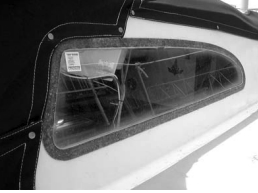
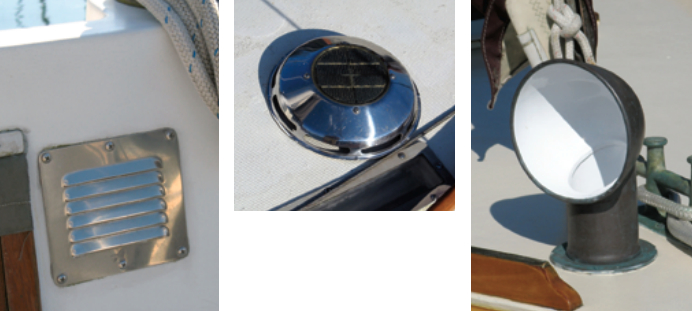
At the other end of the boat, there are multiple ways of moving air about. Companionway slides can be removed, and replaced with screens if necessary, and we’ve got a ventilating portlight in the eye-level companionway slide that helps move air and the steam generated by cooking clams and pasta. Directions for making this portlight are in the July 2007 issue.
During winter, we remove panels from either side of the engine compartment, which is vented through cockpit louvers to the outside. An electric light bulb in the engine compartment also encourages the movement of air up and out.
The head requires special attention. More chemicals do not result in fresher air. Whatever your Porta Potti, holding tank, or other plumbing arrangements are, the compartment should be positively vented. Beth is convinced that the thing that keeps the head sweet, in addition to (my) fastidious cleaning, is the Nicro solar vent that has worked more or less continuously for more than 10 years, except, of course, at night and during sunless days, or if I’ve rigged a tarp above it for one reason or another. Its active operation pulls air through the spaces above and below the door, helping to ventilate the rest of the boat as well.
Hunted all over
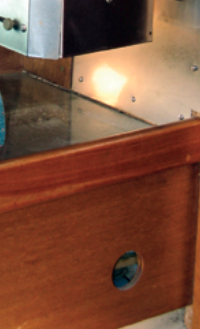
I’ve hunted for dead air spaces all over the boat: in the backs of lockers, behind doors and hatches of all kinds, under the settees and berths. In a wooden boat, surveyors make a bee-line for these spaces to look for rot. In fiberglass boats, these spaces provide ideal breeding grounds for mildew and can foster rot in battens, cleats, cabinetry, and other woodwork.
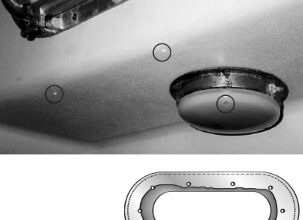
To get air into and through these spaces, I drilled 1 3⁄4 -inch- and 2 1⁄4 -inch-diameter openings with a hole saw. In traditional boats, these apertures often take the shape of anchors, stars, or shells. They may not be to everyone’s taste (there is a good instinct that keeps us from drilling holes, carving sea-horses, or otherwise making holes in perfectly good boats) but they have an important role to play in moving air about and preventing mildew and mold from growing in these spaces.
Our Dickinson wood-burning stove is another small hedge against onboard pollution. It produces a dry, comforting heat on cold, foggy mornings. It pulls combustion air throughout the boat leading it through various openings and back to the outside. It’s a modest and, perhaps more psychological than practical, way of keeping Kuma fresh, but it’s a good shipmate, putting me in mind of Captain Cook and the fires down below that brought fresh air and better health to the good ship Resolution.
Richard Smith is a contributing editor with Good Old Boat. He has built, restored, and maintained a wide variety of boats and sailed them in Michigan lakes and Oregon reservoirs, and from harbors and mud berths in the Irish Sea. He sails Kuma, an Ericson Cruising 31, with his wife, Beth.
Thank you to Sailrite Enterprises, Inc., for providing free access to back issues of Good Old Boat through intellectual property rights. Sailrite.com