A fast racer/cruiser from the early ‘90s
Issue 90: May/June 2013
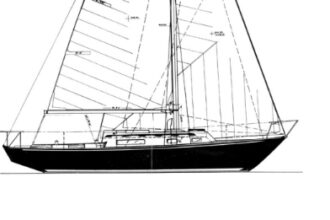
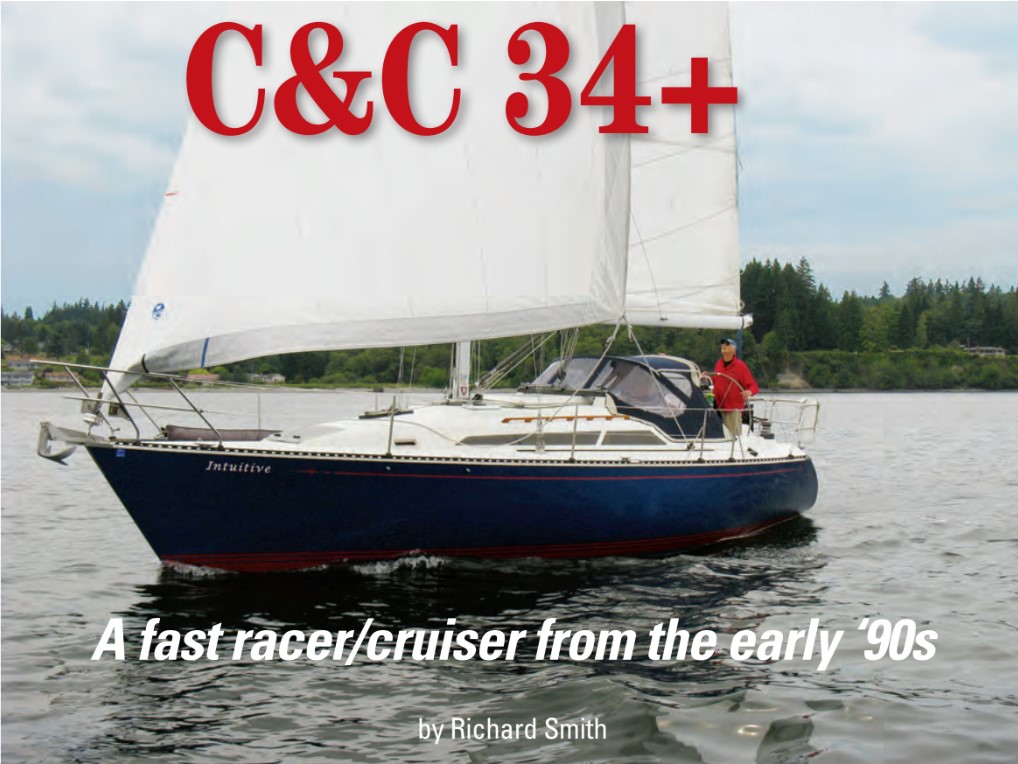
C&C Yachts enjoys a hard-won reputation for building strong, high-performance sailboats without neglecting cruising amenities or appearance. The C&C 34 from the late 1980s and early ’90s exemplifies that tradition. The boat came in two versions. The 34R, designed with racing in mind, has tiller steering and a more race-oriented cockpit and cabin accommodation, while the 34+ version has wheel steering and a cabin biased toward comfortable cruising. These designs should not be confused with the popular C&C 34 designed in 1977, of which 496 were built.
The design firm of Cuthbertson and Cassian, Ltd. joined forces with Belleville Marine Yard and Hinterhoeller, Ltd. in 1969, beginning a rich history of corporate intrigue and boatbuilding ups and downs. For an extended view of the company history, see Dan Spurr’s “The History of C&C Yachts” in the September 2002 issue.
Design
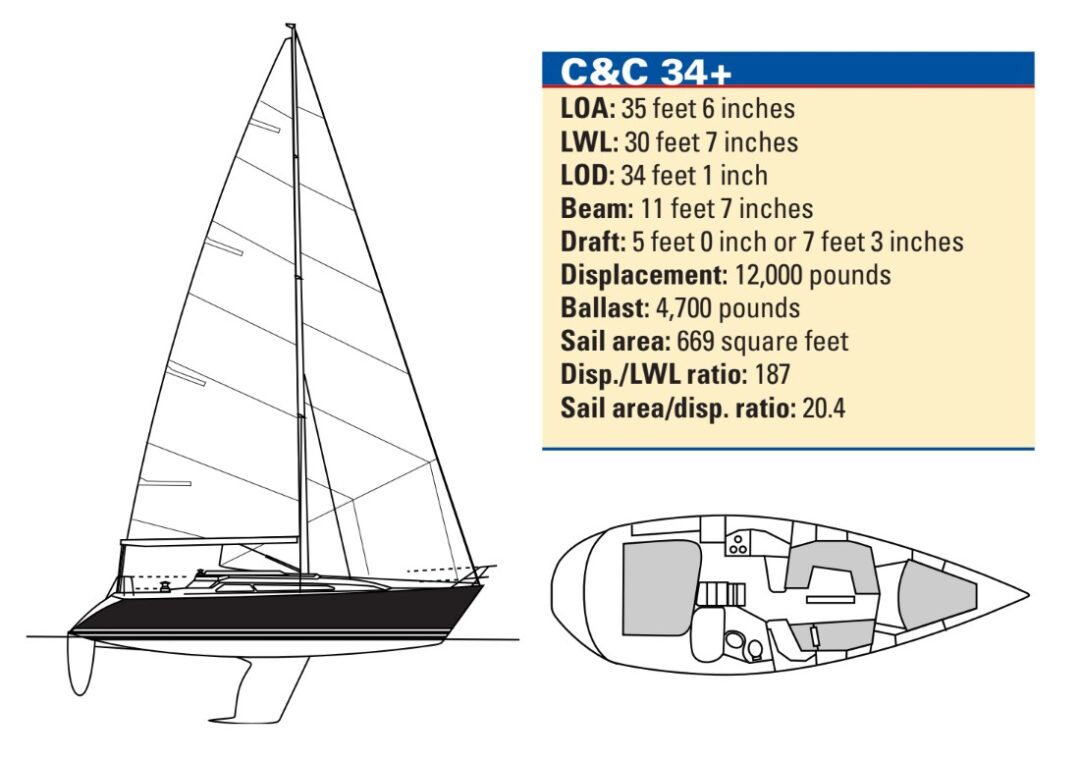
Naval architect Rob Ball was design chief at C&C Yachts for much of its existence. According to Rob, the C&C 34+ hull sections are V-shaped forward for upwind performance and flatten somewhat amidships to gain speed downwind. The stern sections are powerful and full to add sailing length when the boat heels. The 34+ was offered with several keel options: deep keel, shallow keel, wing keel, and keel/centerboard.
The high-aspect-ratio fin keel incorporated a new tip configuration to increase lift without increasing drag, a feature Rob felt would be an improvement on the successful C&C 33. At 12,000 pounds, the 34+ is also relatively light, even for a C&C, with a very low displacement/length ratio of 187; some reviews suggest that the boat is somewhat tender. The R version is lighter by 1,500 pounds.
A perforated toerail (the famous “Canadian picket fence”) emphasizes the graceful sheer from the raked stem to the reverse transom and is a trademark of the distinctive C&C look. The deck and coachroof blend into the hull and the hardware, the hatches, and the acrylic portlights are unobtrusive and well thought out. Nothing appears tacked on or improvised. A fine cove stripe helps to visually lower the rather high freeboard.
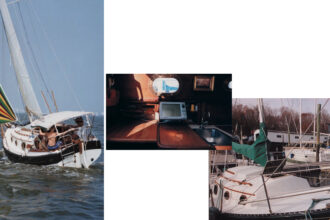
Paul Vezetinski’s 1991 review boat, Intuitive, has a well-fitted dodger that complements the smooth and flowing coachroof. The hull looks as up-to-date as any of the newer arrivals in the marina.
Construction
The C&C 34’s deck is a Kevlar-hybrid laminate with unidirectional glass in high-stress areas. A lightweight end-grain balsa core provides stiffness and insulation. As with all boats using cored construction, scrupulous attention must be paid to bedding hardware to forestall leaks and problems with water penetration into the core material.
The hull is built up of a biaxial fiberglass and Kevlar hybrid laminate over end-grain balsa core. The gelcoat is Hydrex isophthalic NGP. Additional glass is laid up in high-stress areas. C&C, along with Pearson Yachts, was an early proponent of using a balsa core to increase laminate stiffness and reduce weight and cost.
An inward-turning hull flange receives the cored deck with a layer of butyl tape between the joined surfaces. This assembly is capped with the characteristic full-length anodized-aluminum slotted toerail extrusion and secured with closely spaced 1/4 x 20 stainless-steel bolts.
A fiberglass interior floor module provides added structural support along with teak-faced marine-grade-plywood bulkheads that are tabbed and bonded to the hull.
On deck
The foredeck, narrow as it is apt to be on a close-winded boat, is clean and free of unnecessary gear. Chocks and 8-inch mooring cleats are installed close to the gunwale and the 35-pound Bruce anchor is stowed well outboard in a substantial bow roller. A flush hatch covers the anchor-rode locker. Few obstacles impede crew movement fore and aft as the shrouds and chainplates are well inboard on the sidedecks, where they provide good and convenient handholds amidships.
The C&C 34+ has a keel-stepped mast with a small section supported by triple spreaders. It’s tuned with the help of runners, checkstays, and a baby stay. Appropriately, since he sails single-handed much of the time, Paul has the genoa on a Harken furler. Its sheets are led to Barient 28 two-speed self-tailing winches located within easy reach of the helm. Other lines are led aft to clutches on either side of the companionway. The downhaul, Cunningham, second reefing line, outhaul, and mainsheet run along the port side to Barient 21 and 22 two-speed self-tailing winches. The first reefing line, boom vang, topping lift, baby stay, and mainsail and spinnaker halyards are taken aft along the starboard side to a Barient 21 self-tailing two-speed winch. To help organize the potential confusion of such a multiplicity of running rigging on Intuitive, two large Sunbrella tail bags are hung on the cockpit bulkhead to contain lines.
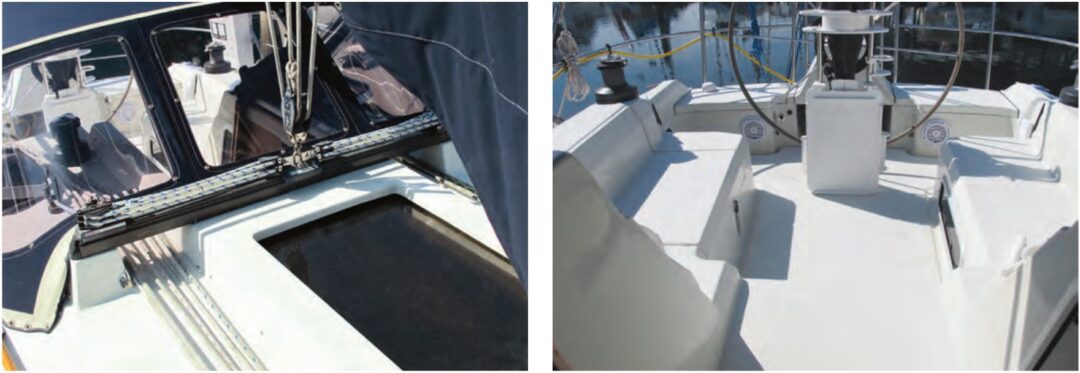
The cockpit
Seating is comfortable in the T-shaped cockpit, though the benches are not long enough to stretch out upon. A bridge deck strengthens the hull and keeps water from sloshing down below. Stowage space below the hinged gull-wing seat to starboard is voluminous and there’s a handy shallow built-in shelf for docklines and small stuff. A split lazarette aft of the large-diameter steering wheel contains additional stowage and the propane bottles. Paul installed an Autohelm wheel pilot and mounted a Garmin GPSMAP 3205 on the binnacle above the compass. A manual bilge pump is handy to the helm.
The depth sounder, wind instruments, and knotmeter are located to starboard of the companionway on the cockpit bulkhead and are easily seen from the helm. Two acrylic ventilation hatches, one over the port quarter berth and the other in the head, are located either side of the companionway where they’re well protected by the dodger. One of Paul’s next projects — and it’s a big one! — is to relocate the mainsheet traveler from its position at the companionway to just forward of the wheel to obtain end-boom sheeting as on the C&C 34R.
After 20 years, some crazing is visible in the gelcoat in highly stressed areas with tight radiuses. Paul says he has found few blisters on the bottom and he takes care of them as they appear.
Belowdecks
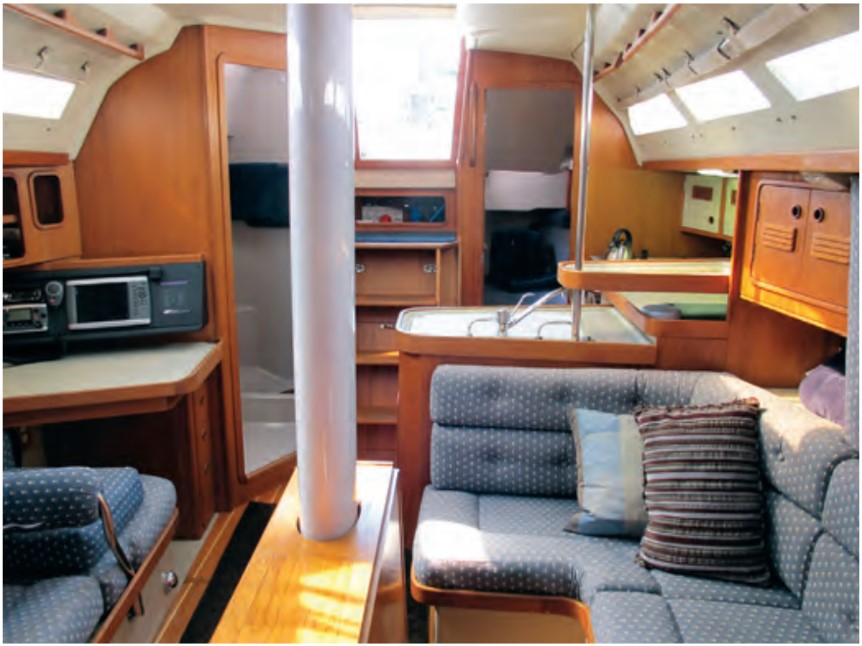
When I asked Paul what led him to the C&C 34+, he said it had a lot to do with the company’s reputation for building good boats. As a contractor to Boeing, designing and building special aerospace components to meet exacting requirements, Paul has a practiced eye for good design and overall quality in industrial products. After looking at comparable boats he preferred Intuitive but, as often happens, it was his wife, Cheryl, whose enthusiasm for the living space on the 34+ tipped the scales. It’s easy to see why.
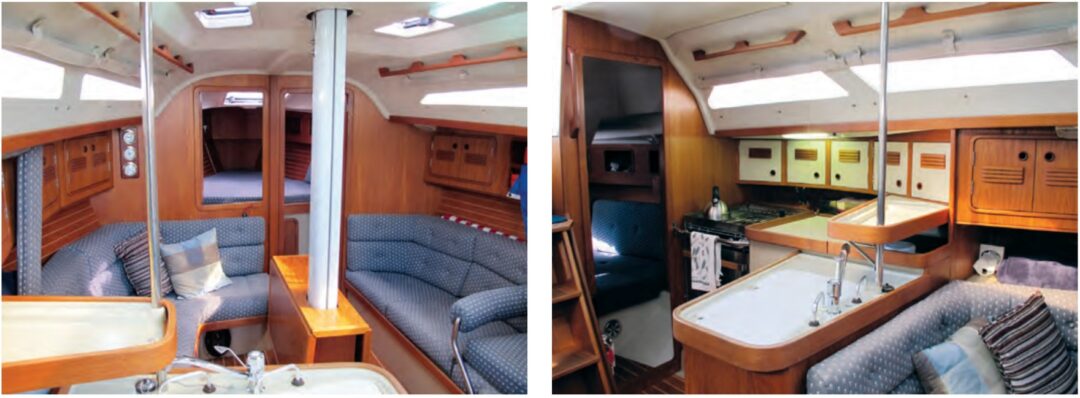
The accommodations stand in marked contrast to the deck and cockpit where boat handling in difficult conditions at sea and safety for a hard-driven racing crew are given the highest priority. The saloon is not intended as a place for stowing sail bags or eating beans out of a can but as a spacious area for convivial social occasions with all the comforts and conveniences of home.
The wraparound seating (with 28-gallon freshwater tanks beneath, port and starboard) is plush and the dining table can be converted to a double berth. Visually, the galley is part of the saloon. Pressure hot and cold water is on tap at the double sink and Intuitive has a three-burner stove with an oven and an electric refrigerator with a freezer compartment. Various storage compartments for food and cutlery add to the carefully planned and well-detailed cabin. A compact navigation station is opposite the galley and provides a comfortable place for the skipper to work, though the nav table is unsuitable for any but the smallest paper charts. A GPSMAP 4208, VHF, and AM/FM radio are close at hand.
The forward cabin feels like an extension of the saloon both visually and functionally — it’s easy to imagine kids climbing up into the space and looking down on the adult gatherings below. The double berth (with a 23-gallon freshwater tank below) is lighted and ventilated by an acrylic hatch.
Light entering the long windows in the coachroof sides and deck hatches on either side of the mast makes for a bright cabin, but the acrylic is crazed with age, putting its replacement close to the top of Paul’s to-do list. Overhead handholds run the length of the cabin. The trim is teak-faced plywood and solid teak and the sole is teak and holly.
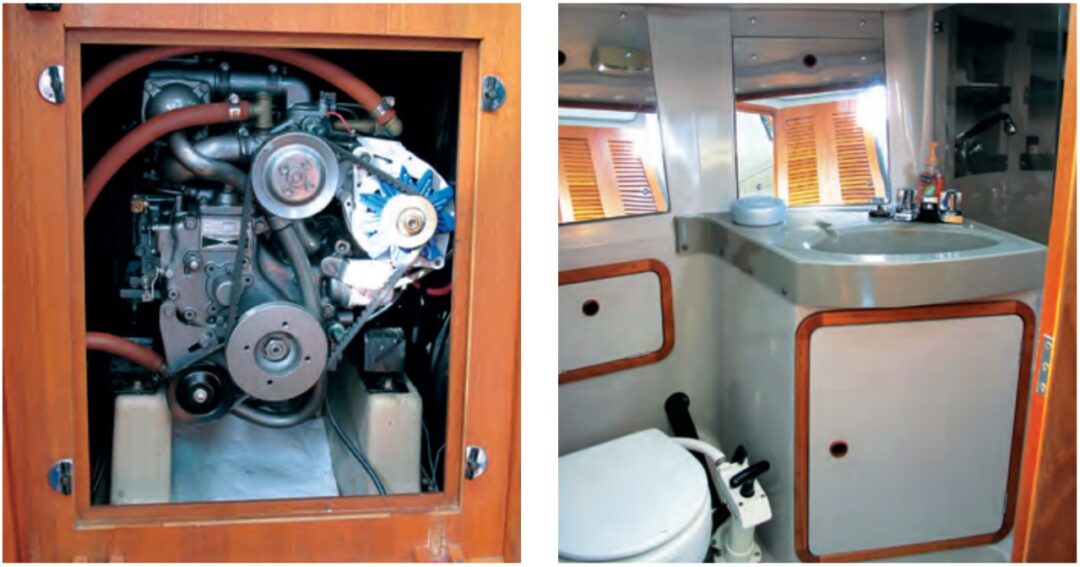
The head is located to starboard of the companionway, where it’s close to the cockpit and convenient for hanging foul weather gear. It houses a separate shower, a molded fiberglass lavatory with a 28-gallon holding tank beneath, and recessed cubbies for the shower head, soap, and towels. Large teak-trimmed lockers provide considerable additional storage.
An athwartships queen-sized berth is located to port of the companionway and extends aft, under and around the cockpit seats and well. A hanging locker and seat make this a stateroom, and it has become the Vesetinskis’ sleeping place of choice. An acrylic deck hatch and portlights provide light and ventilation. Matching upholstery in this space is visible from the saloon, adding to a sense of spaciousness below.
The engine
Removing the companionway ladder and cover panel reveals the 3-cylinder Yanmar 36M 30F diesel. The compact compartment is well insulated with just adequate intake air provided, making for an exceptionally quiet engine. The downside is that service access is restricted and requires opening hatches in the head and sleeping areas. The dipstick is on the starboard side of the engine, and Paul has rigged a small mirror so he can check the oil from the front. There are two starting batteries, two house batteries, and a 48-gallon fuel tank.
Under way
Intuitive backed out of her slip with a predictable move to port and we headed out into a Puget Sound only slightly disturbed by light and variable winds of perhaps 5 to 10 knots. In those conditions, the boat moved well and carried her momentum through airless patches. She was not in the least sluggish, coming about smartly with little fuss and sailing within 40 degrees or so of dead upwind. Paul reported that in higher winds weather helm is easily countered by the large wheel that also makes steering from either side convenient.
The PHRF rating for the few C&C 34+ models competing around the country is 99 seconds per mile. A J/34 is around 117, the older Sabre 34 is 144, and the Sabre 36 is 117 to 126. In comparison, the 34+ is a relatively fast boat.
Conclusion
As well as looking for the usual maladies that befall any 20-year-old fiberglass boat, such as soft areas in the deck, failed bulkhead tabbing, blisters, and so forth, a potential buyer of a C&C 34+ should be aware of the balsa core below the waterline. Water penetrating this core as a result of hull damage could have serious consequences. So far, though, the Kevlar composites and modern construction techniques used in the 34+ have stood up to the stress and strain of two decades of hard sailing.
That said, the boat is a C&C and carries one of the finest pedigrees in the business. The 34+ splits its personality between a practical race-worthy deck and an interior that will appeal to those with something less than a total commitment to the rigors of sailing a boat hard in a very competitive size range.
A check of the Internet showed prices for a 1990 C&C 34+ can range from $77,000 to $99,000 depending on condition, equipment, and location.
The contributions made to this review by chase-boat skipper Gerald Riggs and photographer Elizabeth Smith are greatly appreciated.
Richard Smith, a contributing editor with Good Old Boat, is an architect and has built, restored, and maintained a wide variety of boats. He and his wife, Beth, sail their Ericson Cruising 31, Kuma, on the reaches of Puget Sound.
Thank you to Sailrite Enterprises, Inc., for providing free access to back issues of Good Old Boat through intellectual property rights. Sailrite.com