When you’re up the creek with just one paddle
Issue 45 : Nov/Dec 2005
An event occurred recently that drives me to pass on, to those who may not already be familiar with it, the ancient Welsh technique for propelling a small craft with a single oar or paddle.
First, the terms. Dictionaries and other venerable sources vary in their usage. Rowing is generally taken to mean propelling a craft by means of a pair of oars resting in a pair of oarlocks. Rowing may alternatively be called sculling. (Mole rows or tries to, poor fellow. Ratty sculls.) Some sources make the nice distinction between sculling to the river boatman (which is to propel with two oars) and sculling to the seaman (which refers to propelling the boat with a single oar over the stern where there is a transom notch to accept it).
That technique of sweeping (a sweep, of course, being a long oar for the purpose, while twisting the oar so the blade angles to cut down and forward, something like the blade of a propeller) is termed, somewhat obscurely, wangling. Now, wangling may be defined as sculling or as a clever or artful procedure. In day-to-day English we might say something like, “I don’t know how he was able to wangle his way into that board meeting . . . ” To wangle one’s way into a place is to sort of wriggle in by an artful procedure.
Sculling with one oar in a stern notch is fine so long as the craft in question has good directional stability and will track well enough to resist the yaw component generated by the sideways sweeping sweep. Otherwise, it may be the blade of the scull that stays in one place and the stern of the vessel that sways from side to side like a starlet’s transom.
An alternative
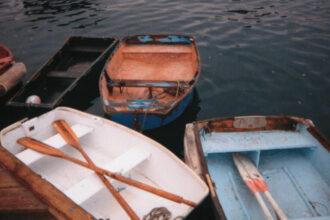
There is an alternative. Recently I had delivered to our little creek a new old boat. Gwendoline is a Macwester 27, built in the early 1970s. Of course, a hundred and one things had to be organized in the month before delivery, one of which, significantly not completed, was the refitting of oarlocks to the pram dinghy essential to launching evolutions. Six feet long, this handy little death trap is shaped like half a walnut shell and has about the same stability and steering characteristics.
Donning a life jacket and clutching a single oar, I cast off from the bank and drew upon the trace elements remaining from the skills of my ancestors. The ancient Welsh built coracles for salmon fishing on this very river. Laths of wood were shaped into a basket form then covered with, originally, animal hides and, later, canvas painted with tar or pitch. One person would sit with his back to a spoon-shaped stern, facing the squared-off bow. You would think to name the bow and stern the other way around to look at the craft. The coracle was barely 4 or 5 feet long, it could be portaged on the shoulder, and directional stability was conspicuous by its absence.
Germane to this discussion is how such craft were, and indeed still are, propelled. A single paddle would be used to scull the vessel except for signifi cant differences: there would be no transom notch; the paddler instead rested the loom of the paddle on his shoulder, and the sculling would be as it were in reverse, drawing the boat toward the paddle, rather like sculling backward. One still sees the old-timers keeping up the tradition on the rivers, mainly in southwest Wales, resting their spade-shaped paddle easily on one shoulder, the same shoulder as the sculling hand, while the free arm is used to let out long seine nets for salmon. This is what I did in my dinghy, although over the stern and perhaps not with an elegant style.
Greater buoyancy
The stern of the dinghy has to become the bow because you must kneel within paddle-reach of the water to perform this evolution and the greater buoyancy in the beamier stern is required to support your weight. It can be done over the bow of a larger boat, if it will support your weight and remain stable.
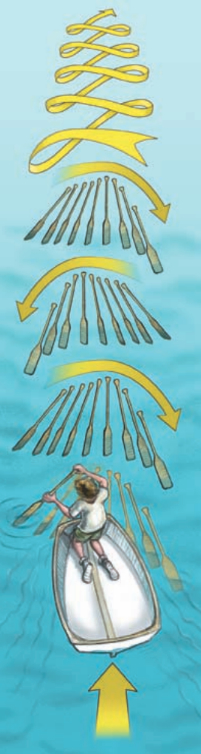
You kneel on the bottom boards and, provided you have achieved and can maintain good stability, forget the shoulder at first, grasp the oar in two hands similar to the grip used on a single canoe paddle, and perform what canoeists would call a drawstroke over the stern. Presuming a right-handed paddler, have the right hand uppermost near the grip of the oar or over its end, the left hand down nearer to the blade. Find a comfortable position, then put the blade into the water to your left (that is, the boat’s starboard quarter because you’re facing aft), not too close to the boat, left wrist ready to bend backward, the blade angled at about 45 degrees bottom left to top right. You will find the correct angle once you begin the stroke.
Sweep the blade across to your right (port quarter), bend the wrist forward, rotate the oar through about 90 degrees to the same angle but this time bottom right to top left, and sweep it back again. The dinghy will now begin to move forward from your perspective, astern from its own, toward the blade of the paddle, which continues tacking from side to side ahead. At first the strokes will be large and aggressive, shoveling the water toward you. Then, as the craft gains momentum, the strokes will refine themselves into a narrower scroll of delicate figure eights on their side, each opening and progressing to the next, most of the movement now in the twisting of the wrist and forearm, a reciprocating propeller advancing ahead of the boat. As you get the knack, you may find you favor one quarter, the left-hand (starboard) for a right-handed person, so the dinghy progresses somewhat crabwise. Steering is a matter of blade angle and pressure, quite natural once you start. You may even slip into the gentle one-handed style, the handle of the oar on your right shoulder, the right hand now further down the loom where the left had been, the left free to handle, say, a light warp or to raise your cap gallantly to the ladies.
Needless to say, if you want to try this technique, master it in controlled conditions where you cannot come to harm, rather than do as one unfortunate I witnessed who had seen me doing it and, arriving at the creek minus one oar, had a crack at getting to his boat by bow-sculling his dinghy in an offshore wind. Luckily, he caught the line I threw to him.
The technique is not difficult to learn, really only a matter of knowing that it is possible; intuition does the rest. It works where sculling does not, in short tubby dinghies and doughnut inflatables. It would hardly be the method of choice in a strong headwind, nor is it nearly so powerful as conventional two-oar rowing, but it can be very handy on occasions, maybe even a lifesaver if you happen to lose one oar or when that dreadful irrevocable plop reminds you that you really should have got around to replacing the little watch-chain that holds the oarlock in place.
Thank you to Sailrite Enterprises, Inc., for providing free access to back issues of Good Old Boat through intellectual property rights. Sailrite.com