The lowdown on your boom’s hold-down
Issue 84 : May/Jun 2012
What we today call the boom vang was once called a martingale. It is also referred to as a kicking-strap, kicker, or boom-jack. The principal purpose of the boom vang is to control mainsail twist by preventing the boom from rising, an otherwise natural result of the force of the wind on the sail (see “Doing the twist,” January 2010). Two basic methods are used to create this downward force: block-and-tackle vangs and rigid vangs.
Controlling twist
When the boom is centered or near amidships, the mainsheet can exert all the needed downward force. When the boom is eased out, however, the pull from the sheet becomes more horizontal and less vertical and the boom is able to rise. This results in twist in the sail, where the top of the sail may be under-trimmed, even to the point of luffing, while the bottom of the sail may be pulling properly. If the boom is over-trimmed to prevent the top of the sail from luffing, the result will be increased weather helm and reduced speed.
The boom vang alleviates this problem. No matter the boom’s position, the boom vang can be used to apply the downward force needed to flatten the sail and reduce twist. A flatter sail allows the boat to sail more efficiently and closer to the wind, and it helps reduce that annoying roll in a short chop.
On a sailboat on which the gooseneck is not attached to a fixed point on the mast but slides in the sail track, tensioning the vang will also tension the luff of the sail somewhat by pulling the gooseneck downward. Of course, if the boom is attached to a fixed point on the mast, luff tension will be controlled by the halyard’s upward pull and the Cunningham’s downward pull.
Block-and-tackle vangs
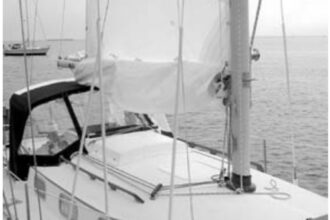
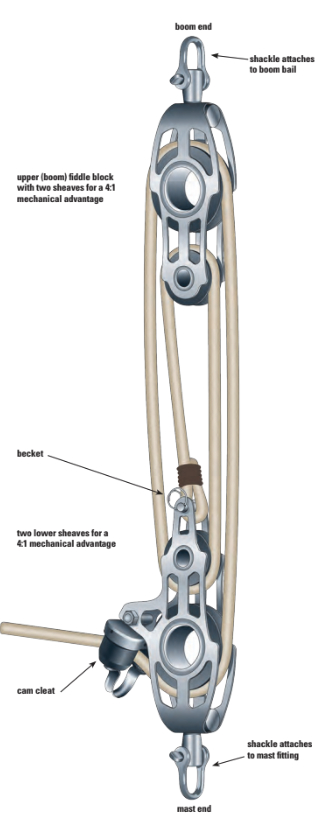
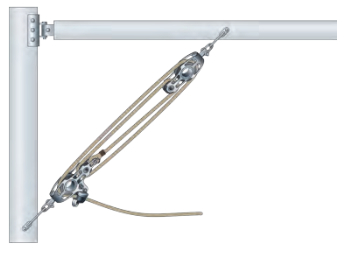
In a typical multiple-part block-and-tackle vang arrangement, one end of the tackle is a fiddle block that’s attached to the boom, usually on a boom bail. The other end is usually a fiddle block with a becket and cam cleat and is attached to a special fitting on the mast that allows it to rotate when the boom is swung out.
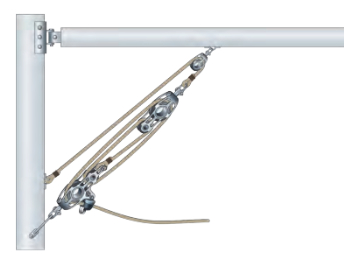
The mechanical advantage of a block-and-tackle boom vang can range from about 3:1 on small boats to as much as 15:1 or higher. Cascading block-and-tackle configurations are used to achieve a mechanical advantage of more than 5:1. An example would be a 4:1 block and tackle cascaded with a 2:1 block and tackle to produce a mechanical advantage of 8:1.
Rigid vangs
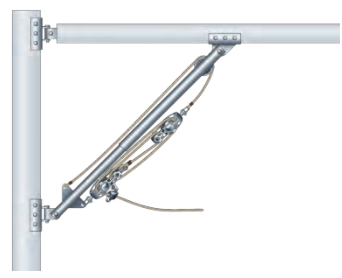
A rigid vang usually consists of inner and outer tubes, like a telescope, with an internal mechanism that resists their being pushed together. This resistance supports the boom and eliminates the need for a topping lift, which has the added bonus of eliminating the wear a topping lift causes on the leech of the sail.
The mechanism inside the vang can be a coil spring or a gas piston. The vang adjustment is made with a ratchet mechanism or an external block and tackle that, when tensioned, compresses the spring or piston to shorten the vang and pull down on the boom. A block-and-tackle adjuster can be controlled either by leading the tackle line to a cam cleat on the vang itself or by leading it back to the cockpit. When led to the cockpit, the line can be pulled directly or with the aid of a winch.
Some rigid vangs have an internal hydraulic piston instead of an external tackle. A hydraulic pump creates the pressure when needed and a bypass valve is used to relieve it.
A rigid vang with a spring has the advantage that its performance can’t be impaired by the loss of gas or fluid. For maximum efficiency, the boom vang should make a 45-degree angle with the mast and boom.
A rigid vang is considerably more expensive than a simple block-and-tackle vang and must be properly matched to the weight of the boom and sail. If it’s not quite up to the job, it can be damaged or bent if someone over-sheets the sail or even leans heavily on the end of the boom. Manufacturers advise that, when the boat is not in use, the main halyard should be fastened to the end of the boom to take up weight and reduce the pressure on the vang.
A furling boom, in which the mainsail is rolled up inside the boom, can weigh much more than a standard boom. If a rigid vang is specified solely by boat size, the spring, gas, or hydraulics might not support this extra weight. In this case, a much larger and more expensive rigid vang should be employed. For these reasons, it’s important to get professional advice before purchasing a rigid boom vang.
Don Launer, a Good Old Boat contributing editor, built his two-masted schooner, Delphinus, from a bare hull and has held a USCG captain’s license for more than 37 years. He has written five books, including The Galley: How Things Work and Navigation Through the Ages, and frequently gives talks on the history of navigation.
Thank you to Sailrite Enterprises, Inc., for providing free access to back issues of Good Old Boat through intellectual property rights. Sailrite.com