Systems that make stuff cool
Issue 82 : Jan/Feb 2012
When considering refrigeration for your boat, it’s imperative that you match the type of refrigeration system to the boat’s potential sources for energy. Several choices are available.
Compressor power options
Any type of mechanical refrigeration system needs a power supply for the compressor. It also needs power for a fan, if the condenser is air-cooled, or for a raw-water pump, if the condenser is cooled by a raw-water heat exchanger. On a boat, the power for a compressor can come from belting the compressor to the engine, from the DC battery system, from an onboard generator, or from shorepower.
Compressors that are belt-driven off the boat’s engine are usually of the type used in automobile air-conditioning systems, in which an electromagnetic clutch engages the compressor when energized by the refrigerator’s thermostat.
Whether to use an engine-driven or electric-powered compressor depends to some extent on how a boat is used.
For a boat kept on a mooring or a cruising boat that seldom spends time in a marina, the engine-driven compressor might be the right choice. Whenever the engine is running, whether it’s to charge the batteries or make progress in light winds, the compressor will be cooling the refrigerator.
On a boat that is often at a dock where shorepower is available, a DC compressor that can run off the batteries or a dual-voltage compressor is probably the better choice, as it eliminates the need to run the engine for the sole purpose of providing refrigeration while at the dock.
Holding plates
Some boat refrigeration systems are just like a household refrigerator, in which the compressor must cycle on and off continuously to maintain the temperature. For cruising sailboats, a better system is the type that uses a holding plate.
A holding plate is a tank in which the refrigerator’s evaporator coils are surrounded by a solution, usually called a “eutectic solution.” When the holding plate has been frozen, it acts like a very cold block of ice and will keep a well-insulated refrigerator box cool for up to 24 hours without the compressor having to run.
Most thermostats for boat refrigerators monitor battery voltage. When they sense a battery voltage that’s above normal — such as when the boat is on shorepower with the battery charger operating or when the engine is running with the alternator charging the batteries — they will automatically turn on the refrigeration system to refreeze the holding plate. These “smart” thermostats will not turn on the refrigeration system if they sense a battery voltage that’s below normal.
Installing refrigeration
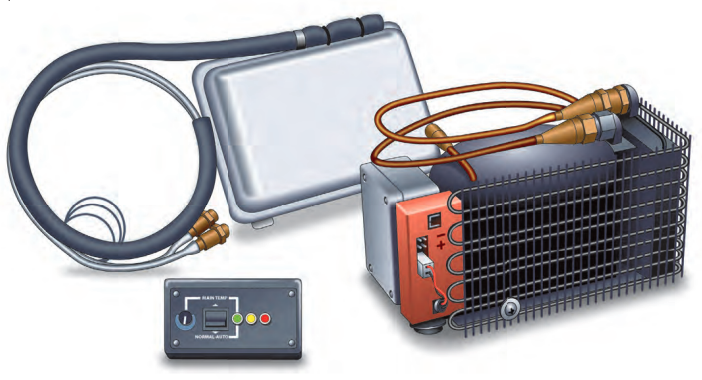
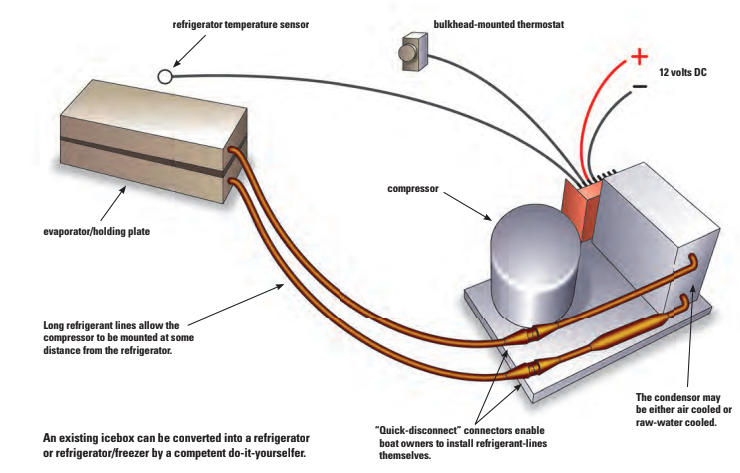
Systems designed to convert an icebox into a refrigerator are available for owner installation. They come in two basic parts, the condensing unit and the evaporator or holding plate with the refrigerant lines attached. The whole system comes pre-charged with refrigerant, including the refrigerant lines that connect the evaporator or holding plate to the condensing unit. To prevent the loss of refrigerant, the ends of these connections are covered with thin seals.
To install the system, you mount the evaporator or holding plate in the icebox and snake the refrigerant lines to the condensing unit, which can be located some distance away. You connect the refrigerant lines to the condensing unit with connections that have special ttings that puncture the seals when the connection is tightened. The system is then pre-charged and ready to go.
In some systems, the condenser is cooled with air, just like a home refrigerator. In others, the condenser is cooled with raw water delivered by a built-in raw-water pump.
An air-cooled condenser can work well in cool or temperate climates but will run nearly constantly when the temperature is in the 90s. In addition, there has to be some way of getting rid of the hot air produced so it doesn’t raise the temperature in the interior of the boat. Air-cooled condensers are not practical in regions where the summer temperatures are very hot.
Water cooling is about 25 percent more ef cient than air cooling but is subject to other drawbacks. If not included in the refrigerator package, a ne-mesh lter should be placed in the incoming cooling-water supply between the refrigerator and the raw-water pump. Because components are made of dissimilar metals, many water-cooled units have a sacrificial zinc anode that should be checked yearly and replaced when necessary.
Portable refrigerators
Portable refrigerator/freezers are available that look just like coolers but contain all the components of a normal refrigerator: a small compressor, evaporator, and condenser. They are made with interior volumes from 6 gallons to more than 25 gallons and weigh from 25 to more than 75 pounds empty. Models are made that operate on 12 volts DC, 24 volts DC, or 120 volts AC.
Finally, there is the old standby — the cooler — that, when packed with ice, will provide all the cooling needed for a day’s outing or an overnighter.
Don Launer, a Good Old Boat contributing editor, built his two-masted schooner, Delphinus, from a bare hull and has held a USCG captain’s license for more than 36 years. He has written five books, including The Galley: How Things Work and Navigation Through the Ages.
Thank you to Sailrite Enterprises, Inc., for providing free access to back issues of Good Old Boat through intellectual property rights. Sailrite.com