On the sharp end in performance and quality
Issue 82 : Jan/Feb 2012
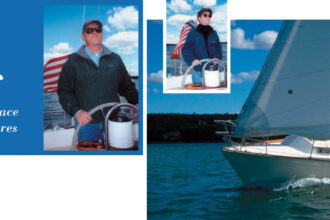
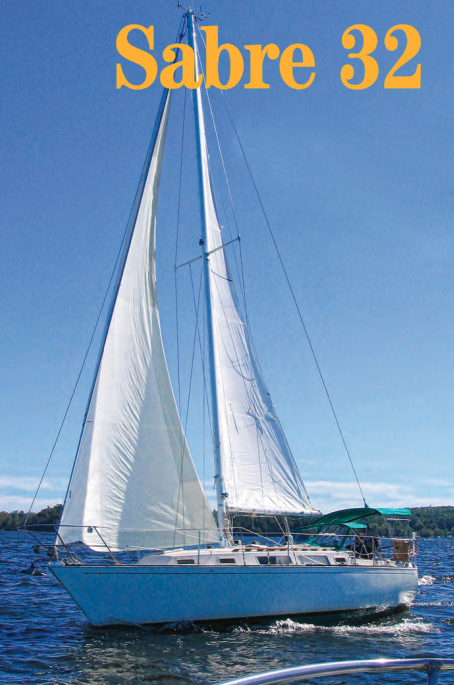
While in Burlington, Vermont, looking for a way to get out on beautiful Lake Champlain, I had a chance to sail Trilogy, Fred and Vicki Meade’s 1985 Sabre 32 aft cabin. Picture this boat anchored near the Burlington town waterfront while awaiting the Fourth of July fireworks display.
The Meades live in the mountains near Sugarbush, Vermont, but spend plenty of time in the summer aboard Trilogy, their fourth boat.
Background and design
Sabre Yachts was started in 1970 by Roger Hewson, who wanted to build the finest 28-foot sailboat possible. Over 15 years, Sabre built 588 of them, and went on to develop a catalog of speedy comfortable boats, sail and power, in its facilities in Raymond, Maine, 25 miles north of Portland. More than 2,500 boats have been built to the tagline “Crafted In The Maine Tradition.” Having long outgrown the original building of only 4,000 square feet, the company now builds Sabres in an 83,750-square-foot complex. Under new ownership since the early 1990s, Sabre Yachts has weathered the ups and downs of the marine industry and is still thriving and building boats on a semi-custom basis. In 1994, Sabre Yachts acquired North End Marine of Rockland, Maine. That company diversified into non-marine fiberglass construction and was renamed North End Composites. It continues to make molds for Sabre.
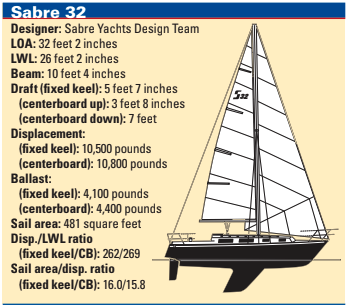
A total of 87 Sabre 32s were built from 1983 to 1987. They were available with the aft-cabin arrangement, as in Trilogy, or with the “classic” cabin. The Sabre 32 was offered with a fixed fin keel drawing 5 feet 7 inches or in a shoal-draft keel-centerboard version with a draft of 3 feet 8 inches. No model number was assigned to differentiate the various configurations, but you might see “CB” tacked onto the 32 when boats are advertised for sale.
All Sabres are known for their construction quality, speed, and comfort. Sabre Yachts claims racing had a strong influence on its designs, and that can be seen in the Sabre 32’s short overhangs, raked bow, flat sheer, and reverse transom. Firm bilges for form stability and plenty of ballast (4,100 pounds) keep the boat on its feet.
Construction
The Sabre 32 is all hand-laid polyester resin and fiberglass. A layer of .75-ounce mat backs up the gelcoat, followed by alternating layers of 1.5-ounce mat and 24-ounce woven roving in various numbers from five in the topsides above the waterline to 24 layers at the keel attachment. In flat areas of the forward sections of the hull, a core of 1⁄4-inch balsa provides added strength and stiffness. Construction of the deck is similarly hand laminated with molded non-skid and a first layer of .75-ounce mat, followed by one layer of 10-ounce cloth, one layer of 1.5-ounce mat, a 3⁄8-inch end-grain balsa core, one layer of 1.5-ounce mat and one layer of 24-ounce woven roving. Plywood and additional reinforcements are used in high-stress areas.
The cabin overhead liner is made separately and bonded to the underside of the deck with fiberglass putty. A 1⁄2-inch space between the liner and the deck provides insulation and conceals hardware fasteners. Another fiberglass liner bonded to the hull supports the cabin furniture.
To form the hull-to-deck joint, the deck lands on an inward-turning hull flange. A butyl sealant is applied between them and they are fastened together with 1⁄4-inch bolts on 6-inch centers that pass through the flange, a vinyl rubrail, and a teak toerail. The lead keel is attached to the hull with large stainless-steel bolts; the nuts are accessible in the bilge. The owner’s manual notes that filler in the hull-to-keel joint will crack on the first sail due to flexing of the keel.
The spade rudder is made in the conventional way. Two fiberglass sides are joined together around a backbone made up of the rudder stock and a welded stainless-steel web. This shell is then filled with closed-cell urethane foam. The rudder is mounted aft of a short skeg but not connected to it.
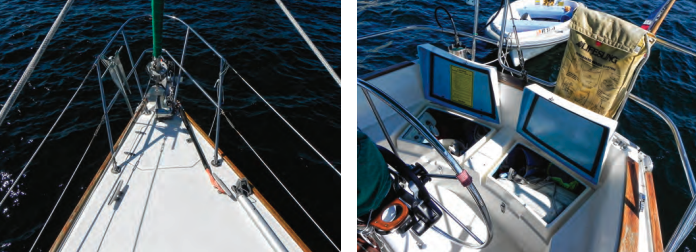
A walk about the deck reveals a number of nice features: wide sidedecks with excellent non-skid, long teak grabrails on the cabin trunk, jib tracks recessed in the sidedecks, and genoa tracks mounted on the toerail. The shrouds will block your path as you move along the sidedeck, but you can pass around outside of them while the double lifelines keep you aboard. Lifeline gates are located aft on both sides.
Two fixed windows and six opening portlights are fitted in the cabin sides. More ventilation comes from two large opening tinted hatches, one forward and one above the saloon, and a smaller one above the head, as well as four Dorade vents with plastic cowls on the cabintop.
The anchor locker has plenty of room for ground tackle. Fred has added an electric windlass just forward of the anchor well and keeps his plow at the ready on a roller mounted on a short sprit. All the deck cleats are large and adequate to their tasks.
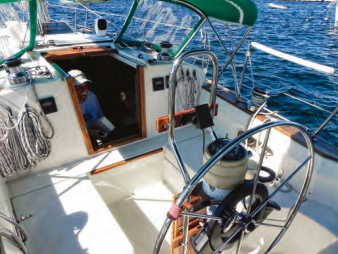
The cockpit is fairly roomy, although with the aft-cabin arrangement, the side benches, while they each seat two, are not long enough for a good nap. The stern seat is nice and wide and the backstay does not interfere with the helmsman. Storage space is provided in shallow lockers under both seats and in pockets in the seatbacks. The seatbacks are at a comfortable angle and chamfered edges ease the transition to a wide coaming on which self-tailing winches are conveniently at hand.
Two hatches give access to the lazarette under the stern seat, and the start and stop controls for the engine are under the starboard one. The engine panel is to port, exposed at the aft end of the side seat. A manual bilge pump is installed where it can be operated by the helmsman, and removing a small cover exposes the top of the rudder stock for fitting the emergency tiller. A folding table is mounted to the steering pedestal, to which Fred has added a grab bar. A gate in the stern pulpit provides access to a long swim ladder over the transom. Stove fuel, either CNG or LPG, is stored behind a removable panel.
Rigging
The Sabre 32 is a masthead sloop with a deck-stepped single-spreader aluminum mast supported underneath by either a stainless-steel or teak compression post. It has a single backstay and cap shrouds and double lower shrouds that terminate inboard of the toerail to allow narrow sheeting angles. The high-aspect-ratio mainsail is sheeted at mid-boom and the sheet, traveler controls, and halyards are led to self-tailing winches and rope clutches on the cabintop.
Trilogy has a 135 percent Mylar genoa on a roller furler, a new mainsail, and a soon-to-be-added Dutchman flaking system. Sabre designed the 32 to sail with a 150 percent genoa and full mainsail in moderate winds.
Accommodations
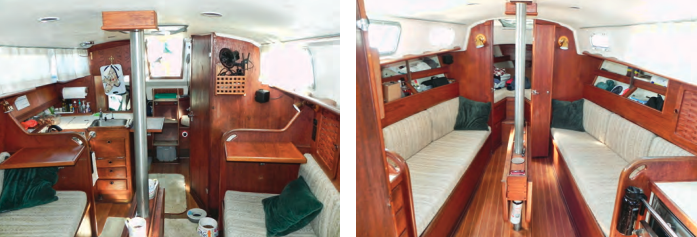
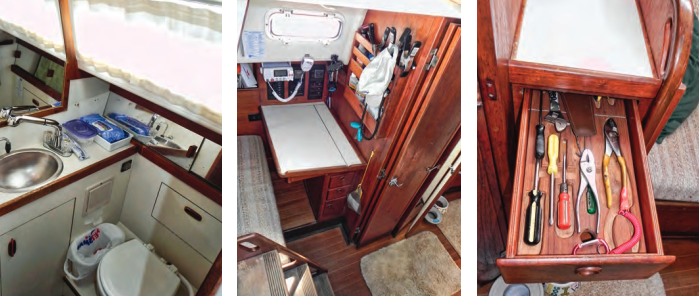
After descending the wide three-step companionway ladder, you are in the Sabre 32’s small aft cabin. To port is the nav station, with the electrical panel and electronics tucked outboard under the deck. Its seat is the head of the port quarter berth. To starboard is a double berth and a locker. Cleverly, the locker door acts as a privacy cover for an opening in the bulkhead between the cabin and the galley. Both berths and the nav station have plenty of drawers and storage areas. A teak bi-fold door closes this area off from the main cabin, but privacy in the aft cabin is limited, particularly when under way.
Between the aft cabin and the main cabin, the head is to port and the L-shaped galley is to starboard. The head contains a marine toilet and a sink. Trilogy is fitted with optional hot-and-cold pressure water. For showering, Fred installed a sink faucet with a detachable spray head.
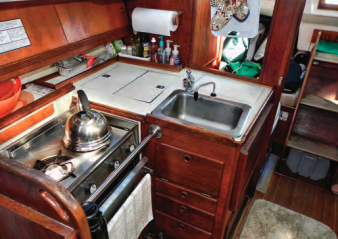
The galley has a sink, icebox, and a CNG gimbaled stove ( finding CNG for the stove can be a problem; its advantage is that, unlike LPG, it’s lighter than air). The work area is augmented by two small folding tables forward of the galley and head. A stack of small drawers (one of them a specially designed tool drawer) is to port, forward of the head. Plenty of drawers are provided in the immediate galley area as well. I measured standing headroom at the galley and aft cabin at 6 feet 2 inches, an inch more than stated in the manual. A nice feature is the angled sections on either side of the teak-and-holly cabin sole that provide sure footing when the boat heels. Two long teak grabrails overhead provide security for moving about while under way. The cabin is well lit and airy.
In the saloon, port and starboard settees of equal length (and more than adequate for sleeping) flank a folding table with two leaves that straddles the centerline around the compression post. It’s easy to get by on either side. The port settee slides out to create a double berth and storage spaces are located under and behind each settee. A 25-gallon water tank is under the starboard settee and the 20-gallon holding tank is located under the port settee.
The V-berth is forward of a solid door, has 5 feet 10 inches of headroom, has a removable insert, and is roomy enough to be called a cabin. Under the V-berth is a 30-gallon water tank.
The textured-gelcoat cabin headliner is attractive and easy to clean. Vinyl fabric covers the hull where it’s exposed (most of the interior surfaces are teak). All the storage lockers appear designed to keep their contents secure while the boat is sailing. Some of their doors have an interesting basket-weave pattern.
We did not access the engine during my inspection. It appears to have the standard access behind the companionway ladder and through panels from the quarter berths — not great, but acceptable.
Under sail
The Meades could not give up their prized anchoring spot for long as the bay would soon fill with boats waiting for nightfall and the fireworks, but we did get a brief sail in conditions windy enough to produce whitecaps. The helm felt moderate to light, with good feedback. The sails could be easily trimmed for a neutral helm. Upwind and down, Trilogy was stable, and she happily tracked as the helmsman desired. Judging by this boat’s design and heritage, I doubt it will produce any surprises when sailing. Hull speed is 6.85 knots, and I’m sure Trilogy can exceed that on a blustery Lake Champlain day.
The few Sabre 32s racing under PHRF are rated at 159 to 162 seconds per mile, faster than a Pearson 32 at 168-171 and competitive with a C&C 32, which rates 153 to 165 in most fleets across the country.
A 21-hp Westerbeke diesel powers the boat, and the prop shaft is offset to minimize prop walk in reverse. The fuel tank holds 20 gallons.
Conclusion
Overall, I liked the aft-cabin arrangement. While it causes the cockpit to be a bit short, it places the head and nav station close to the cockpit, which is handy when under way. As in most boats, the number of places for people to sleep exceeds the ability to carry their gear. However, most are crewed by two, so those extra berths become storage areas, and Trilogy is no exception. An option was to forego the port quarter berth and substitute a large cockpit locker. I think I would have preferred that arrangement.
As with any 25-year-old boat, you need to have a good look at some areas when considering a purchase. If it has a teak mast-compression post, check to see if it’s soggy at the base where it rests on top of the keel. End-grain-balsa core in the deck warrants a careful sounding of the deck for voids and a close inspection wherever hardware is attached. Leaks at the hull-to-deck joint are not uncommon, but tightening the bolts often cures the drip. Hull blisters may be present and a survey should reveal any wet areas in the hull. The bilge is large but shallow — not a great feature. Centerboard boats should receive a close out-of-water inspection of the centerboard and its hardware.
On the plus side, the seacocks are bronze and the owner’s manual is thick and thorough. In general, Sabre Yachts has always paid close attention to detail and quality when constructing its boats and has fitted them out with top-quality hardware. This is reflected in the Sabre 32’s excellent resale value — an Internet search turned up asking prices of $42,500 to $54,900.
Sabre Yachts maintains a list of regional Sabre owner associations at www.sabreyachts.com.
Allen Penticoff is a contributing editor with Good Old Boat. He has trailersailed on every Great Lake and on many inland waters and has had keelboat adventures on fresh and salt water. He presently owns an American 14.5, a MacGregor 26D, and a 1955 Beister 42-foot steel cutter that he’s restoring.
Thank you to Sailrite Enterprises, Inc., for providing free access to back issues of Good Old Boat through intellectual property rights. Sailrite.com